
Story of the Earth

CITE
We have made every effort to follow citation style rules, but there may be some minor differences. If in doubt, please refer to the appropriate citation style manual.
Geological time. (2026). In Q-files Encyclopedia, Earth, Story of the Earth. Retrieved from
https://www.q-files.com/earth/story-of-the-earth/geological-time
"Geological time." Earth, Story of the Earth, Q-files Encyclopedia, 6 Mar. 2026.
https://www.q-files.com/earth/story-of-the-earth/geological-time.
Accessed 22 Sep. 2026.
Geological time 2026. Earth, Story of the Earth. Retrieved 22 September 2026, from
https://www.q-files.com/earth/story-of-the-earth/geological-time
Earth, Story of the Earth, s.v. "Geological time," accessed September 22, 2026.
https://www.q-files.com/earth/story-of-the-earth/geological-time


Geological time
The Earth is 4.6 billion years old. This extremely long stretch of time is difficult to imagine, so events in the Earth’s history are therefore measured in geological time, spans of millions of years. A “recent” event in geological time might be, for example, the current Ice Ages that peaked about 20,000 years ago when ice caps extended over the continents of the Northern Hemisphere.

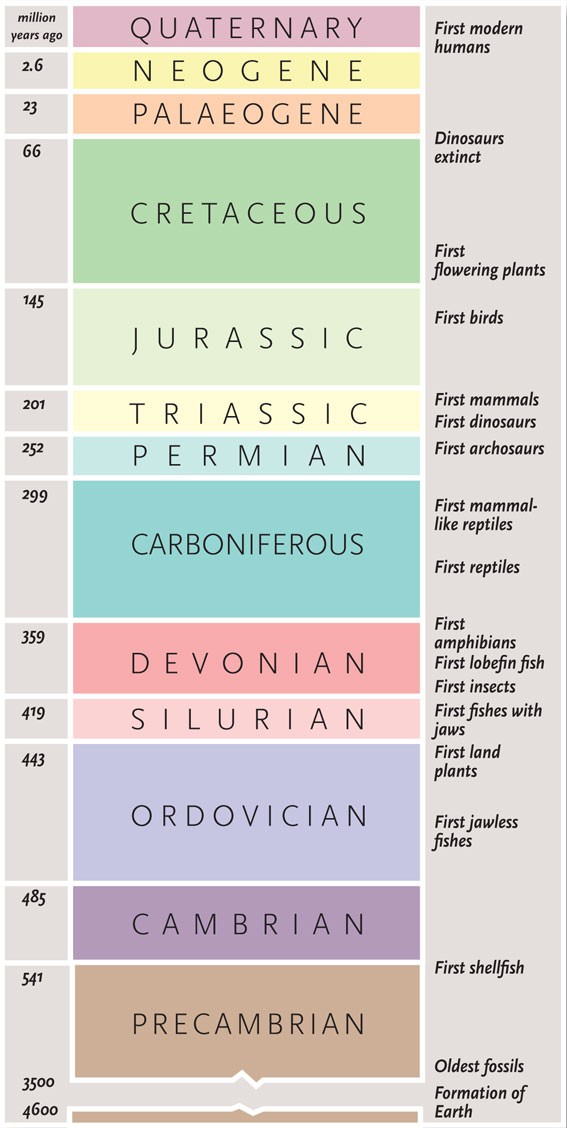
Aeons and periods
Geologists divide time into three aeons: the Archaean (“ancient”), from the origin of the Earth to about 2.5 billion years ago, the Proterozoic (“first life”) to 541 million years ago, and the Phanerozoic (“visible life”) to the present. The Archaean and Proterozoic are often referred to together as the Precambrian. The Phanerozoic is subdivided into eras: the Palaeozoic (541–252 million years ago), the Mesozoic (252–66 million years ago) and the Cenozoic (66 million years ago–present). The eras are split into periods, which are shown here. The Palaeogene, Neogene and Quaternary periods are themselves divided into epochs.
Life, scientists believe, began about 3.8 billion years ago. Since then, many different kinds of plants and animals have evolved and died out. The Earth, itself, has changed, too. Mountains have been pushed up and worn down. Even the continents, the Earth’s great land masses, have drifted, very slowly, around the globe.
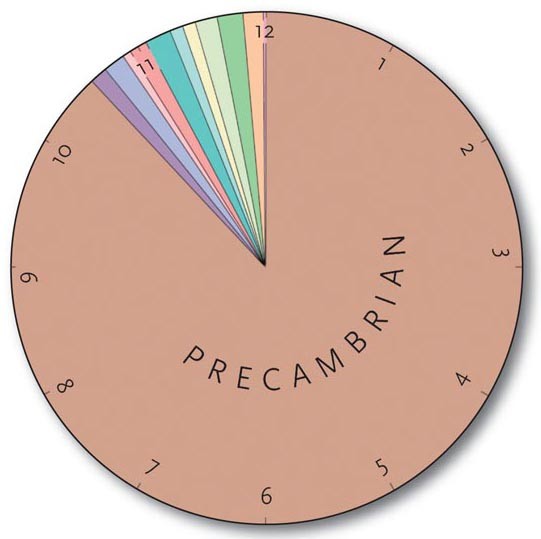
The clock of geological time
A way to understand geological time is to imagine 4.6 billion years of Earth’s history taking place in just 12 hours. The Precambrian would take up the first 10 hours 30 minutes on the clock. From the Cambrian “explosion” of life 541 million years ago to the present day would occupy 90 minutes. The dinosaurs became extinct (an event that happened 66 million years ago) only 9 minutes ago. The entire history of humankind would make up the very last second.

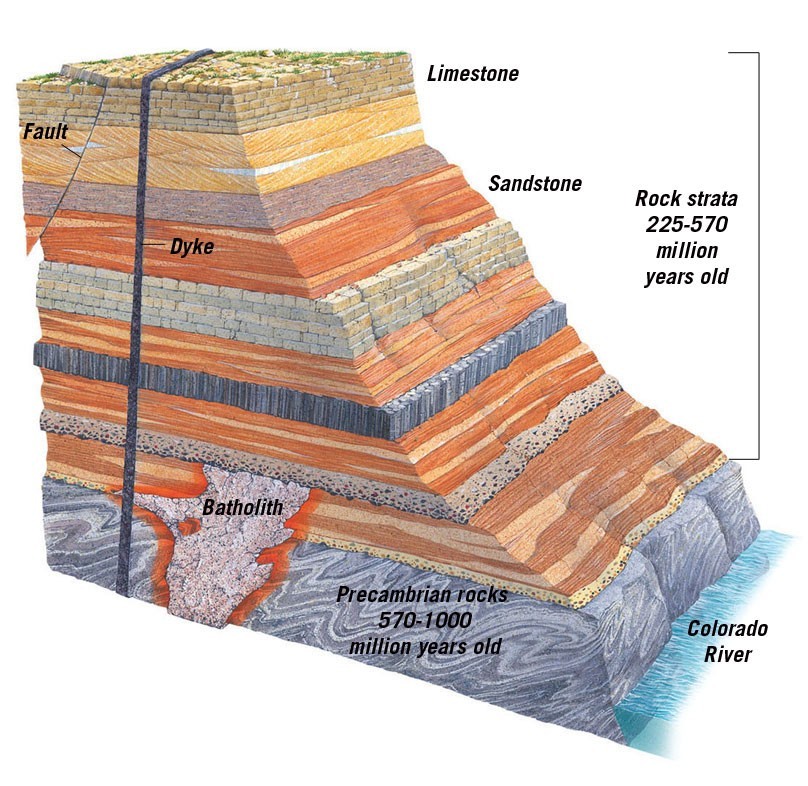
Rock strata
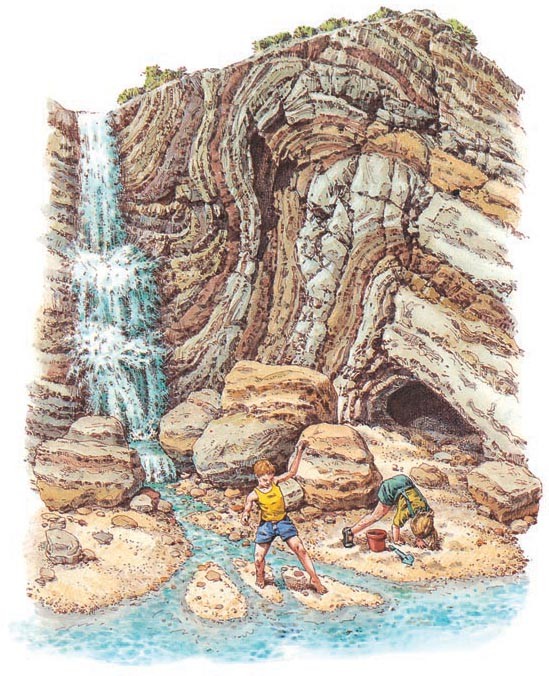
Sedimentary rocks are made from tiny fragments of other rocks, such as sand, silt or mud, pressed and cemented together over geological time. They form layers, one on top of the other, called strata. Generally, younger strata lie on top of older ones, but this is not always the case: over time, mountain-building may have folded or tipped up the strata. Strata of sedimentary rock represent every geological epoch, although there is no single place on the Earth's surface where rocks from every epoch in the Earth's history are found.
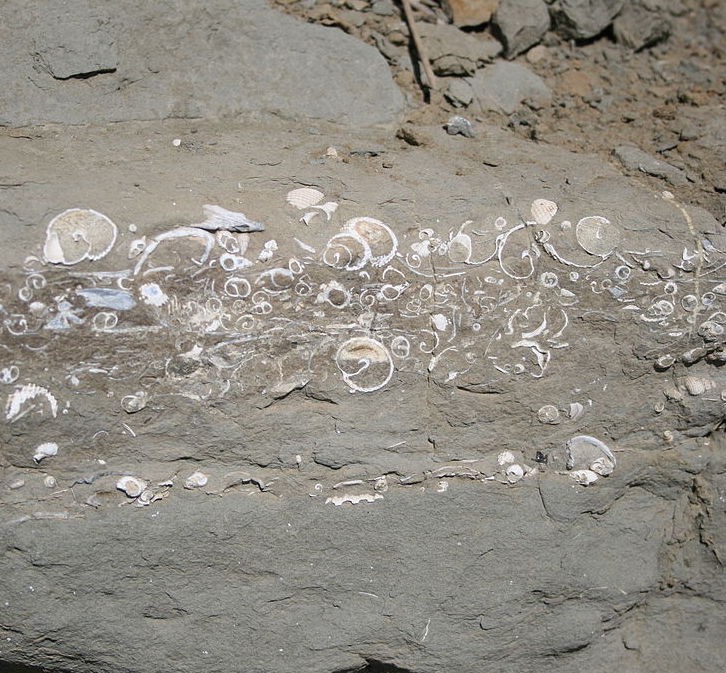
Fossils
The events of Earth’s history are recorded in the rocks that formed at a certain time. When sedimentary rocks were formed, the remains of life-forms that lived at the same time became fossilized in the same rocks. Examination of the strata often reveals the shapes of bones, shell, teeth, or even the outlines of plants. In this way scientists can piece together evidence of what the world was like in all the various geological periods.
Consultant: Ian Fairchild
pics
Without in any way limiting Q-files Ltd’s exclusive rights under copyright, any use of this publication to “train” generative artificial intelligence (AI) technologies to generate text is expressly prohibited. Q-files Ltd reserves all rights to license use of this work for generative AI training and development of machine learning language models.