
Story of the Earth

CITE
We have made every effort to follow citation style rules, but there may be some minor differences. If in doubt, please refer to the appropriate citation style manual.
Fossils. (2026). In Q-files Encyclopedia, Earth, Story of the Earth. Retrieved from
https://www.q-files.com/earth/story-of-the-earth/fossils
"Fossils." Earth, Story of the Earth, Q-files Encyclopedia, 6 Mar. 2026.
https://www.q-files.com/earth/story-of-the-earth/fossils.
Accessed 13 Sep. 2026.
Fossils 2026. Earth, Story of the Earth. Retrieved 13 September 2026, from
https://www.q-files.com/earth/story-of-the-earth/fossils
Earth, Story of the Earth, s.v. "Fossils," accessed September 13, 2026.
https://www.q-files.com/earth/story-of-the-earth/fossils


Fossils
Fossils are remains of once-living things preserved in rock. Most living things are eaten or die and their soft parts rot away leaving no trace. But sometimes hard body parts remain, like the shells, bones, teeth, horns and claws of animals and the bark, cones and seeds of plants. These are the parts most likely to form fossils. Trace fossils are not actual body parts but signs and traces of living things such as animal burrows, footprints and droppings.


How fossils form
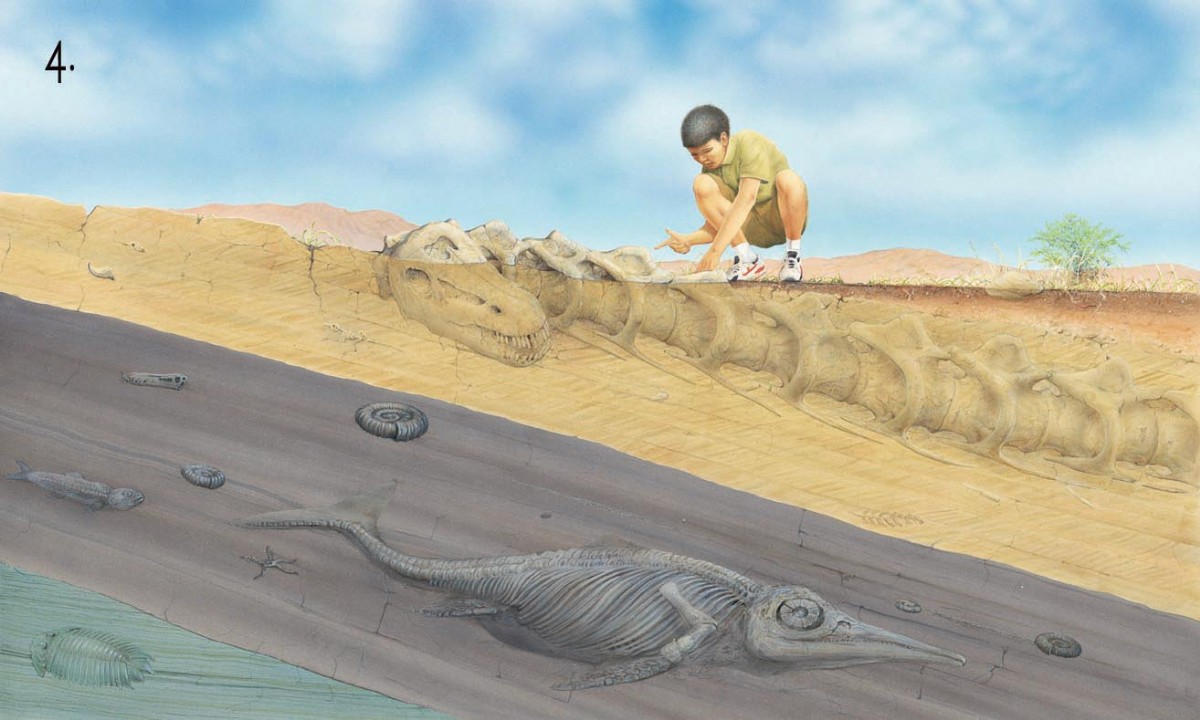
This sequence of illustrations shows how a dinosaur that perished many millions of years ago came to be preserved as a fossil which we can study today.
When a creature—in this example, a dinosaur—dies under water (1) the hard parts, such as bones and teeth, may be buried under sediment particles such as sand grains on a beach, silt on a river bank or mud on a sea bed (2). Slowly the surrounding water dissolves away the remains and replaces them with rock minerals from the water.
Meanwhile the particles around them also turn into rock. If undisturbed, the remains keep their original shape but they are now solid rock. They are now fossils (3). The remains of animals and plants that lived at the same time become fossilized in the same rocks. So scientists can use fossils to work out what life-forms existed at different times in the past.
Fossils take millions of years to form. As a result of Earth movements caused by plate tectonics and the wearing-away forces of erosion, the rocks in which fossils form may one day be exposed at or near the surface (4).
Experts called palaeontologists search for fossils, dig them from the ground, study their shapes and structures, and compare them with similar body parts of living things today. From this evidence, it is possible for them to recreate what dinosaurs, mammoths and other animals and plants that lived millions of years ago looked like, and even gather information about how they lived.
Fossils form only in sedimentary rocks. They are destroyed if the rock is heated or squashed too much so they do not occur in igneous rocks or metamorphic rocks. Some sediments contain layer upon layer of fossils, like certain types of limestone.
Amber fossils
The sticky sap or resin that oozes from trees and other plants may fossilize as a hard yellow substance called amber. This sometimes contains insects and other small animals that were trapped in it, preserved in amazing detail.


Trace fossils
Body impressions, droppings, footprints and burrows are known as trace fossils. They can be just as revealing as true fossils—especially helpful in describing a prehistoric animal’s lifestyle, for example.
The soft parts of living things, including an animal’s internal organs or skin, are usually eaten by scavengers or rot away before fossilization begins. But if the dead organism is buried rapidly in soft sediment such as mud, with little or no bacteria present, then it is possible that the soft parts can become fossilized as well. Such fossils are extremely rare. One example is the Solnhofen beds of southern Germany, where plants, feathers and even the wings of dragonflies are all preserved.

Fossilized droppings are called coprolites. By examining coprolites, paleontologists are able to find information about the diet of a prehistoric animal, such as whether it was a herbivore or a carnivore. In rare cases, coprolites have even been found to contain insect remains.

Consultant: Ian Fairchild
pics



Without in any way limiting Q-files Ltd’s exclusive rights under copyright, any use of this publication to “train” generative artificial intelligence (AI) technologies to generate text is expressly prohibited. Q-files Ltd reserves all rights to license use of this work for generative AI training and development of machine learning language models.