
Planet Earth

CITE
We have made every effort to follow citation style rules, but there may be some minor differences. If in doubt, please refer to the appropriate citation style manual.
Plate tectonics. (2026). In Q-files Encyclopedia, Earth, Planet Earth. Retrieved from
https://www.q-files.com/earth/planet-earth/plate-tectonics
"Plate tectonics." Earth, Planet Earth, Q-files Encyclopedia, 6 Mar. 2026.
https://www.q-files.com/earth/planet-earth/plate-tectonics.
Accessed 13 Sep. 2026.
Plate tectonics 2026. Earth, Planet Earth. Retrieved 13 September 2026, from
https://www.q-files.com/earth/planet-earth/plate-tectonics
Earth, Planet Earth, s.v. "Plate tectonics," accessed September 13, 2026.
https://www.q-files.com/earth/planet-earth/plate-tectonics


Plate tectonics
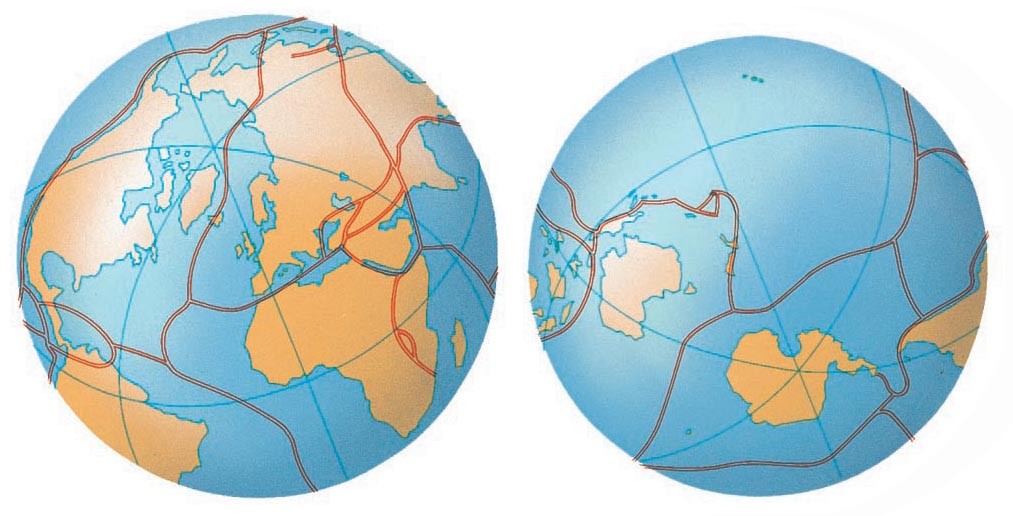
The Atlantic Ocean gets wider by about the width of your thumb every year, pushing North and South America away from Europe and Africa. The Himalayan mountains, already the highest in the world, grow taller by about the length of your thumb every year. Many other parts of the Earth are moving and changing shape, too. This is because the Earth’s outer layer is divided into enormous curved pieces called tectonic plates, which fit together like a ball-shaped jigsaw. There are six large plates and about 12–15 smaller ones, and they are continually on the move, pulling apart, bumping together or sliding past each other. The movements and collisions along the edges of the plates cause volcanoes and earthquakes. They also build mountains. Scientists call these movements plate tectonics.

Continental drift
Each plate consists of a piece of the Earth’s outer layer, the crust, plus a thin layer of outer mantle that lies beneath it. Together they make up the layer known as the lithosphere. Its depth varies from 70–80 kilometres (40–50 miles) below the oceans to 100–150 kilometres (60–90 miles) below the continents.
Under the lithosphere is a slightly deeper part of the mantle about 100 kilometres (60 miles) thick, called the asthenosphere. This is partly molten and allows the plates to slide about over it. In fact, the flowing motion of the mantle, due to the enormous heat and pressure within that layer, pushes the plates and makes them slide around the globe. As they do so, they carry the continental land masses like giant rafts. This is called continental drift.

Collisions
Plates meet at three types of boundaries. The first type is convergent boundary, where two plates collide. If a continental plate collides with an oceanic plate, oceanic crust is lost as the thinner oceanic plate is forced down under a thicker continental one. This is called subduction.
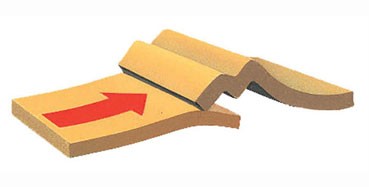
If two continental plates collide, both tend to squeeze and buckle up into mountain ranges. The most spectacular example of this is in the Himalayas, where the plate carrying India has rammed into the rest of Asia.
Pulling apart
While old oceanic plate is being eaten up in the depths of the Earth by subduction, new oceanic plate is being created in the gap between plates that are moving away from each other. This is the second type of plate boundary, known as a divergent boundary.
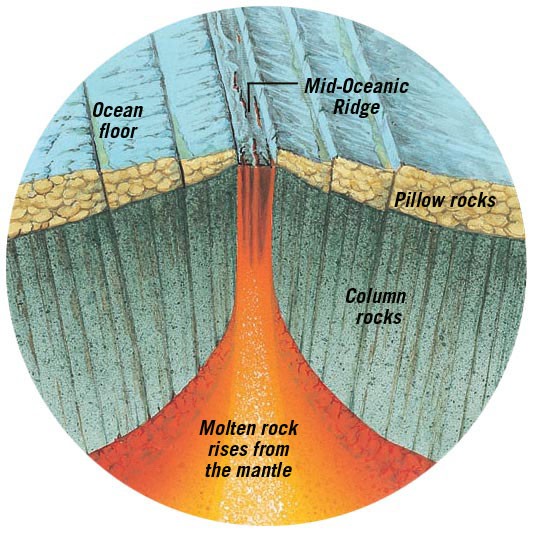
Molten rock from inside the Earth, called magma, rises to the surface into the crack or boundary between two plates that are moving apart under the oceans. The rock cools rapidly and solidifies as it emerges into the cold water, and so becomes a new part of the ocean floor itself, forming a long undersea mountain range called the Mid-Oceanic Ridge. As more and more magma oozes its way to the surface, the earlier rocks are pushed away from the Ridge to make way for the new rock. In this way, the ocean floor spreads apart. This process is called seafloor spreading.

Sliding past
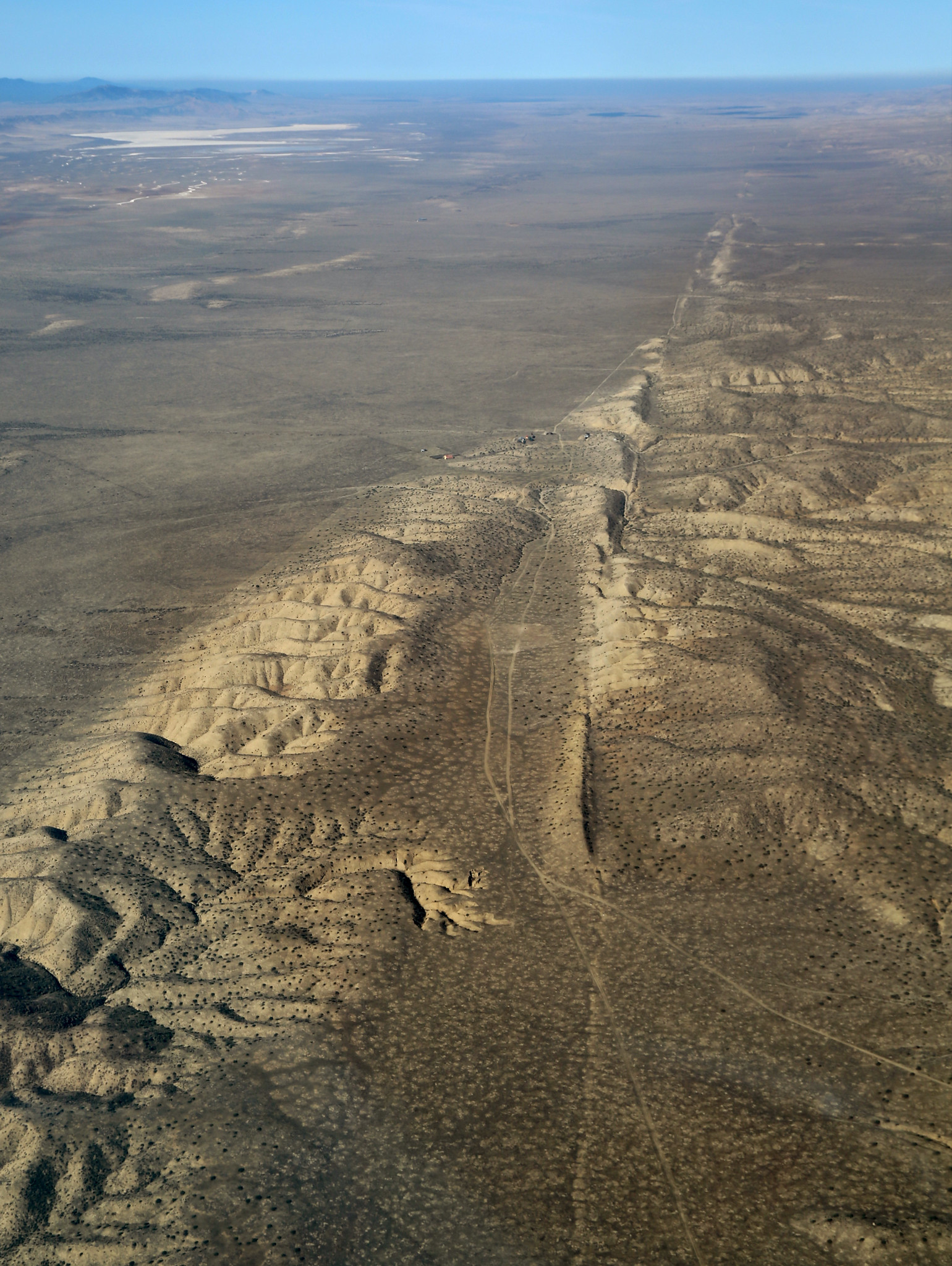
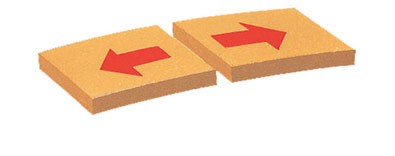
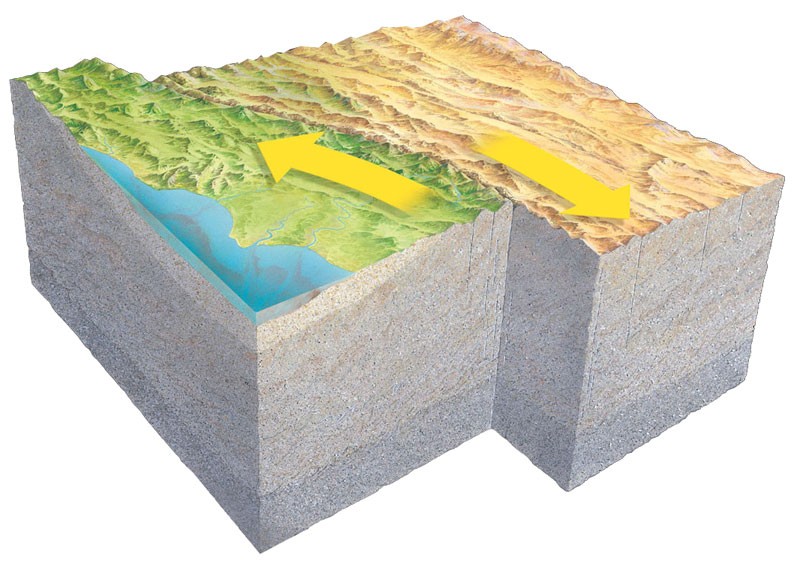
At the third type of boundary, a transform fault, two plates slide past each other. Most earthquakes occur at transform faults, such as along the San Andreas Fault on the west coast of the USA. The plates may lock together for a time. Pressure builds up until they “give” suddenly, releasing pent-up energy and sending shock waves out in all directions.
Subduction zones
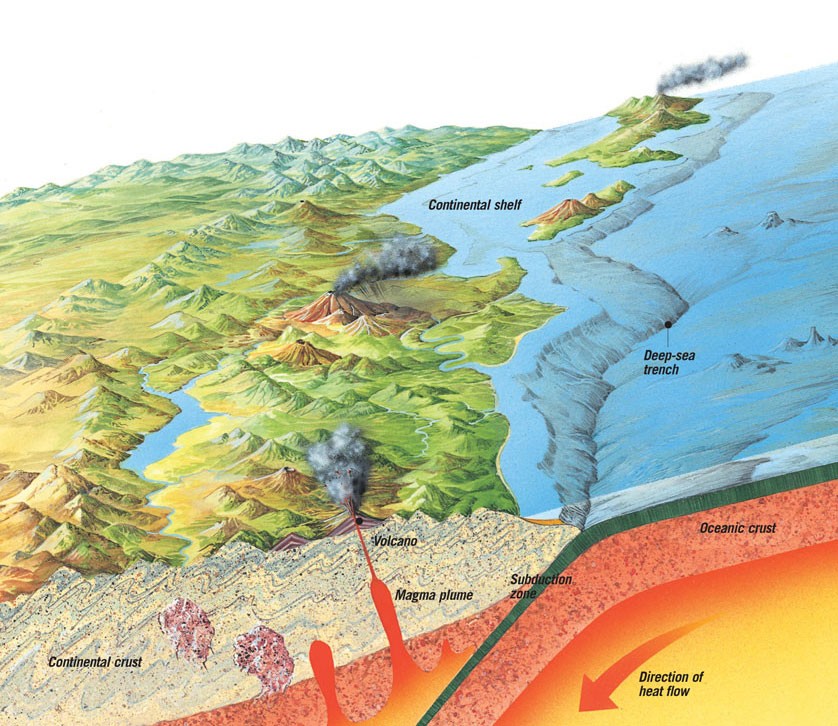
When an oceanic plate collides with a continental plate, the edge of the thinner, denser ocean plate slides beneath it. This is because the material that makes up the ocean floors is heavier than that of the surrounding continents. In these regions, called subduction zones, the ocean floor is pulled downwards, forming a deep trench. The rocks of the ocean floor sink deeper and deeper into the Earth and eventually melt. Some of the molten rock rises, erupting at the surface as volcanoes. A subduction zone runs nearly all the way around the Pacific Ocean. There are so many volcanoes that it is called the “Ring of Fire”.
Convection currents
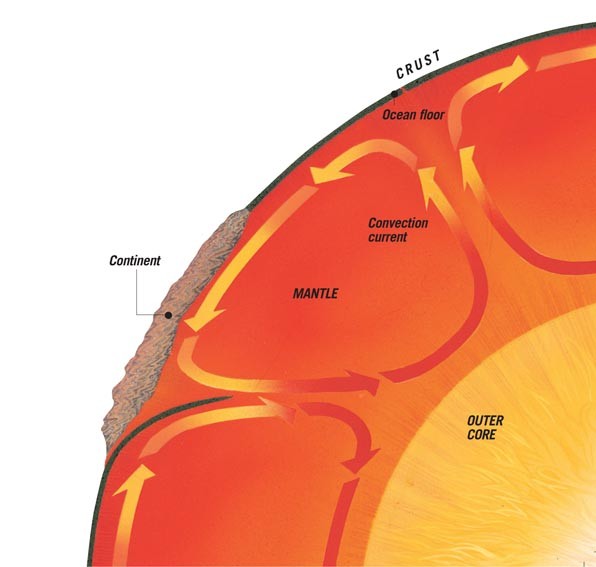
The mantle is the Earth’s “heat engine”. It is heat flowing through the mantle that carries the tectonic plates on their continuous drift around the globe. Over millions of years, the mantle rocks flow like liquid. Warm rock rises up then fans out sideways when it reaches the base of the crust. As it does so, the ocean floor at the Earth’s surface is gradually spread apart. Eventually, the rock cools and sinks back in subduction zones, and it is swallowed up back in the depths of the mantle. In the lower reaches of the mantle, the rock is reheated and sent on its way back to the surface again. And so the cycle repeats itself—like a continuously revolving conveyor belt.
These heat flows, similar to those in a pan of soup as it heats up on a stove, are called convection currents. In a simple way, the diagram above shows how convection could be linked to seafloor spreading and continental drift. The real pattern of movement is more complex, and the “pull” from the cold, sinking slab in subduction zones also plays an
important role.
Consultant: Ian Fairchild
pics
Without in any way limiting Q-files Ltd’s exclusive rights under copyright, any use of this publication to “train” generative artificial intelligence (AI) technologies to generate text is expressly prohibited. Q-files Ltd reserves all rights to license use of this work for generative AI training and development of machine learning language models.