
Planet Earth

CITE
We have made every effort to follow citation style rules, but there may be some minor differences. If in doubt, please refer to the appropriate citation style manual.
Earth's rotation. (2026). In Q-files Encyclopedia, Earth, Planet Earth. Retrieved from
https://www.q-files.com/earth/planet-earth/earths-rotation
"Earth's rotation." Earth, Planet Earth, Q-files Encyclopedia, 6 Mar. 2026.
https://www.q-files.com/earth/planet-earth/earths-rotation.
Accessed 28 Oct. 2026.
Earth's rotation 2026. Earth, Planet Earth. Retrieved 28 October 2026, from
https://www.q-files.com/earth/planet-earth/earths-rotation
Earth, Planet Earth, s.v. "Earth's rotation," accessed October 28, 2026.
https://www.q-files.com/earth/planet-earth/earths-rotation


Earth's rotation
Earth rotates (spins) on its axis, the invisible line running vertically down its centre from the North Pole to the South Pole. It takes Earth 24 hours (a day) to make one complete rotation. As it rotates, Earth orbits (moves around) the Sun. This movement is called a revolution. It takes Earth about 365 days (a year) to complete a revolution. Earth's rotation and revolution have significant effects on climate and weather patterns. Earth's rotation is also responsible for creating its magnetic field.


Earth's orbit
Earth travels along its orbital path at a speed of about 30 kilometres (18.5 miles) per second or 107,800 km/h (67,000 mph). It takes roughly 365 days to complete its orbit of the Sun—a single revolution. Observed from the Sun's north pole, the Earth, along with all the planets, orbits in an anticlockwise direction.
The time taken for Earth to orbit the Sun is actually closer to 365.25 days. This is why, every four years, we have a leap year—an extra day, 29th February—to make up for the extra quarter day in Earth's orbit.
Earth's orbit is not perfectly circular, but slightly elliptical (oval-shaped). When at its closest to the Sun, the point known as the perihelion, which occurs around 3rd January, the Sun is 147 million kilometres (91 million miles) away. At its farthest point, the aphelion, around 4th July, the Sun lies 152 million kilometres (94.5 million miles) distant.
Earth is itself orbited by the Moon, which takes 27.3 days to complete a single revolution. It, too, follows a slightly elliptical orbit. The point closes to Earth is called the perigee; the point farthest away from Earth is the apogee.

Gravitational pull of the Sun
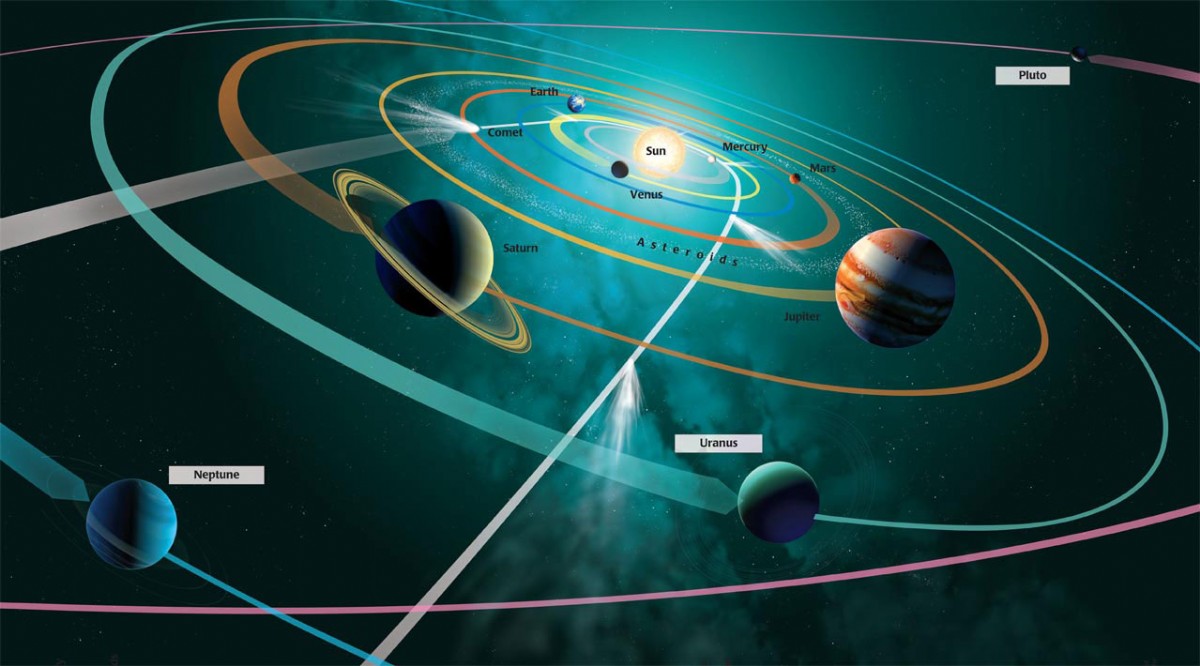
The Sun has a huge gravitational field which pulls Earth and all the other planets—some of them lying many hundreds of millions of kilometres away—towards it. The planets remain in their orbits, however, and never crash into the Sun. This is because they are travelling fast enough for their momentum (the tendency for moving objects to carry on moving) to balance exactly the Sun’s gravitational pull. In space, there is no air resistance to slow the planets down, so they carry on moving at the same speed along the same orbital paths. They have been doing so for billions of years.

Axial rotation
As it goes on its year-long journey around the Sun, Earth rotates on its axis at around 1670 kilometres per hour (1040 mph) at the equator. As with any spinning object, the speed of rotation is lower closer to the axis, so that London rotates at 1050 km/h (650 mph) while Reykjavík (Iceland) rotates at 740 km/h (460 mph).
Earth rotates in an eastwards direction. If you were an observer above the North Pole, you would see the Earth spin anticlockwise.
Earth completes a single rotation once every 24 hours, a period we call a day. To the observer on the ground, it looks as if the Sun is moving, not Earth. The Sun appears to rise in the east at dawn, pass across the sky and set in the west at dusk, giving us day and night. It is daytime on the side of the Earth that faces the Sun, while on the side that is facing away it is night.


Axial tilt
Earth's rotational axis is tilted about 23.5 degrees from its orbital axis, the line perpendicular (at a right angle) to the plane of its orbit around the Sun. Scientists call this angle its axial tilt, or obliquity.
When the North Pole is tilted towards the Sun, to an observer in Northern latitudes the Sun appears to be higher in the sky and the day lasts longer. Temperatures are warmer than average because more sunlight reaches the Earth's surface.
Meanwhile in the Southern Hemisphere average temperatures are cooler because the South Pole is tilted away from the Sun.

As the Earth travels around the Sun, the tilt brings the Southern Hemisphere closer to the Sun and the North farther away. The Southern day lengthens while the Northern day shortens. Temperatures in the South are warmer than average, while in the North they are cooler.
Seasons
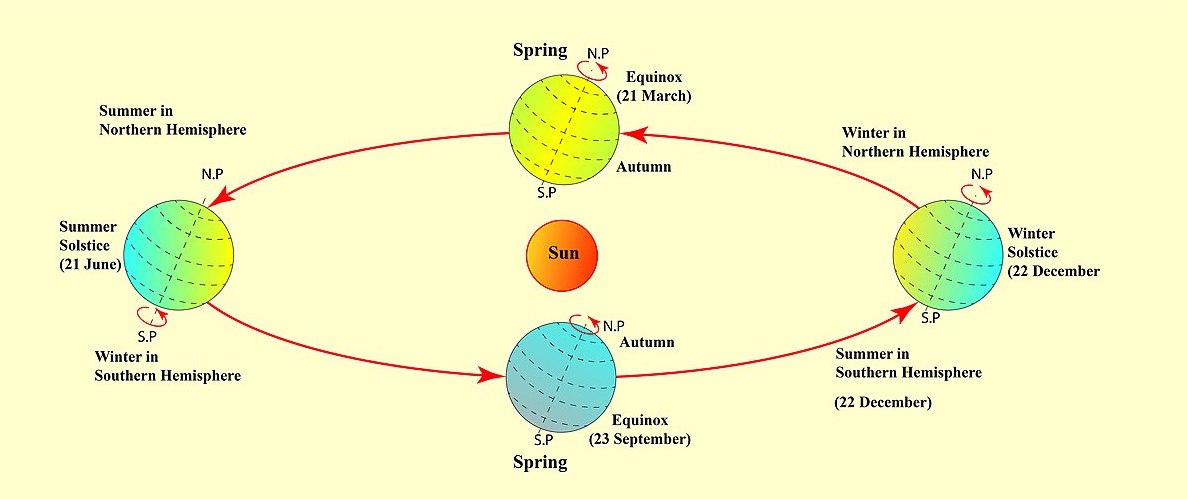
This annual variation in the length of day due to the Earth's axial tilt results in the seasons: spring, summer, autumn and winter.

Because the Earth is tilted, the Sun is nearer the half (either the Northern Hemisphere or Southern Hemisphere) that is leaning towards it. There are two times of the year, however, when the Sun shines directly overhead at the Equator—that is, the Sun is equally near both hemispheres. The first time falls on or around 21st March. This is called the equinox. Everywhere on Earth there are 12 hours of daylight and 12 hours of darkness (equinox means "equal night").
As the weeks pass, the Earth’s Northern Hemisphere leans more and more towards the Sun. The Sun is nearer and higher in the sky for longer each day, so the North moves from spring into summer. Meanwhile, the Southern Hemisphere leans farther away from the Sun and days shorten, so there it moves from autumn then to winter.
On 21st June the Sun shines directly overhead at the Tropic of Cancer (the line of latitude at roughly 23°26′ North). In the Northern Hemisphere, this is the summer solstice; in the Southern Hemisphere, it is the winter solstice. After this date, the days start to shorten in the north and lengthen in the south as the Southern Hemisphere's leans more and more towards the Sun.


On 23rd September, it is the equinox once more as the Sun again shines directly overhead at the Equator. As before, there are 12 hours of daylight and 12 hours of darkness everywhere on Earth. In the Northern Hemisphere, autumn is beginning, while the Southern Hemisphere is enjoying the onset of spring.
The Southern Hemisphere continues its lean towards the Sun until the summer solstice arrives on 22nd December, when the Sun lies overhead at the Tropic of Capricorn (latitude 23°26′ South). In Australia, people can celebrate Christmas on the beach, while at the same time the Northern Hemisphere is in the grip of winter.

Coriolis Effect
Earth rotates faster at the Equator than it does at the poles. A person standing on the Equator is travelling at 1607 kilometres (1000 miles) per hour. The further they are from the Equator the slower they go. Because of this varying speed, anything not connected to the ground—a fluid like the ocean waters or the air above—will be deflected as it moves north or south. Known as the Coriolis Effect, it is, however, noticeable only in water or air flowing over long distances.

Winds and ocean currents that move towards the north in the Northern Hemisphere or to the south in the Southern Hemisphere are deflected towards the east. Those that move towards the Equator are deflected towards the west. These large-scale movements of water are called ocean gyres. In equatorial regions, the airflows are known as trade winds.

Weather patterns such as cyclones demonstrate the Coriolis Effect. Cyclones are low pressure systems that draw air in towards their centres. In the Northern Hemisphere, airflows swing to the right so cyclones rotate anticlockwise. In the Southern Hemisphere, airflows are deflected to the left, so cyclones rotate clockwise.
Slowing down
... or speeding up?
Earth’s rotation is slowing down, although the change in speed is far too slight for us to notice. This long-term trend is mostly due to what is known as tidal deceleration—an effect of the gravitational pull of the Moon and Sun, which drags ocean water across the Earth (the tides). The friction between the water and the sea bed causes the slowing down. As a result, the length of a day has increased by about 1.7 milliseconds (thousandths of a second) compared to 100 years ago.


Major earthquakes can disturb the trend: the 2004 Indian Ocean earthquake changed the Earth's shape a tiny bit, increasing its rotation speed very slightly and shortening the length of the day by 2.68 microseconds (millionths of a second).
The length of the day can also be influenced by the building of large reservoirs. For example, the huge volume of water stored in the Three Gorges Dam in China, completed in 2010, increased the length of a day by 0.06 microseconds. This is due to the lifting of water further from Earth's axis. The effect is the same as that which causes spinning ice skaters to slow down when they raise their arms: some of their mass moves away from the axis.
Since 2020 Earth has started spinning faster. On 29th June 2022 it completed its rotation 1.59 milliseconds ahead of its normal schedule, making it the shortest day since records began. Scientists do not yet know why this is happening. One theory is that the planet is wobbling less on its axis (see below). Another is that as ice sheets and glaciers melt and sea levels rise due to global warming, the movement in mass is causing Earth to spin slightly faster.
Why does Earth revolve and rotate?
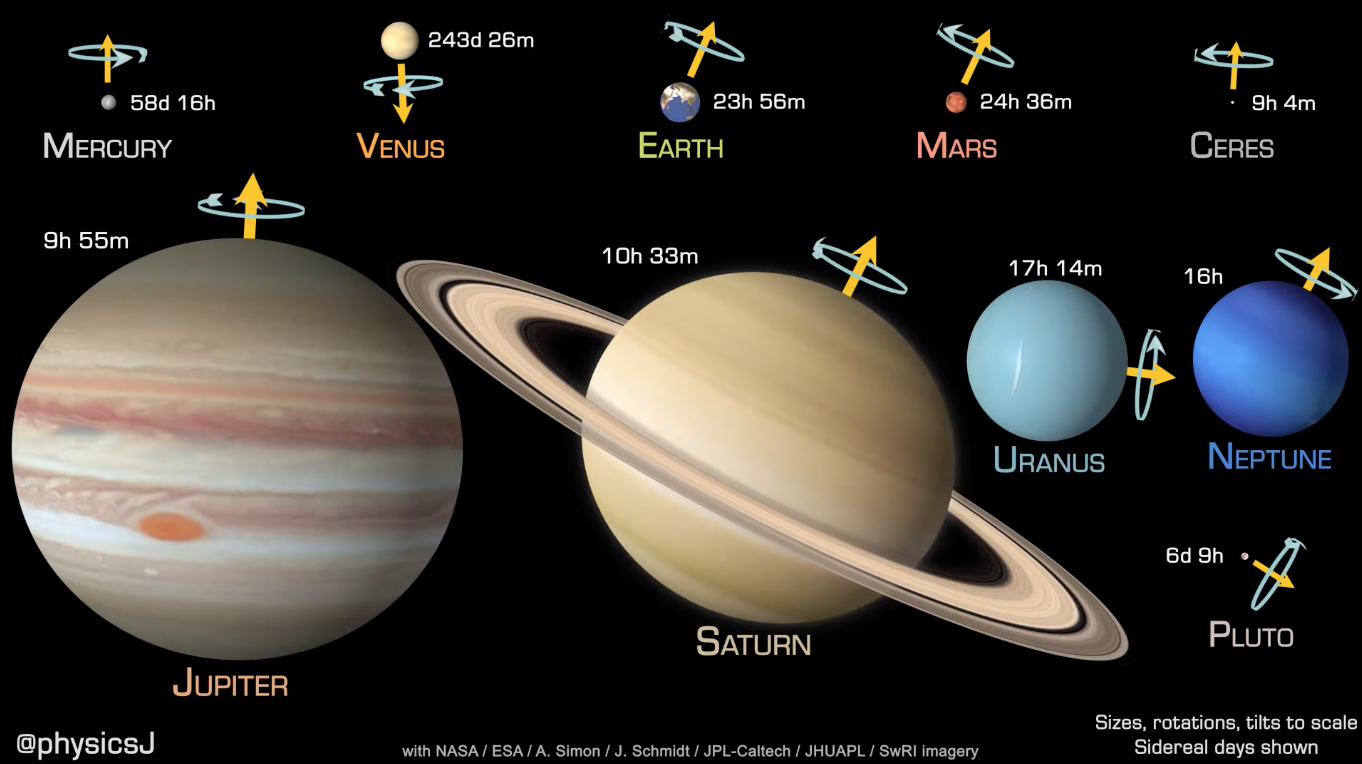
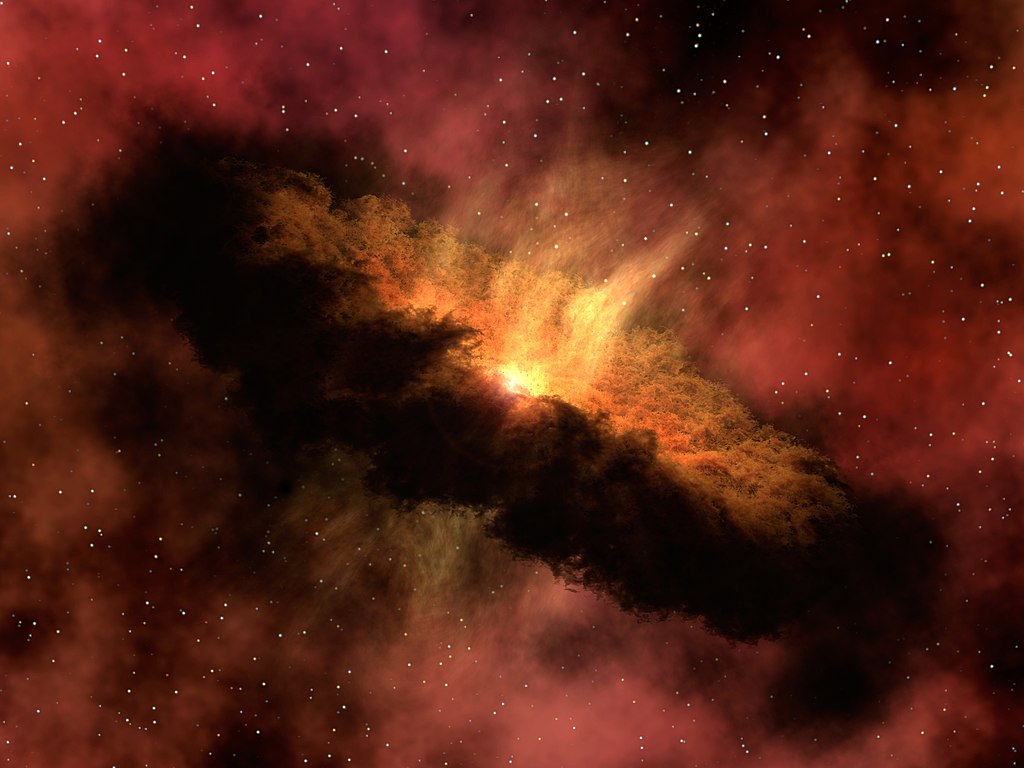
All the planets of the Solar System—not just Earth—rotate around an axis and revolve around the Sun. Some, like Jupiter and Saturn, spin faster, while Mercury and Venus spin much more slowly. The momentum that causes them to revolve around the Sun is left over from billions of years ago when the Solar System was forming. At this time it was a swirling disc of dust and gas spinning round a protostar—the hottest, densest mass at its centre—that became our Sun. Around 4.6 billion years ago, the dust and rocks eventually coalesced into (came together to form) the planets, moons, asteroids and comets, all of which revolve around the Sun today. In addition, each planet, including Earth, kept its rotating motion.
Why is the Earth tilted?
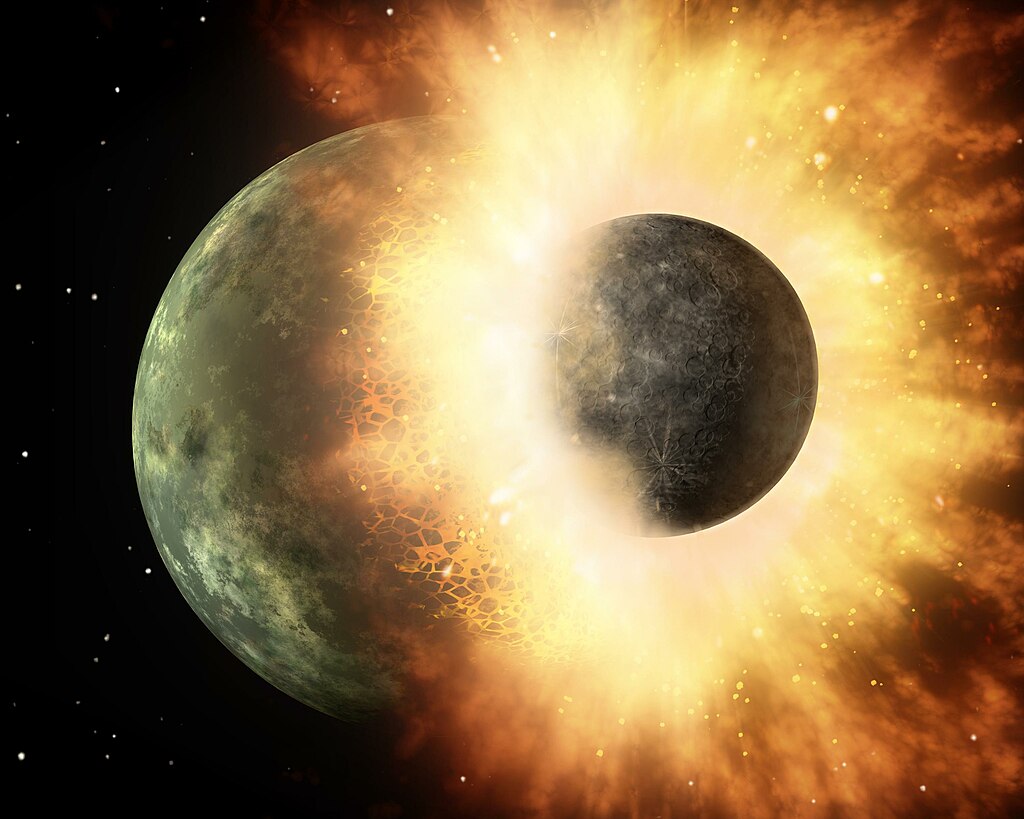
Scientists think that the Earth became tilted as a result of an event that took place during its early years of existence, around 4.5 billion years ago. Then, the theory goes, a large planetesimal collided with Earth. Called Theia, the object was probably about the size of Mars and travelling at around 4 kilometres per second (14,000 km/h or 8700 mph). A huge volume of rubble was blasted into orbit where, due to gravity, it eventually came back together to form our Moon. Earth’s current tilt of about 23.5° resulted from the angle of the collision with Theia—a 45-degree glancing blow—and has stayed that way ever since.
Earth wobble

Earth does not rotate entirely smoothly: it wobbles slightly on its axis. Scientists call this nutation. The wobbling causes the angle of Earth's tilt to vary slightly. As a result, the major circles of latitude—such as the Tropic of Cancer and Tropic of Capricorn—are constantly shifting by a few metres each year.
Consultant: Mike Goldsmith
pics


Without in any way limiting Q-files Ltd’s exclusive rights under copyright, any use of this publication to “train” generative artificial intelligence (AI) technologies to generate text is expressly prohibited. Q-files Ltd reserves all rights to license use of this work for generative AI training and development of machine learning language models.