
Solar System

CITE
We have made every effort to follow citation style rules, but there may be some minor differences. If in doubt, please refer to the appropriate citation style manual.
Origins of the Solar System. (2026). In Q-files Encyclopedia, Space, Solar System. Retrieved from
https://www.q-files.com/space/solar-system/origins-of-the-solar-system
"Origins of the Solar System." Space, Solar System, Q-files Encyclopedia, 25 Mar. 2026.
https://www.q-files.com/space/solar-system/origins-of-the-solar-system.
Accessed 6 Aug. 2026.
Origins of the Solar System 2026. Space, Solar System. Retrieved 6 August 2026, from
https://www.q-files.com/space/solar-system/origins-of-the-solar-system
Space, Solar System, s.v. "Origins of the Solar System," accessed August 6, 2026.
https://www.q-files.com/space/solar-system/origins-of-the-solar-system


Origins of the Solar System
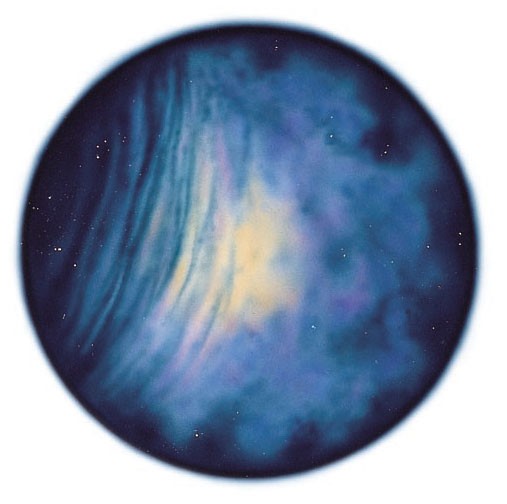
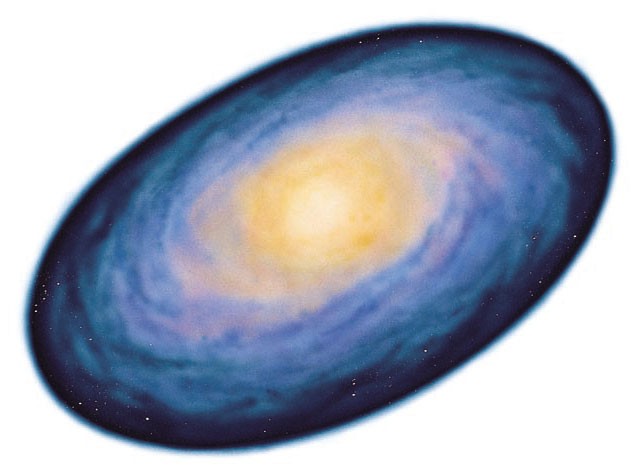
The Solar System began forming about 4.6 billion years ago. Then it was just a small part of a vast cloud of gas and dust, measuring about 65 light years across, that drifted through the Milky Way Galaxy. The cloud had probably formed in a region where large stars, including supergiants, were being created—a region possibly quite similar to the Orion Nebula. A supernova, an exploding supergiant star, may have sent massive shock waves racing across space, striking the cloud. The impact may have been sufficient to trigger the cloud's collapse under its own gravity. In many locations (each of which would eventually become a star with a system of planets) the massive amount of gas and dust started to spiral inwards.
Formation of the Sun
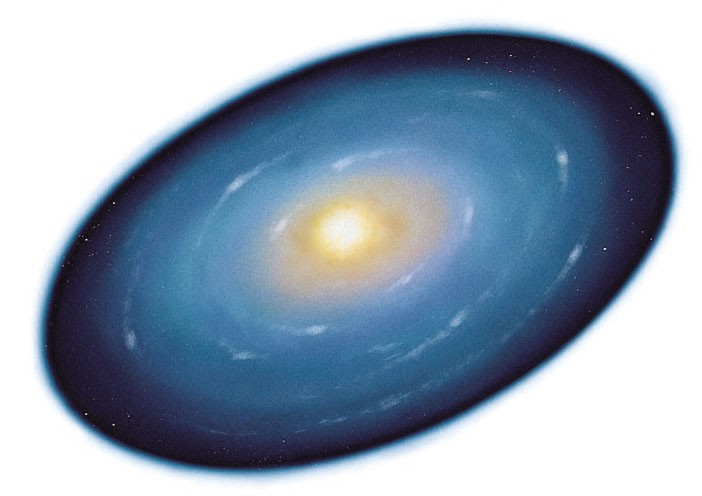
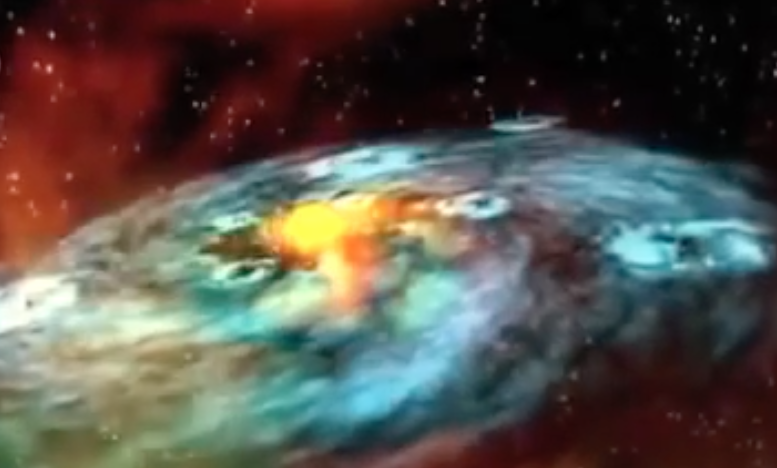
Within 100,000 years of the shock wave's impact, the collapsed cloud became a swirling disc, called a protoplanetary disc. Under pressure from gas and dust spiralling inwards, the centre of the disc became hotter and denser. It was now what is called a protostar, a so-called T Tauri star, in which nuclear fusion at its core was yet to begin. It would soon evolve into a true star, the infant Sun.
Planetesimals
Away from this central furnace, particles of dust began to clump together like snowflakes, first into small rocks, then becoming large boulders. Over millions of years, some grew into blocks several kilometres across, called planetesimals. They were now large enough to have gravity strong enough to attract one another as well as smaller material. Many collided and were destroyed, but some remained together, growing even larger.
Solar wind
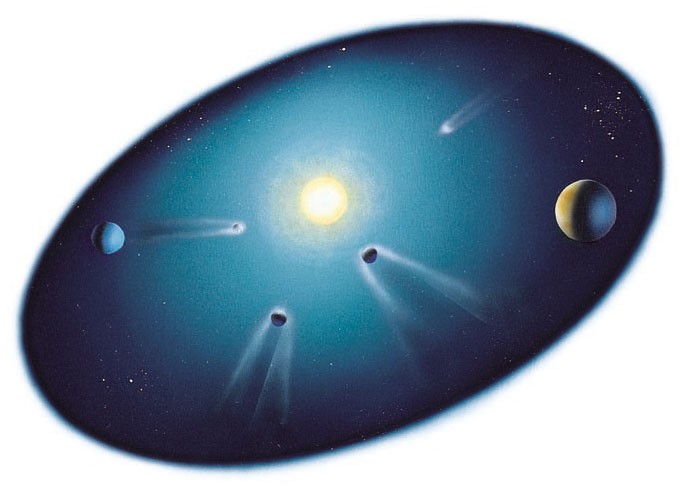
The T Tauri star had a powerful solar wind: a constant stream of subatomic particles that flowed out from it. The solar wind—stronger then that it is today—stripped away any remaining dust and gas in the surrounding disc. Some of the planetary embryos, attracted by each other’s gravity, collided to form the planets (or in the case of the gas giants, the planets' cores). Further collisions may have removed the outer layers of Mercury and resulted in the formation of the Moon.
Solar System today
The end result was the Solar System as it is today: four inner planets, two of which, Venus and Earth, still have significant atmospheres, and four giant outer planets, all with thick gaseous atmospheres. Jupiter’s gravitational pull caused nearby planetesimals to destroy one another rather than build up into another planet. This resulted in a belt of rocky (or metallic) fragments, called asteroids, that orbit the Sun between Mars and Jupiter.
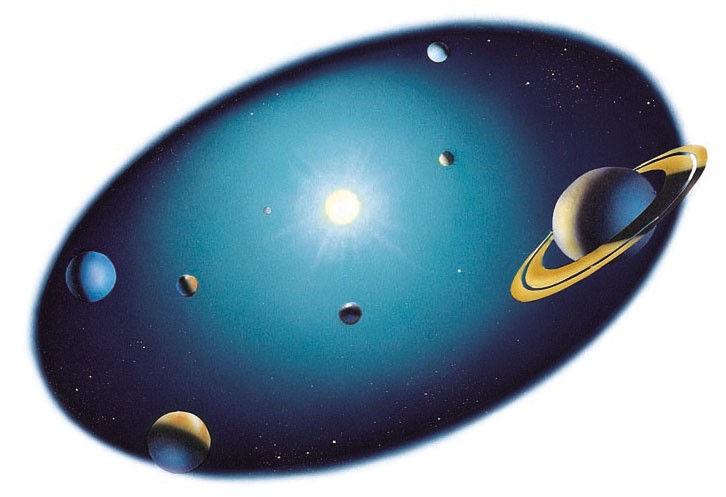
There are a number of variations on this theory. Recently, many scientists have suggested that the planets have changed their positions since they were formed. For instance, Uranus and Neptune may have formed much closer to the Sun that they are now.
Lying beyond Neptune's orbit is another belt made up of fragments left over from the Solar System's early days: the Kuiper Belt. Its objects, known as Kuiper Belt Objects or KBOs, are composed largely of frozen volatiles such as methane, ammonia and water (also called "ices"). Their origin possibly lies in the scattering of planetesimals by the migration of Jupiter and the other giant planets soon after the Solar System was born.
Consultant: Mike Goldsmith
pics
Without in any way limiting Q-files Ltd’s exclusive rights under copyright, any use of this publication to “train” generative artificial intelligence (AI) technologies to generate text is expressly prohibited. Q-files Ltd reserves all rights to license use of this work for generative AI training and development of machine learning language models.