
Solar System

CITE
We have made every effort to follow citation style rules, but there may be some minor differences. If in doubt, please refer to the appropriate citation style manual.
Trans-Neptunian objects. (2026). In Q-files Encyclopedia, Space, Solar System. Retrieved from
https://www.q-files.com/space/solar-system/trans-neptunian-objects
"Trans-Neptunian objects." Space, Solar System, Q-files Encyclopedia, 2 Jun. 2026.
https://www.q-files.com/space/solar-system/trans-neptunian-objects.
Accessed 21 Sep. 2026.
Trans-Neptunian objects 2026. Space, Solar System. Retrieved 21 September 2026, from
https://www.q-files.com/space/solar-system/trans-neptunian-objects
Space, Solar System, s.v. "Trans-Neptunian objects," accessed September 21, 2026.
https://www.q-files.com/space/solar-system/trans-neptunian-objects


Trans-Neptunian objects
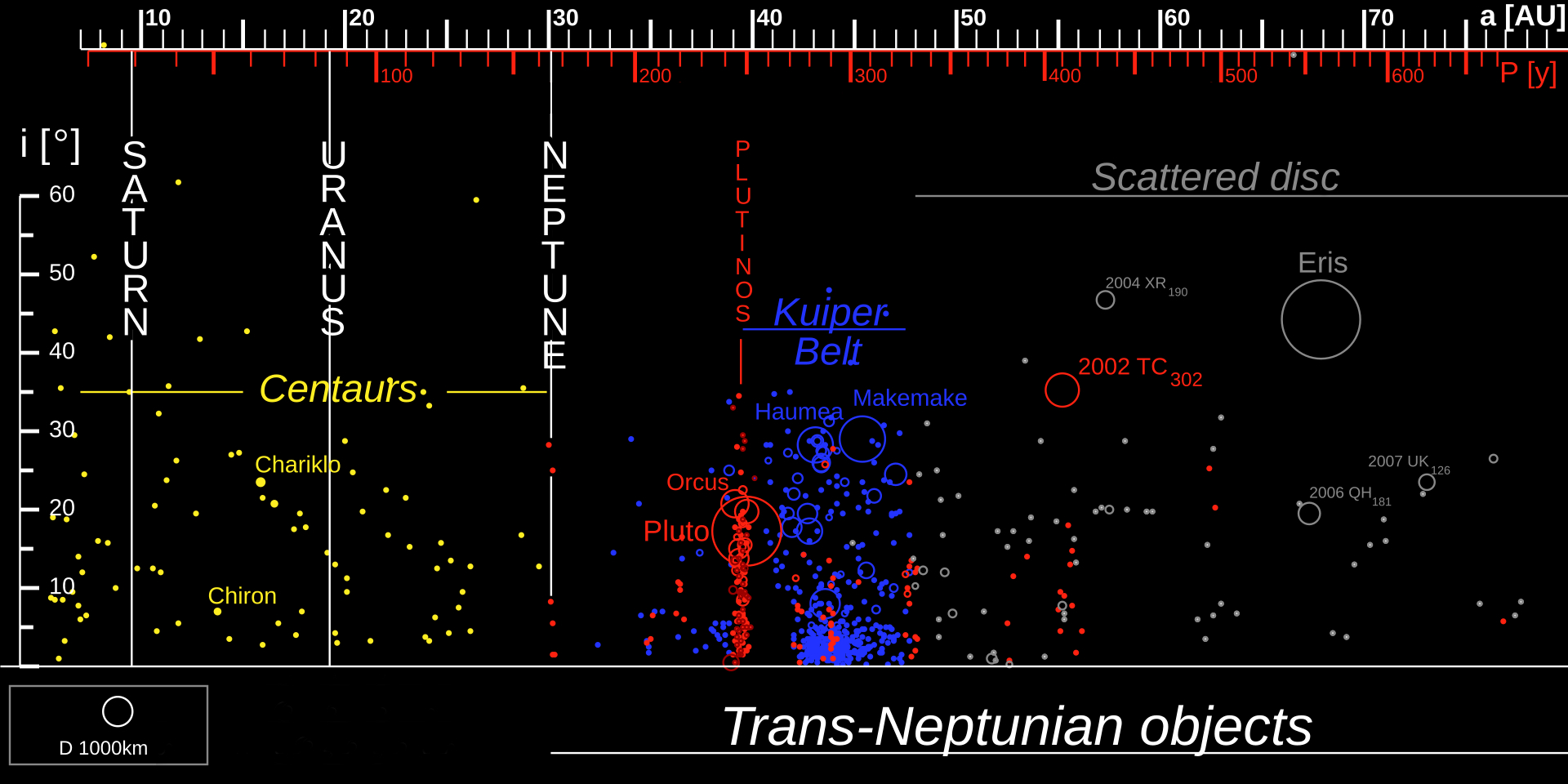
A trans-Neptunian object (TNO) is any minor planet or dwarf planet in the Solar System that orbits the Sun at a greater average distance than Neptune. TNOs are classified into two groups: Kuiper Belt objects (KBOs) and Scattered Disc objects (SDOs). As of February 2025, there were 1006 numbered and more than 4000 unnumbered TNOs. The largest TNO known is Pluto, followed by Eris (which is the most massive), Haumea, Makemake and Gonggong. TNOs orbit amongst countless millions of smaller objects made mostly of ice and rock in the farthest regions of the outer Solar System.
9th March 2026

Kuiper Belt

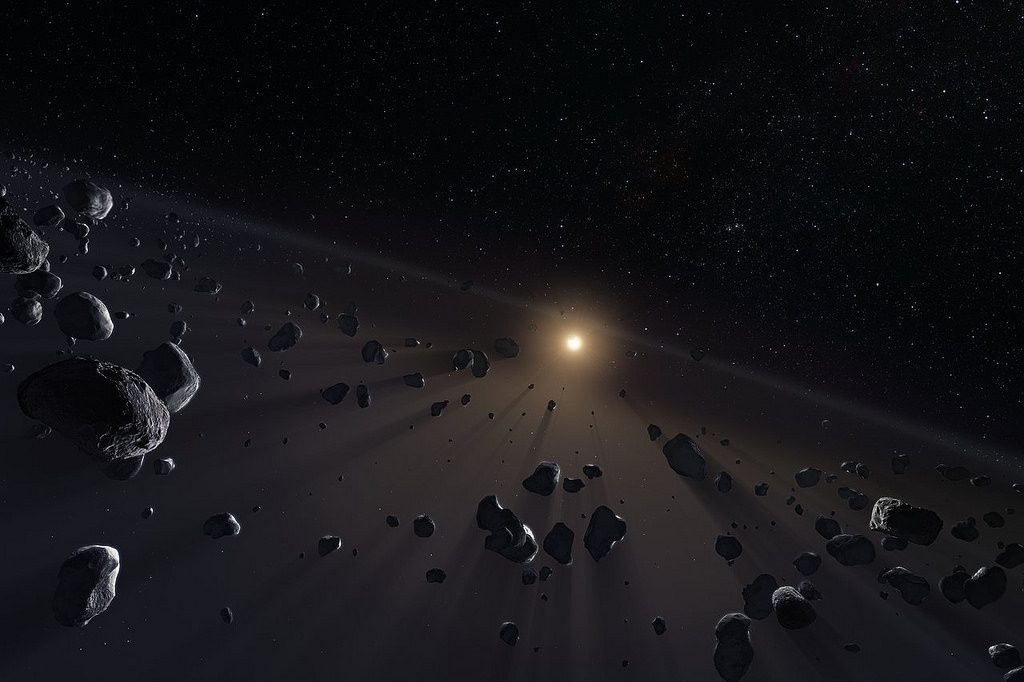
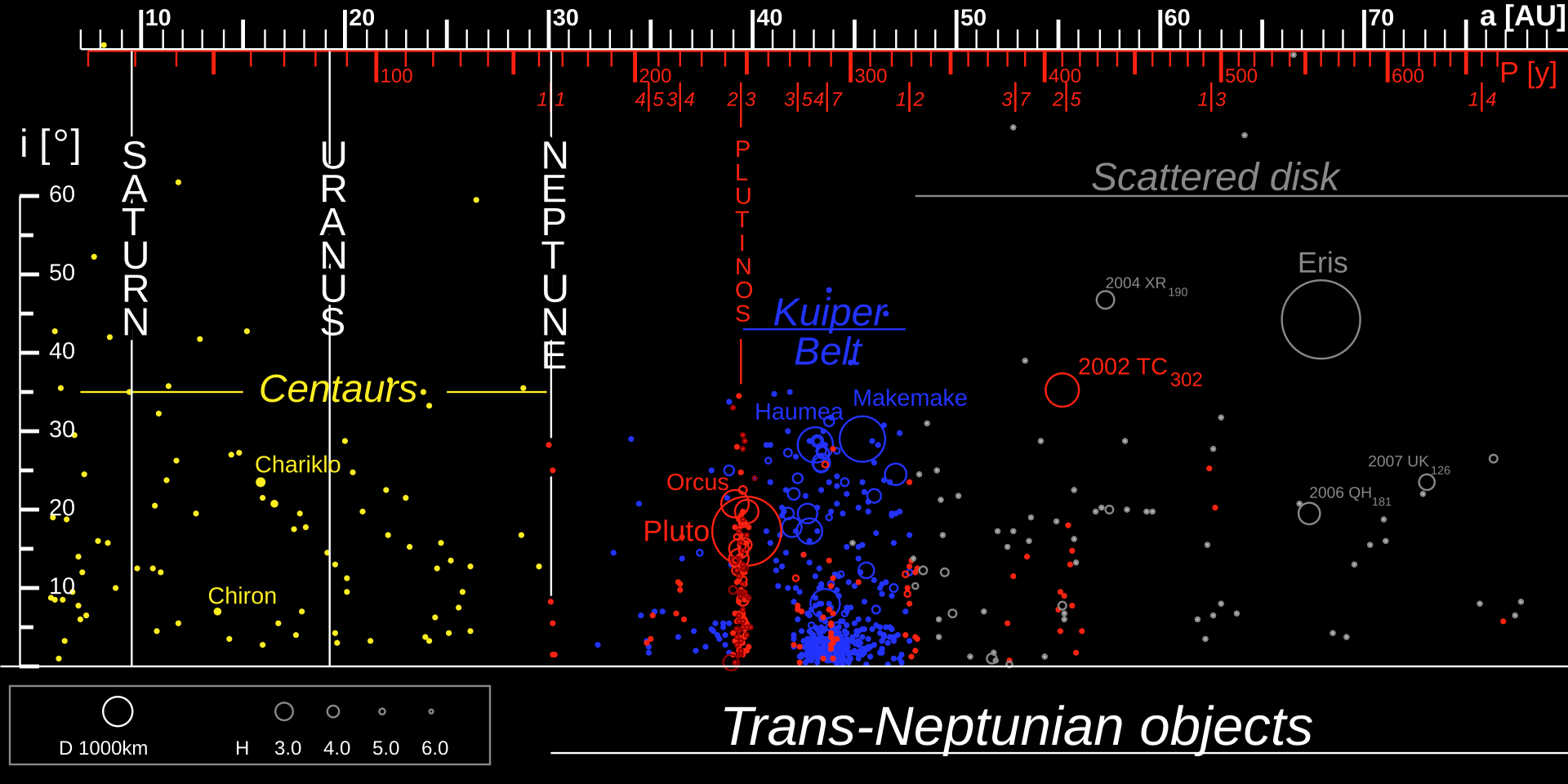
The Kuiper Belt is a doughnut-shaped region lying beyond Neptune, the outermost planet. It extends from a distance of about 30 AU to approximately 55 AU from the Sun (1 AU or Astronomical Unit, is equivalent to the distance from the Earth to the Sun). The region consists of a myriad of icy objects known as as Kuiper Belt objects (KBOs), mostly small lumps of frozen water, methane and ammonia mixed together with dust.
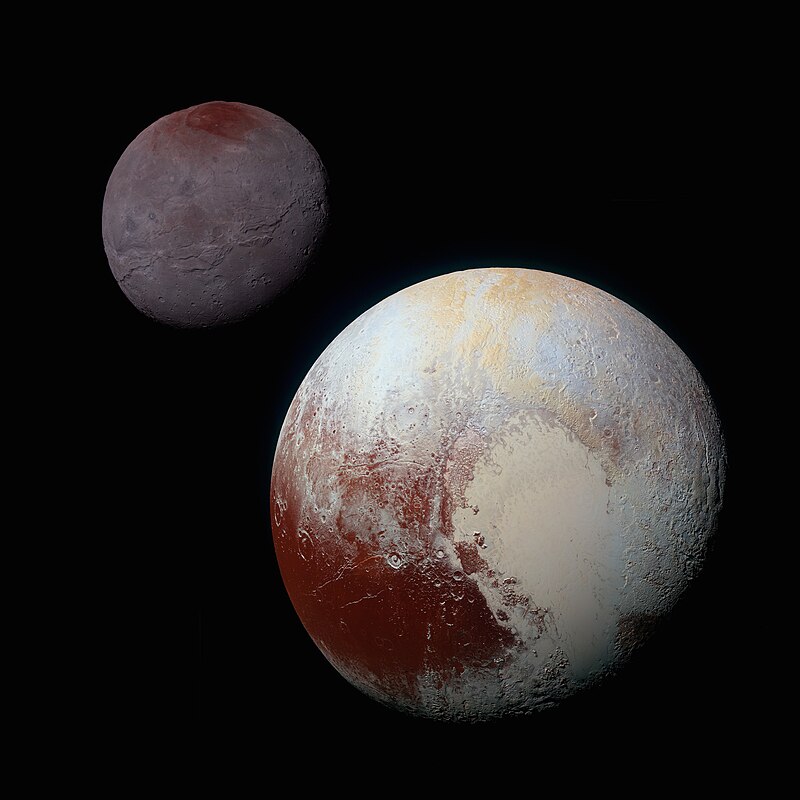
The largest KBOs—massive enough for their gravity to pull them into a rounded shape—are classified as dwarf planets: Pluto, Orcus, Haumea, Quaoar and Makemake. Some of the Solar System's moons, such as Neptune's Triton and Saturn's Phoebe, may have originated in the Kuiper Belt and were later "captured" by the gravitational pull of those planets.
More than 100,000 KBOs with a diameter of over 100 kilometres (60 miles) are thought to exist, but there are likely to be hundreds of millions more smaller objects. However, the total mass of the Kuiper Belt is probably no more than just a tenth—or even a hundredth—the mass of Earth. Many KBOs also have moons orbiting around them.

KBOs are classified into two types. "Resonant" objects are locked in an orbital resonance with Neptune (they include a group called the plutinos, of which Pluto is a member). This means Neptune's gravity affects their orbits, pulling them into a more eccentric, or elliptical, shape. "Classical" objects, also known as cubewanos, on the other hand, have no resonance with Neptune. Making up about two-thirds of all KBOs, they move in almost circular orbits within the Kuiper Belt, unaffected by Neptune's gravitational pull.

Formation of the Kuiper Belt
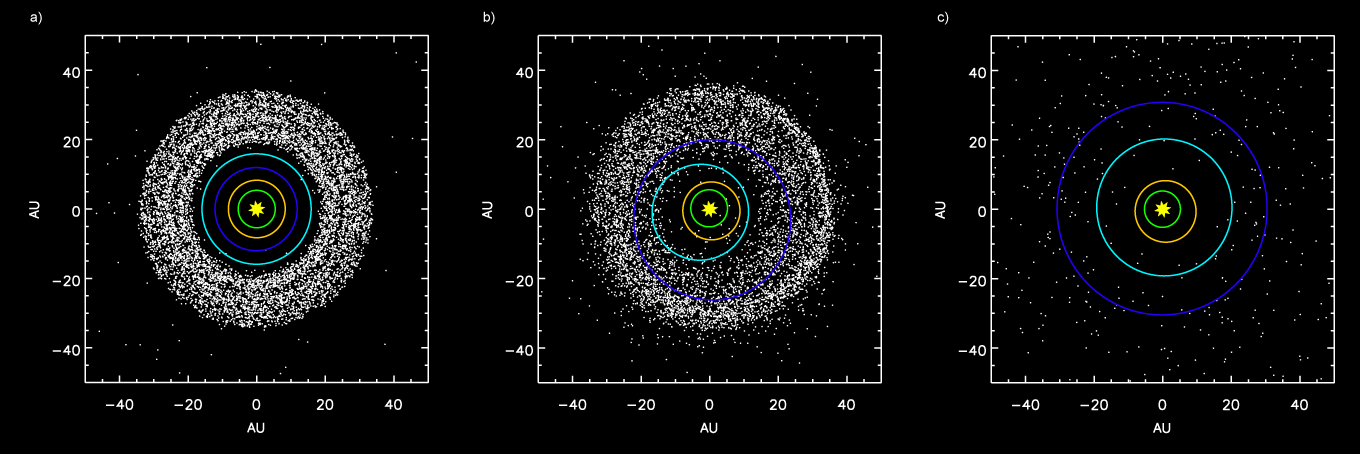
Kuiper Belt objects are probably planetesimals, fragments from the original protoplanetary disc that swirled around the Sun 4.6 billion years ago, but which failed to clump together to form planets. Scientists think this was due to the outward migration of Neptune during the early years of the Solar System, driven by the shifting orbits of Jupiter and Saturn. Neptune's gravity stirred up the region of space into which it moved, sending all the icy bodies present flying in all directions.
Arrokoth
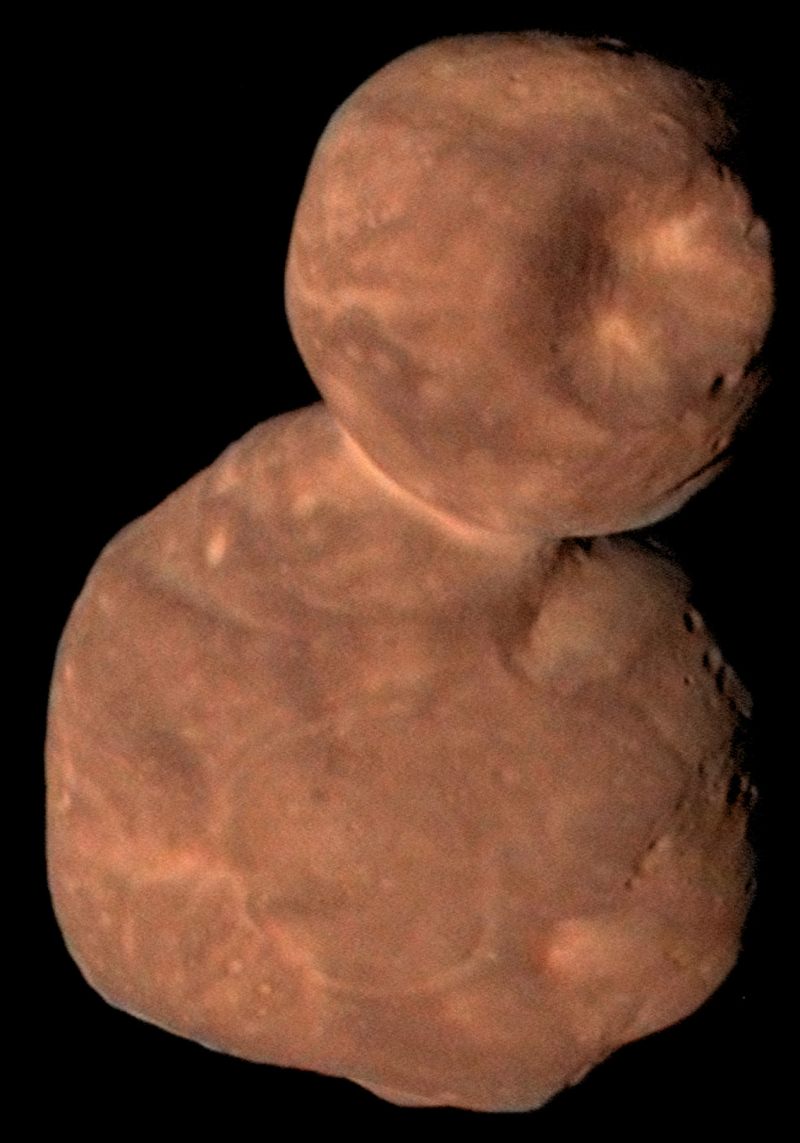
Arrokoth is one of millions of KBOs, but one of only two that have been studied up close by a space probe (the other is Pluto). On 1st January 2019, New Horizons beamed back its first close-up images, taken from a distance of about 137,000 kilometres (85,000 miles). The pictures revealed a dark reddish object, shaped a bit like a snowman. It was about 34 kilometres (21 miles) long and 16 kilometres (10 miles) wide. It spun on its axis once every 15 hours.
Arrokoth's odd shape may have come about when, during the formation of the Solar System, two large lumps of rock began to orbit one another, eventually spiralling in and joining together. Scientific instruments aboard the probe detected the presence of methanol, water ice and organic molecules on Arrokoth's surface.
Haumea
Haumea, one of the largest known Kuiper Belt objects, was discovered in 2005. It possesses both a ring system and two known moons, named Hiʻiaka and Namaka. It rotates so quickly—once every 3.9 hours—that it is stretched horizontally into the shape of an egg: an ellipsoid. Astronomers think that Haumea's elongated shape, together with its rapid rotation, are thought to be the consequences of a massive collision that occurred billions of years ago. It left Haumea the largest member of a family of objects all with roughly the same composition and sharing similar orbits.

Scattered Disc

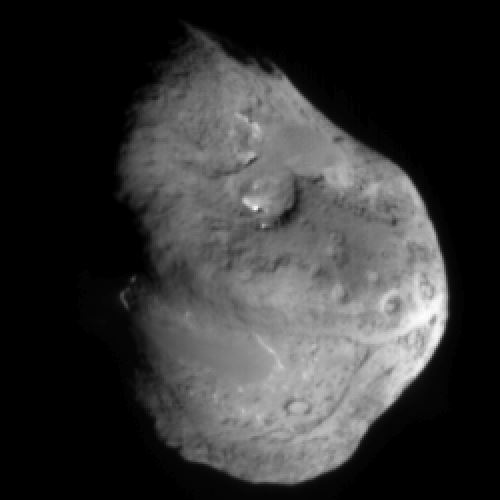
The inner part of the Scattered Disc overlaps the Kuiper Belt and is made up of similar types of icy objects. But, unlike KBOs, Scattered Disc objects (SDOs) were "scattered" by the gravity of Neptune as the Solar System was forming, giving them extreme orbits. SDOs, including the dwarf planets Eris and Gonggong, have highly eccentric orbits (elongated oval, rather than circular in shape). This means that, although an SDO's nearest point to the Sun (its perihelion) lies within the Kuiper Belt, its orbit takes it far beyond it. In some instances, an SDO's farthest point (aphelion) can be as much as 150 AU from the Sun. SDOs also have steep orbital inclinations (angles of tilt from the planets' orbital plane or ecliptic), with some more than 40°.
Some SDOs have orbits that take them in the opposite direction—deep into the inner Solar System. As they approach the Sun they can be seen from Earth as periodic comets. This type of comet reappears in our skies at intervals of less than 200 years.
Eris
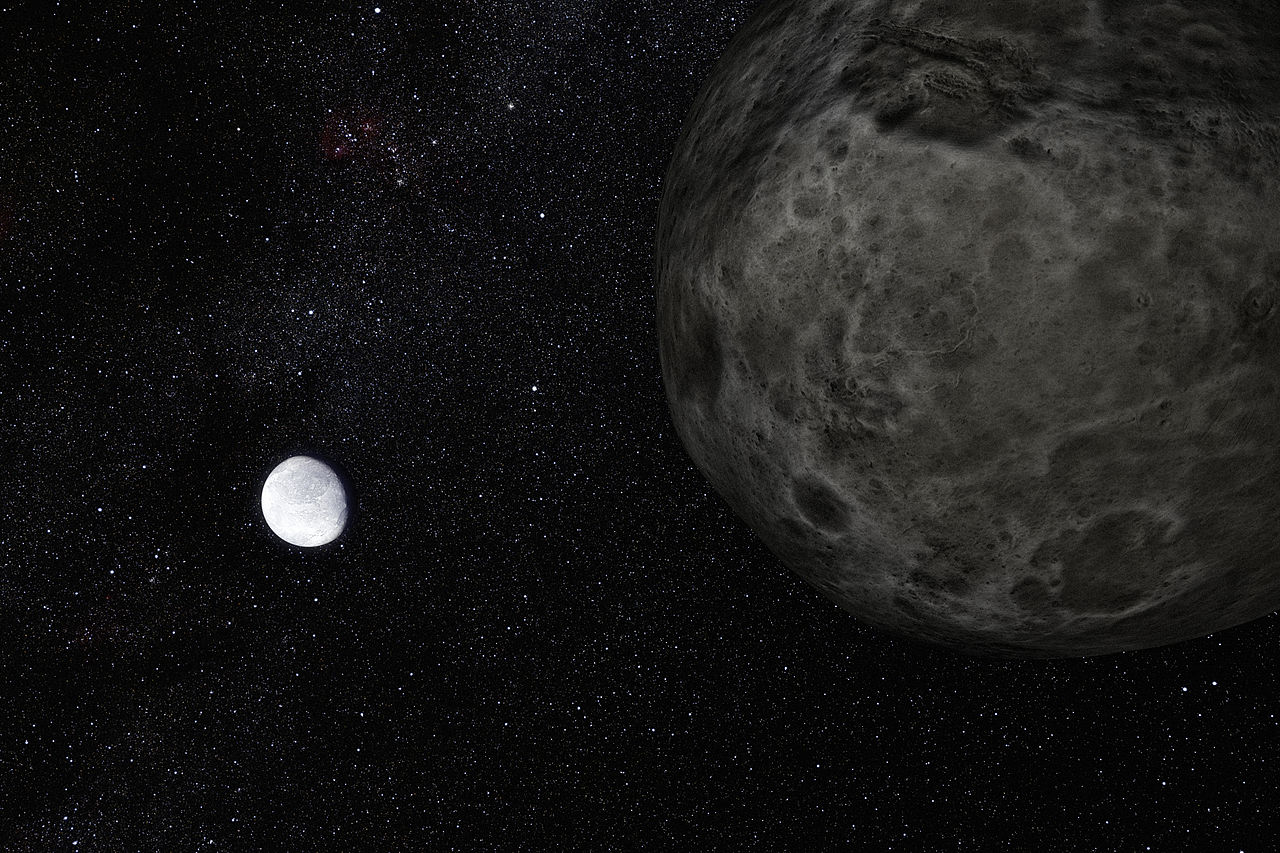
Eris is the largest known SDO and the most massive dwarf planet known. It has one large known moon, Dysnomia. Like Pluto, its orbit is highly eccentric, with a perihelion of 38.2 AU (roughly Pluto's distance from the Sun) but an aphelion of 97.6 AU. It is steeply inclined to the ecliptic plane at an angle of 44°. Eris takes 559 years to complete a single orbit of the Sun. Unlike the reddish surface of Pluto and several other dwarf planets, which are coated with organic compounds known as tholins, the surface of Eris appears almost uniformly white. This is probably because any tholins are covered over by methane and nitrogen ice.


FarFarOut
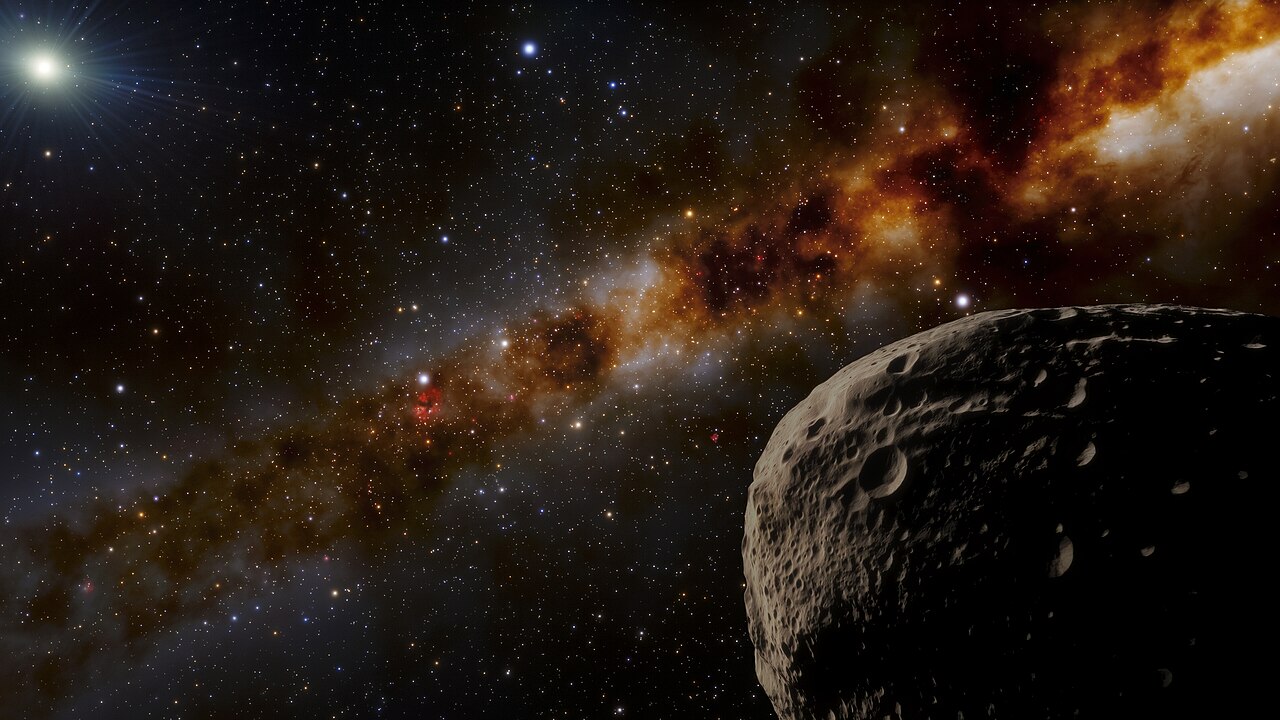
2018 AG37 is a trans-Neptunian object that was discovered in January 2018, when it was more than 130 AU from the Sun. It lies farther than any other currently observable known object in the Solar System. (Other known objects will eventually lie much farther away as they move outwards on their orbital paths.) Several years of observations are needed to determine the object's trajectory, but it is thought to come inside the orbit of Neptune to around 27 AU at its closest point to the Sun, and 175 AU at its farthest.
The object was nicknamed "FarFarOut" because of its distant location from the Sun—and because it lay even farther away than the previous farthest known object, nicknamed "FarOut". Analysis indicates that FarFarOut is probably only about 400 kilometres (250 miles) across, and we do not yet know whether it has sufficient mass to give it a round shape. Only the very largest telescopes can observe this extremely faint object.
Extreme trans-Neptunian objects

Some objects in the Solar System have extremely distant orbits, and so are less affected by the gravitational pull of the giant planets. Called extreme trans-Neptunian objects (ETNOs), they have highly elongated orbits and are steeply tilted to the ecliptic (the orbital plane of the planets). For example, Leleakuhonua orbits the Sun once every 32,000 years or so at a distance ranging from 65 to 2000 AU.
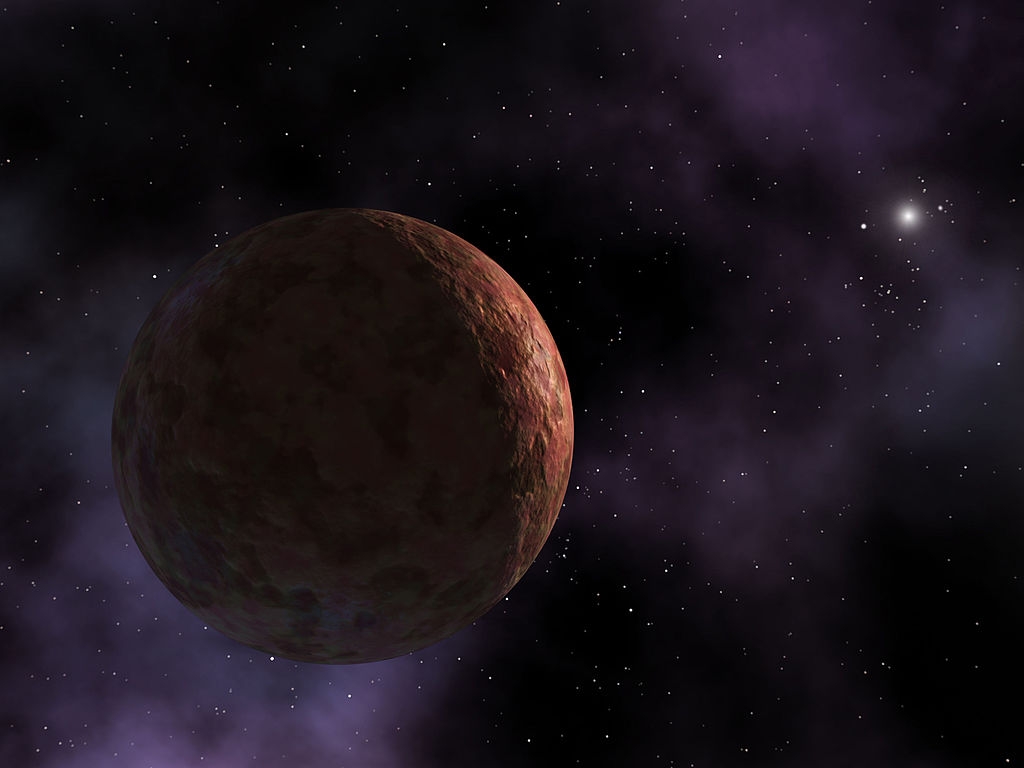
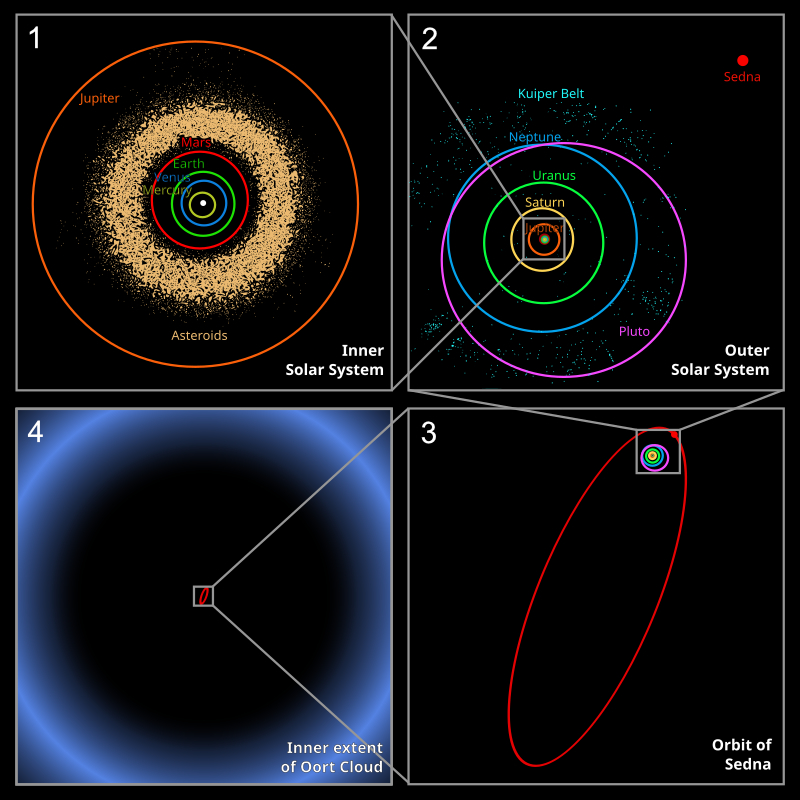
Currently, there is one ETNO, named Sedna, that is classified as a dwarf planet. It is mostly a mixture of the ices of water, methane and nitrogen. A large, reddish object roughly 1000 kilometres (600 miles) in diameter, Sedna takes around 11,400 years to complete one orbit of the Sun. Its aphelion is 937 AU, while its perihelion is 76 AU.
Planet Nine
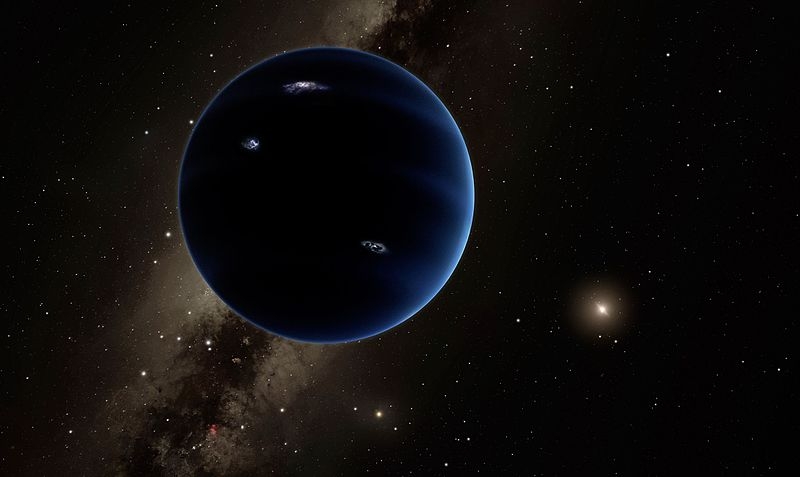
The existence of Planet Nine has been suspected by some astronomers since 2014. They noticed that the orbits of Sedna and several other ETNOs appeared to have been tugged into place by the gravitational pull of some unknown large object. So far undiscovered, this object is known as Planet Nine.
The mysterious planet could be located between 400 and 500 AU from the Sun and would take between 10,000 and 20,000 years to complete one orbit. Planet Nine, if it exists, would be about four times the size of Earth and five times its mass. Astronomers call any large rocky planet that has up to 10 times the mass of the Earth a “super-Earth”. These types of planet are quite common amongst exoplanets orbiting other stars. But no super-Earth has yet been found in our own Solar System.
Oort Cloud
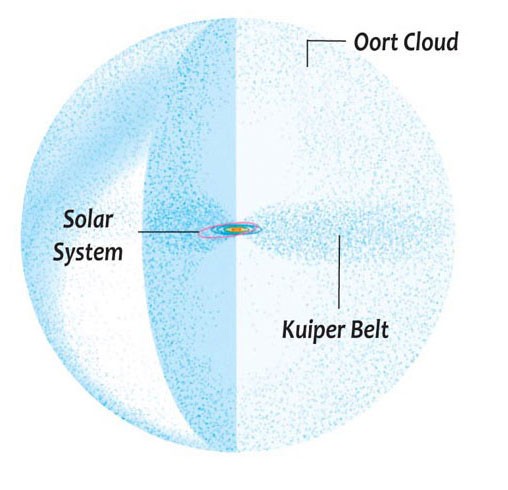
Much more distant from the Sun than both the Kuiper Belt and Scattered Disc lies the Oort Cloud, a vast spherical cloud of icy objects that is thought to surround the Solar System. Its inner edge may be around 1000 AU from the Sun, well beyond the heliopause, the boundary of the Solar System which is about 120 AU from the Sun. The Cloud's outer edge may be roughly a light year out from the Sun, or about a quarter of the distance to Proxima Centauri, the nearest star. The Oort Cloud forms the limit of the Sun's gravitational hold on objects. Beyond it, the Sun's gravity is so weak objects can easily drift away into deep space.
No direct observation of the Oort Cloud is possible with current imaging technology. Objects in the Cloud are probably small icy worlds similar to KBOs and SDOs. They may have formed closer to the Sun, but were ejected into more distant space by the gravity of the giant planets in the early years of the Solar System. The Oort Cloud is thought to be the source of long-period comets—those with orbits lasting longer than 200 years. The gravitational pull of other stars may be enough to dislodge the icy objects from their orbits within the Oort Cloud and send them hurtling towards the inner Solar System as comets.
pics

Without in any way limiting Q-files Ltd’s exclusive rights under copyright, any use of this publication to “train” generative artificial intelligence (AI) technologies to generate text is expressly prohibited. Q-files Ltd reserves all rights to license use of this work for generative AI training and development of machine learning language models.