
Planets and moons

CITE
We have made every effort to follow citation style rules, but there may be some minor differences. If in doubt, please refer to the appropriate citation style manual.
Pluto. (2026). In Q-files Encyclopedia, Space, Planets and moons. Retrieved from
https://www.q-files.com/space/planets-and-moons/pluto
"Pluto." Space, Planets and moons, Q-files Encyclopedia, 25 Mar. 2026.
https://www.q-files.com/space/planets-and-moons/pluto.
Accessed 22 Sep. 2026.
Pluto 2026. Space, Planets and moons. Retrieved 22 September 2026, from
https://www.q-files.com/space/planets-and-moons/pluto
Space, Planets and moons, s.v. "Pluto," accessed September 22, 2026.
https://www.q-files.com/space/planets-and-moons/pluto


Pluto
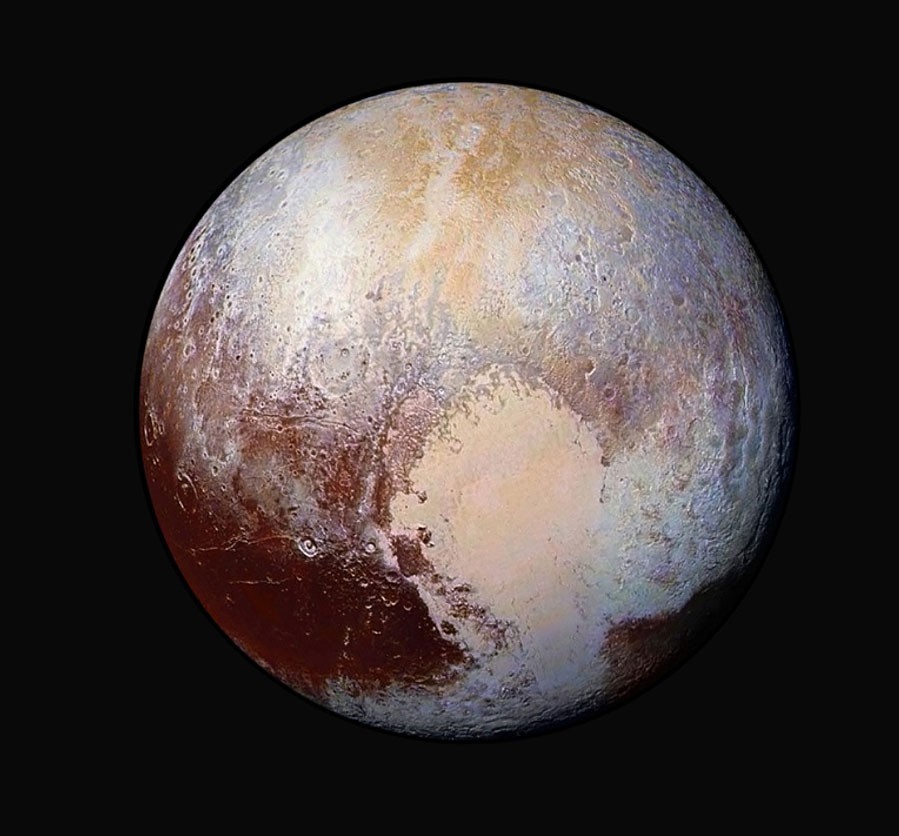
Thanks to images sent back by the New Horizons space probe in July 2015, astronomers have discovered much new information about Pluto. Once the smallest and most distant planet in our Solar System, its status was changed in 2006. This was because many objects similar to—or even bigger than—Pluto had been recently discovered in the outer Solar System, notably Eris. So astronomers decided that Pluto, along with Eris, Haumea, Makemake and the largest asteroid Ceres, should all become officially classified as "dwarf planets".
Discovery
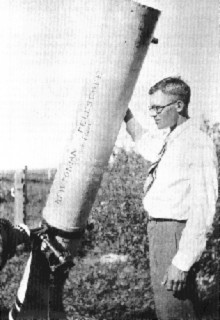
Pluto was first identified in 1930 by the American astronomer Clyde Tombaugh (1906–97). Astronomers had been puzzled over why the orbit of Uranus was not quite as it should be. The only explanation—they thought then—was that there was another planet apart from Neptune farther out from the Sun with a force of gravity strong enough to affect the orbit of Uranus. The hunt was on for the mysterious Planet X. Working at the Lowell Observatory, Arizona, Tombaugh eventually pinpointed Pluto by comparing photographs taken of the same part of the sky six days apart and noticing that a pinprick of light had moved slightly against the background of stars. (Pluto, it turns out, does not have a gravitational force sufficient to affect the orbit of Uranus. Astronomers have recently found that its “wobble” is due to Neptune having a larger mass than was previously thought.)
Orbit and rotation
Pluto has a highly elliptical (elongated oval-shaped) orbit, ranging between 7400 and 4400 million kilometres (4600–2700 million miles) from the Sun, bringing it inside the orbit of Neptune for 20 of the 248 years it takes to circle the Sun. The orbit is also tilted by 17° to the average plane of the other planets.
Pluto's rotation period, its day, is equal to 6.4 Earth days. Like Uranus, Pluto rotates on its "side", with a tilt of 120°. This means that at certain times of year, a quarter of its surface is in continuous daylight, while the opposite quarter is in continuous darkness.

Landscape
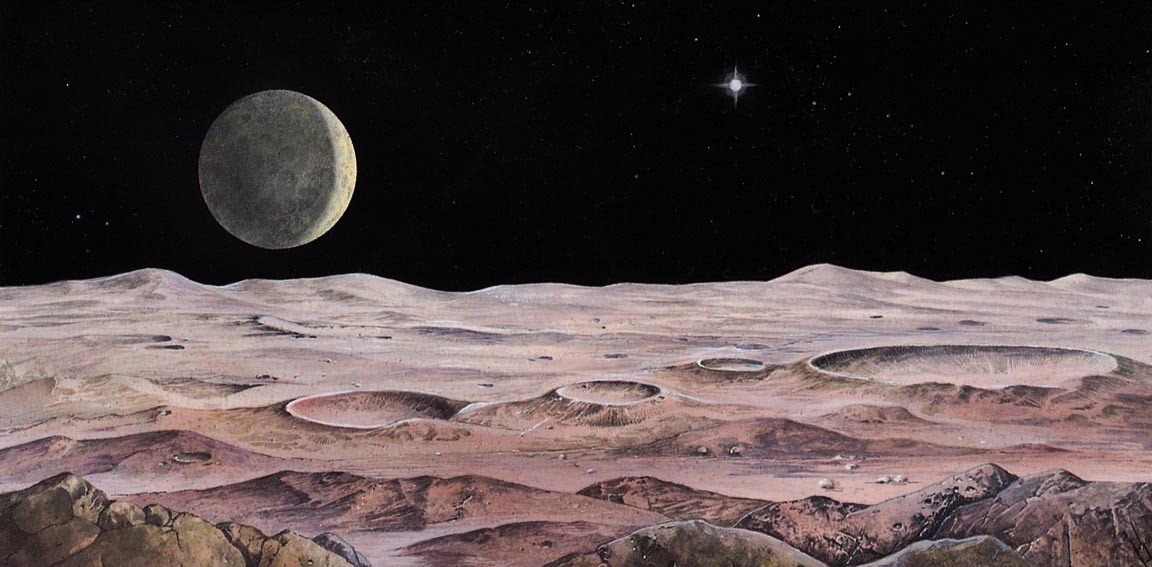
Pluto's surface consists mostly of frozen nitrogen, with traces of methane and carbon monoxide. These probably evaporate when the planet is closer to the Sun, which slightly warms the surface, but fall back down to the ground as snowflakes when it gets colder. Around Pluto’s equator there is a long, dark band of material named Cthulhu Regio (also known as the “Whale”). This is interrupted by a bright, heart-shaped plain, nicknamed the "Heart", but officially called Tombaugh Regio, after Pluto's discoverer, Clyde Tombaugh.
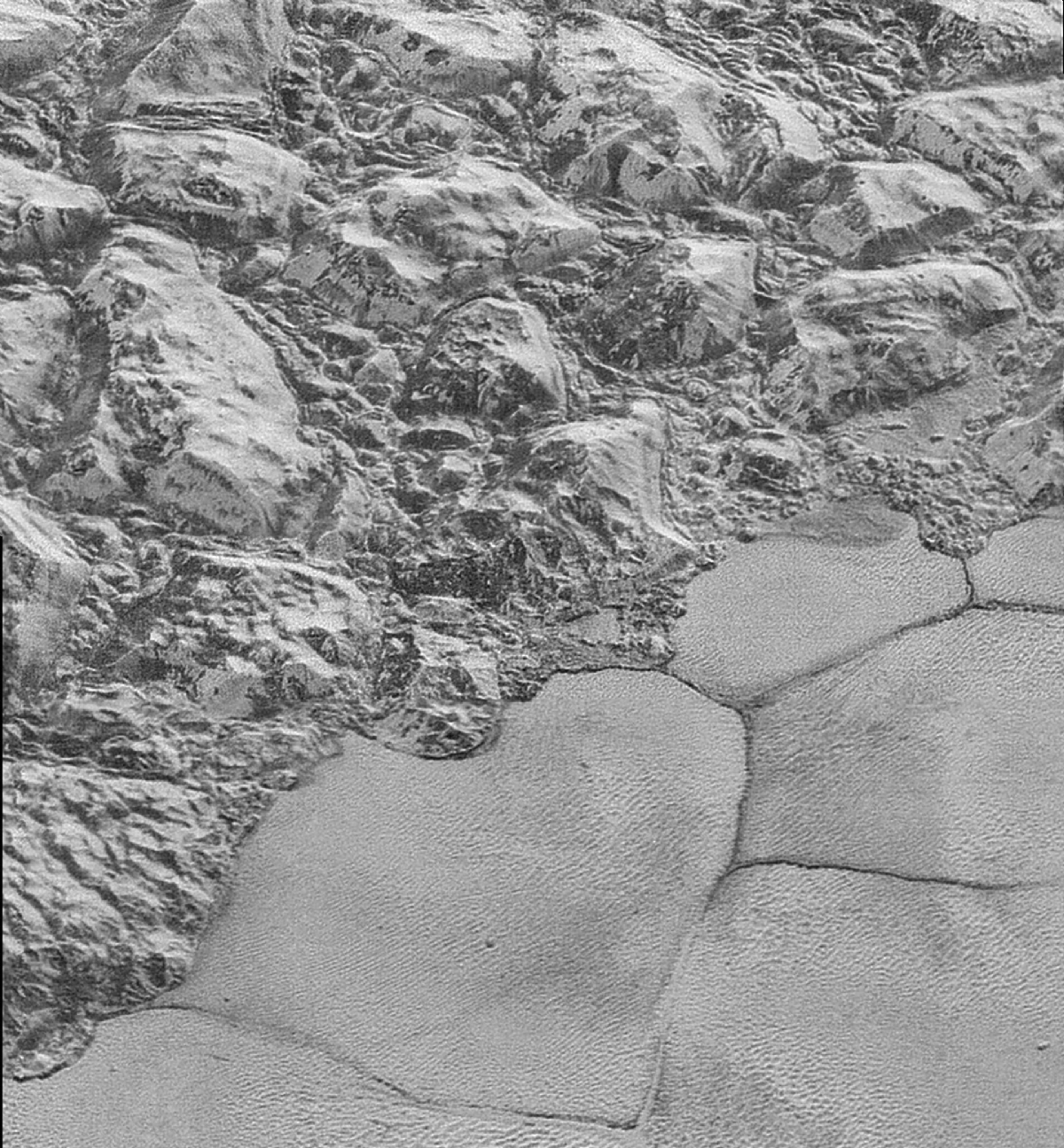
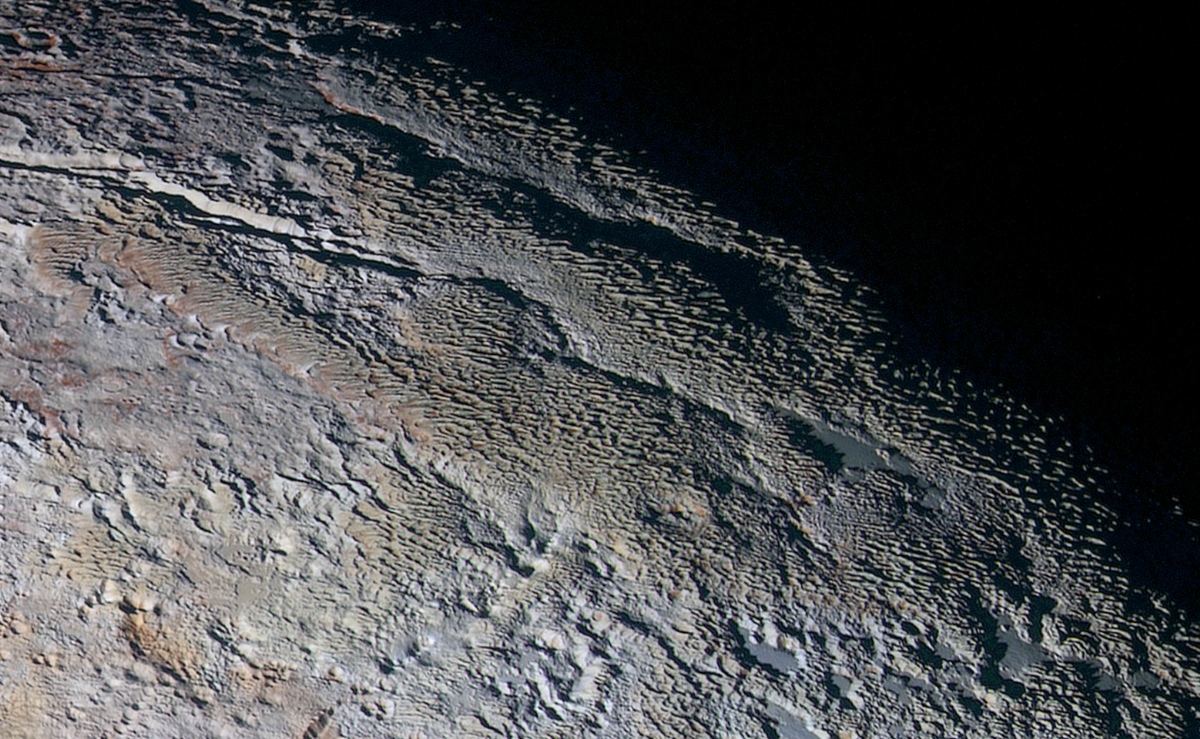
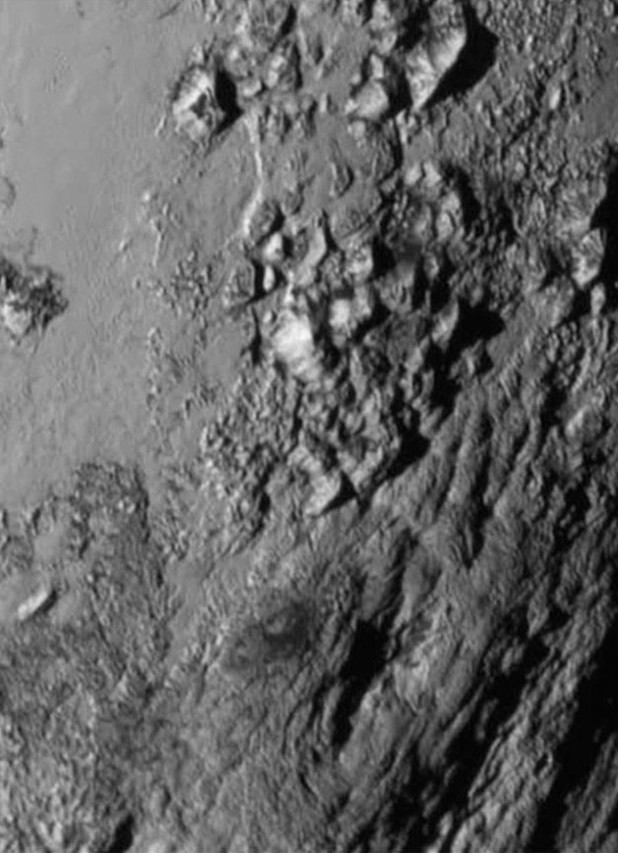
The New Horizons probe revealed mountain ranges on Pluto’s surface. The Norgay Montes range (named after Tenzing Norgay, who along with Edmund Hillary was the first to ascend Mount Everest) on the edge of Tombaugh Regio includes peaks more than 3300 metres (11,000 feet) high. The mountains are made of water ice.
Underground ocean?
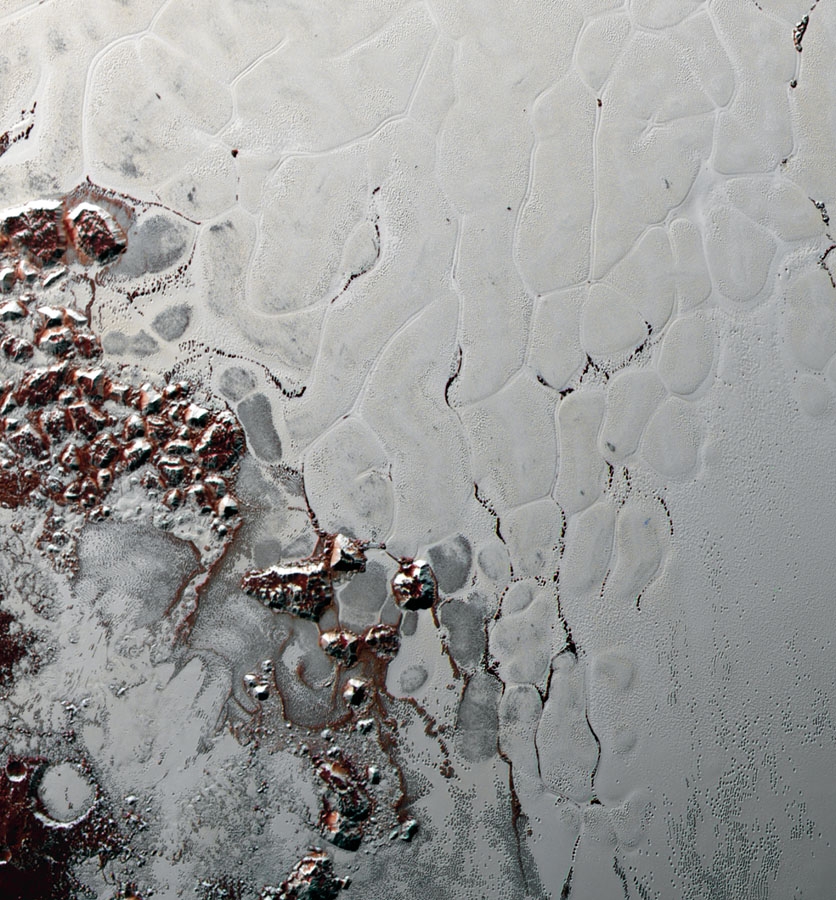
Sputnik Planitia, the western lobe of the "Heart", is a 1000 kilometre (600 mile) basin of frozen nitrogen ice. Completely without craters, it is divided into "cells" with polygonal shapes—hexagons and pentagons. Scientists believe this pattern is the result of convection currents. A heat source is melting the ice from below, causing it to rise, cool and then fall again. The melting and refreezing constantly resurfaces the area, covering over any impact craters. Obvious signs of glaciers of nitrogen ice spreading across Sputnik Planitia also indicate that heat is leaking from Pluto's interior. The heat source may be a warm water ocean at least 100 kilometres (60 miles) deep, occupying a layer between the ice crust and a rocky core.
Charon
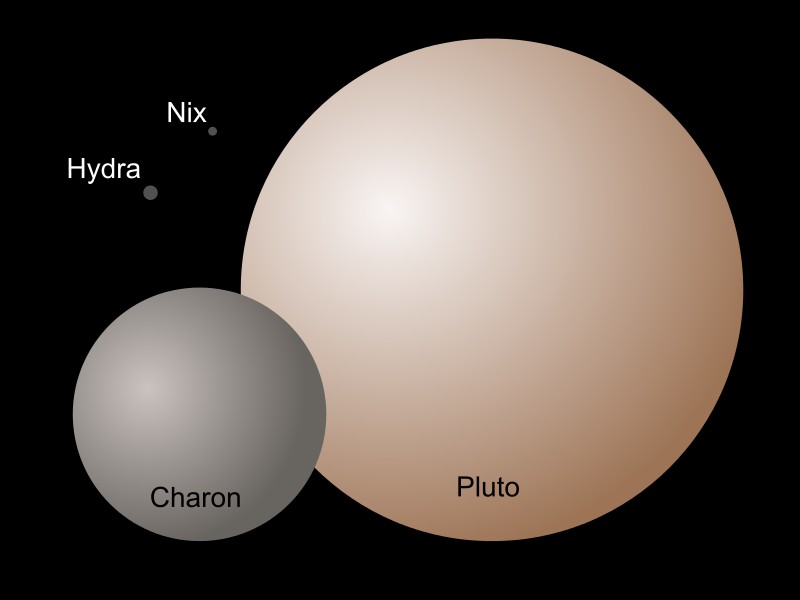
Pluto has five moons: Charon (by far the largest), Hydra, Nix, Kerberos and Styx. Charon was discovered in 1978 by the American astronomer Jim Christy. Nix and Hydra were identified in 2005, Kerberos in 2011 and Styx in 2012. With a diameter of 1212 kilometres (753 miles), Charon is just over half Pluto’s size, the largest moon relative to its “parent” in the Solar System. It lies only 19,640 kilometres (12,200 miles) away from it. The two bodies could be said to form a “double planet”.
Charon orbits Pluto with the same hemisphere always facing the same hemisphere of Pluto. They are "tidally locked" to one another. This is a case of mutual tidal locking, as compared to that of the Earth and the Moon, where the Moon always shows the same hemisphere to Earth, but not the other way round. If you stood on one side of Pluto, Charon would never move in the sky. If you stood on the other side, you would never see Charon.
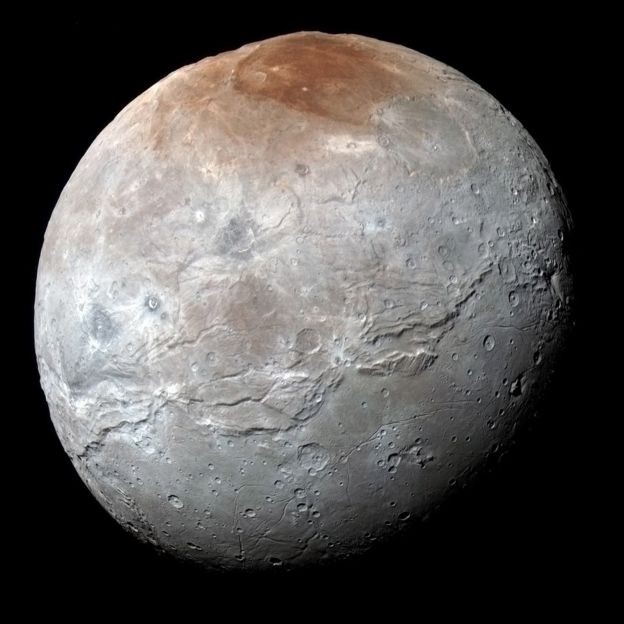
Surface of Charon
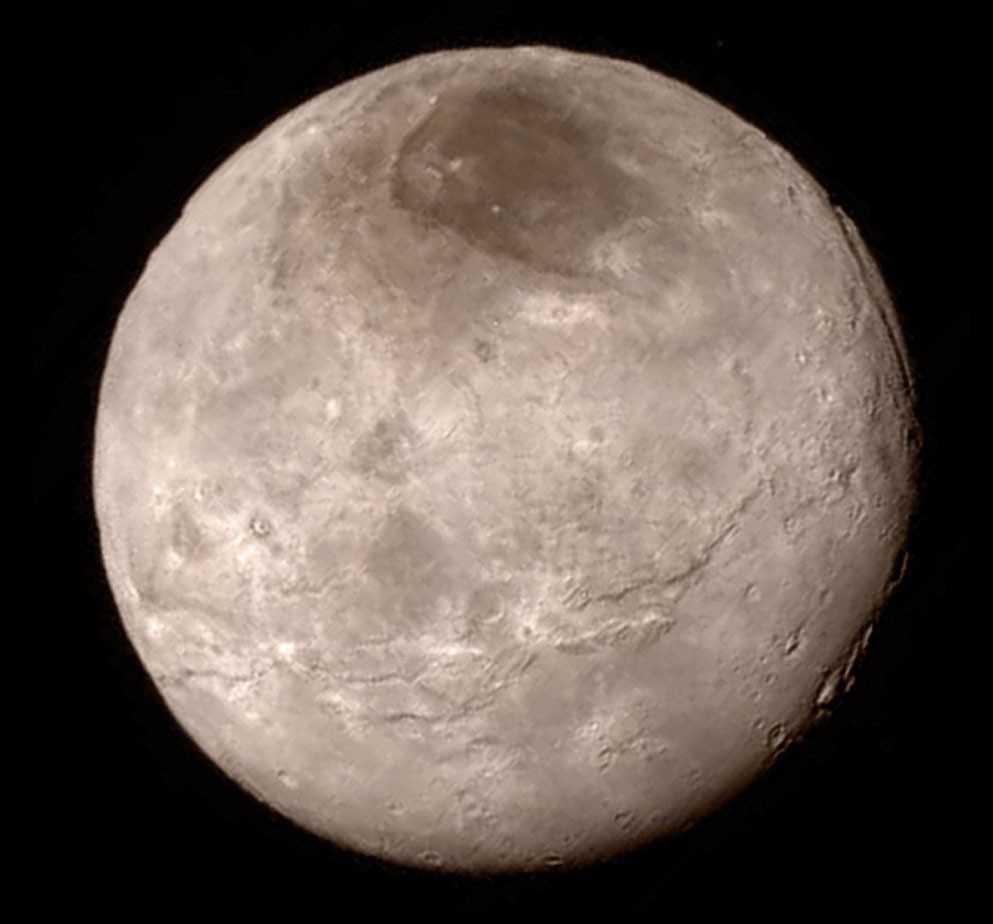
The first high-resolution image produced by New Horizons space probe of Charon showed cliffs that run for hundreds of kilometres across its surface and canyons between 6 and 10 kilometres (4 to 6 miles) deep. Charon's southern hemisphere has fewer craters and is much less rugged. A very cold moon, Charon's surface is mostly made of water ice. The reddish-brown area at the north pole is composed of carbon-based organic compounds, produced from the condensation of gases such as nitrogen and methane released from Pluto's atmosphere which drifted across space to Charon.
It is possible that Charon has cryovolcanoes, fissures in its surface through which ice erupts (instead of magma as with volcanoes on Earth). However, no active cryovolcanoes were detected by the New Horizons probe. In 2024, scientists were able to detect carbon dioxide on Charon thanks to observations from the James Webb Space Telescope. This may come from below the icy surface and been released as a result of asteroid impacts.
Kuiper Belt
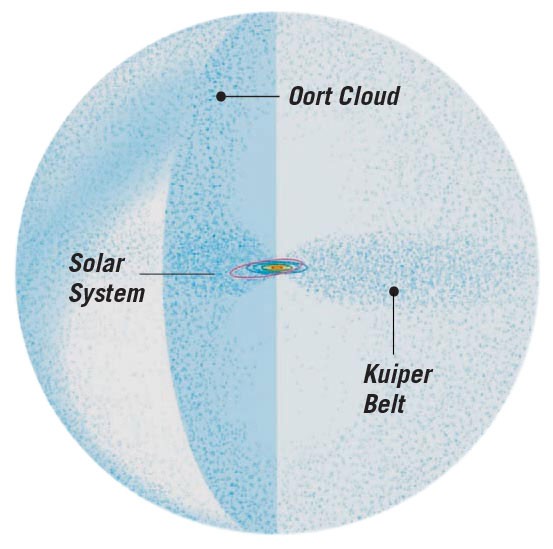
Pluto is a Trans-Neptunian object: it orbits in a region extending outwards from the orbit of Neptune along with countless of small objects made of frozen methane, ammonia and water mixed together with dust. These objects make up what is called the Kuiper Belt. Pluto along with fellow dwarf planets Haumea and Makemake are the largest-known residents of the belt. Much further beyond it there is thought to be a spherical cloud of comets surrounding the Solar System, known as the Oort Cloud.
Composition
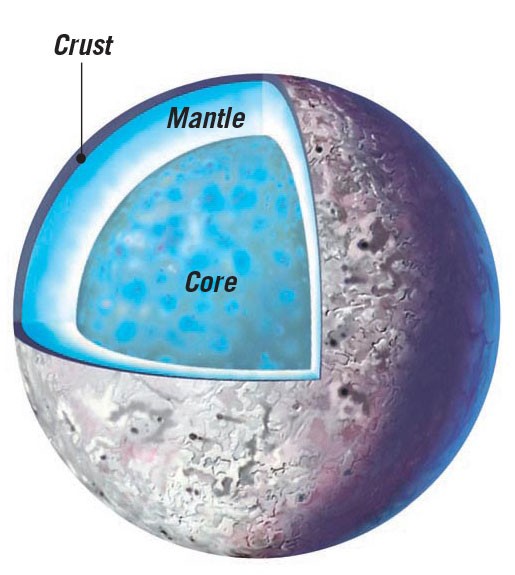
Pluto is dense for its size, so it has a large, rocky core. This is surrounded by a mantle of water—possibly in a liquid state—and a crust of nitrogen, methane, water and carbon monoxide—all in a frozen state. When Pluto is closest to the Sun on its elliptical orbit, it develops an atmosphere. Although the Sun is still very distant, it provides just enough heat to evaporate some of the surface frost on Pluto and create a very thin atmosphere of mostly nitrogen, with traces of methane and carbon monoxide. The New Horizons probe revealed the presence of haze particles in the atmosphere.
Factfile
Average diameter: 2324 km (1443 miles)
Mass: 0.00218 (Earth = 1)
Average density: 2.1 (water = 1)
Surface gravity: 0.04 (Earth = 1)
Day: 6.4 days
Year: 248 years
Speed in orbit: 4.7 km/sec (2.9 miles/sec)
Average distance from the Sun: 5914 million km (673 million miles)
Surface temperature: -240°C to -220°C
Atmosphere: Nitrogen, with traces of methane and carbon monoxide
Number of moons: 5
Name: the Roman god of the underworld
Consultant: Mike Goldsmith
pics

Without in any way limiting Q-files Ltd’s exclusive rights under copyright, any use of this publication to “train” generative artificial intelligence (AI) technologies to generate text is expressly prohibited. Q-files Ltd reserves all rights to license use of this work for generative AI training and development of machine learning language models.