
Planets and moons

CITE
We have made every effort to follow citation style rules, but there may be some minor differences. If in doubt, please refer to the appropriate citation style manual.
What is the Moon made of?. (2026). In Q-files Encyclopedia, Space, Planets and moons. Retrieved from
https://www.q-files.com/space/planets-and-moons/what-is-the-moon-made-of
"What is the Moon made of?." Space, Planets and moons, Q-files Encyclopedia, 25 Mar. 2026.
https://www.q-files.com/space/planets-and-moons/what-is-the-moon-made-of.
Accessed 13 Sep. 2026.
What is the Moon made of? 2026. Space, Planets and moons. Retrieved 13 September 2026, from
https://www.q-files.com/space/planets-and-moons/what-is-the-moon-made-of
Space, Planets and moons, s.v. "What is the Moon made of?," accessed September 13, 2026.
https://www.q-files.com/space/planets-and-moons/what-is-the-moon-made-of


What is the Moon made of?
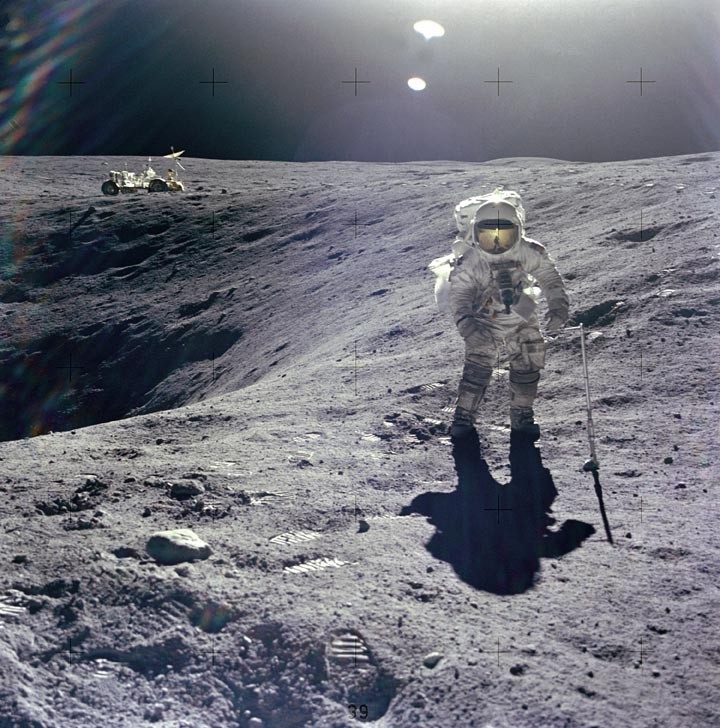
The Moon is made of rock and metal—just like the Earth and the other rocky planets (Mercury, Venus and Mars). The crust, the Moon’s outer shell, is covered by lunar soil, also called regolith: a blanket of fine rock particles, varying between three and 20 metres (10–65 feet) deep. The footprint of the first person to walk on the Moon, Neil Armstrong, is preserved in regolith. This layer was produced partly by the action of the Sun, breaking down surface rocks, and partly by the arrival of meteorites, most of them tiny (less than a gram), over millions of years. The Moon’s crust itself is about 50 kilometres (30 miles) deep. Its rocks are mostly composed of the elements oxygen and silicon. The crust also contains the metals magnesium, iron, calcium, titanium and aluminium—of interest to nations involved in future lunar exploration.

Water on the Moon
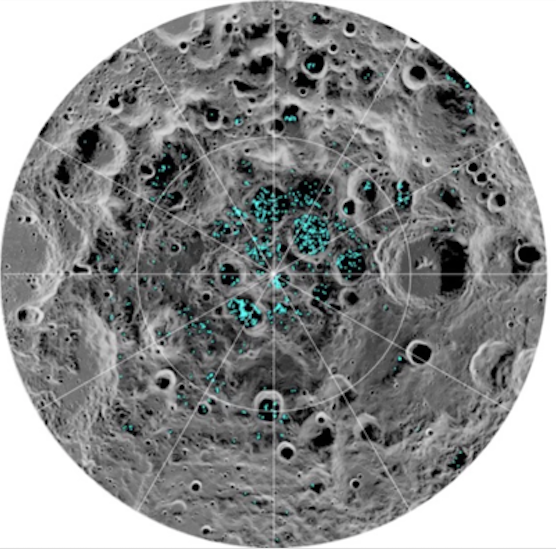
With no atmosphere to protect it from the Sun’s rays, water in its liquid form cannot exist on the Moon’s surface. Water does, however, exist as solid ice in cold, permanently shadowed craters known as "cold traps" near the lunar poles. Water has now also been discovered in flat, sunlit regions near the Moon's south pole by scientists using an infrared telescope.
Strewn across the Moon’s surface are countless tiny glass beads, each containing water. (This "glass" is a naturally occurring solid material with no regular pattern in its molecules.) The beads, which measure less than a millimetre across, form when meteoroids crash into the Moon and send up showers of molten rock droplets. On cooling rapidly, the droplets solidify and fall into the soil. The water inside them forms when high-energy particles streaming from the Sun—solar wind—strike the rock droplets while they are still molten. The solar wind contains hydrogen which combines with oxygen in the droplets to produce H20: water.
Unlike frozen water found in steep-walled craters, which would be difficult to access, water in glass beads should be far easier to obtain by astronauts or robots working on the Moon. The water can be extracted by heating the beads above 100°C. It could then be used by astronauts on future crewed missions to the Moon and, later, Mars.
Inside the Moon

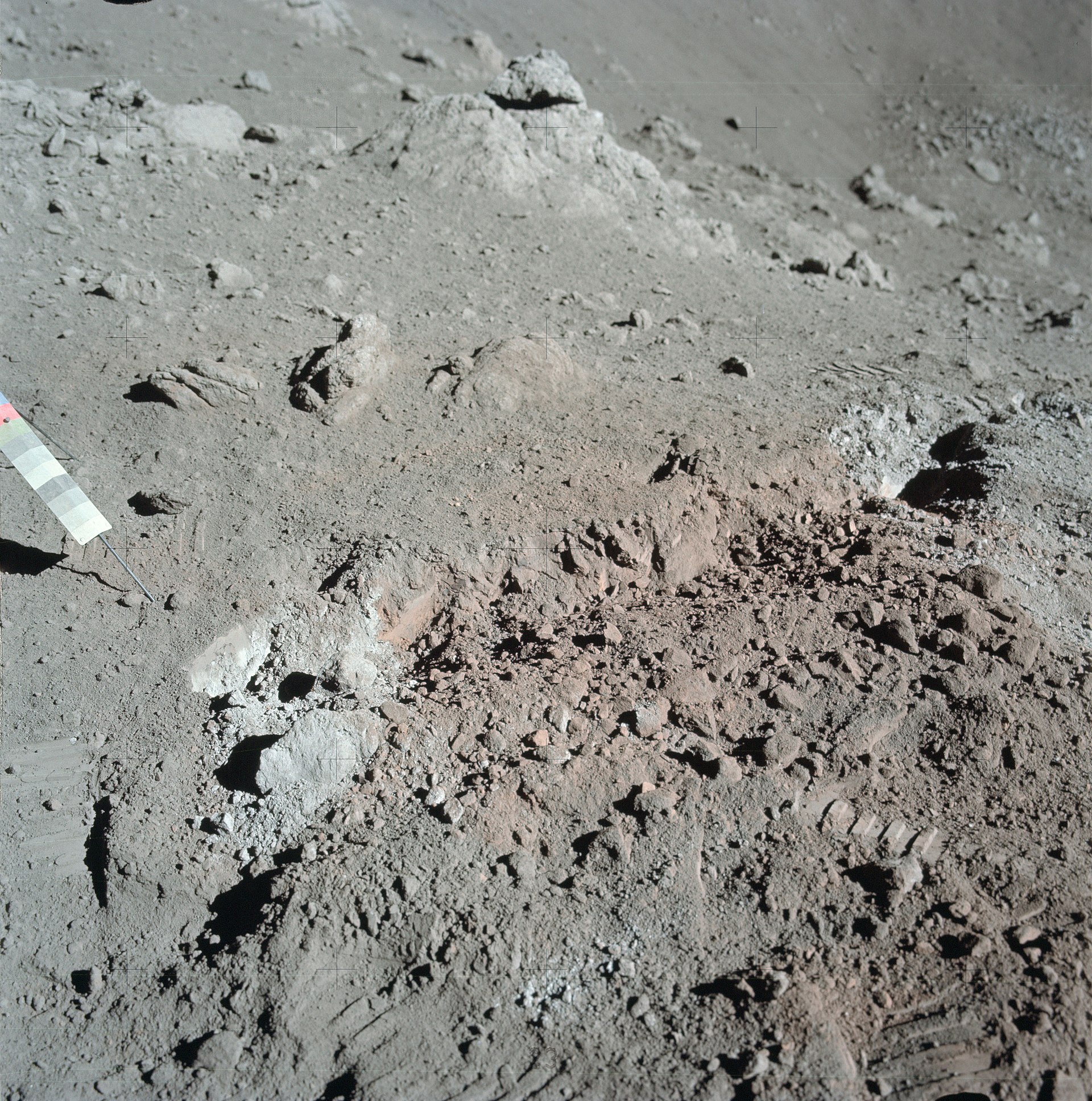
Deep inside, the Moon probably has a solid iron core, containing small amounts of sulphur and nickel. This is surrounded by a liquid iron outer core. The inner core makes up only about 20% of the Moon (compared to about 50% of the other rocky planets and moons). Above the core is the largest internal layer, the rocky mantle, which is about 1000 kilometres (600 miles) thick. In the past, magma from this hot, partly molten, mantle would have burst up through the crust in volcanoes. These created the lava plains we see today on the Moon’s surface, known as mare. The lava later cooled and solidified to form solid rock. All the Moon’s volcanoes became extinct.
Consultant: Mike Goldsmith
Other Q-&-As to explore:
For a full list of all our Q&As, please click here.
If you have a question that you would like to see answered on Q-files, please send us an email to info@Q-files.com or use the contact us page.
pics
Without in any way limiting Q-files Ltd’s exclusive rights under copyright, any use of this publication to “train” generative artificial intelligence (AI) technologies to generate text is expressly prohibited. Q-files Ltd reserves all rights to license use of this work for generative AI training and development of machine learning language models.