
Planets and moons

CITE
We have made every effort to follow citation style rules, but there may be some minor differences. If in doubt, please refer to the appropriate citation style manual.
Ganymede. (2026). In Q-files Encyclopedia, Space, Planets and moons. Retrieved from
https://www.q-files.com/space/planets-and-moons/ganymede
"Ganymede." Space, Planets and moons, Q-files Encyclopedia, 25 Mar. 2026.
https://www.q-files.com/space/planets-and-moons/ganymede.
Accessed 7 Aug. 2026.
Ganymede 2026. Space, Planets and moons. Retrieved 7 August 2026, from
https://www.q-files.com/space/planets-and-moons/ganymede
Space, Planets and moons, s.v. "Ganymede," accessed August 7, 2026.
https://www.q-files.com/space/planets-and-moons/ganymede


Ganymede
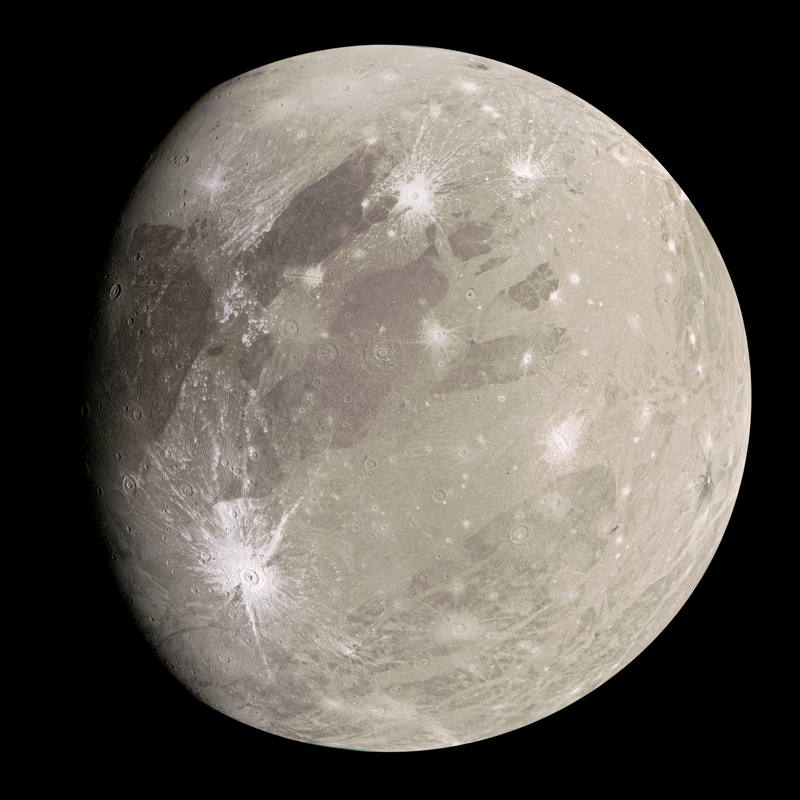
Jupiter's Galilean moon Ganymede, at 5268 kilometres (3273 miles) across on average, is the largest moon in the Solar System. It also has the greatest mass of any moon, more than twice that of Earth's Moon. It is the only moon known to have its own strong magnetic field. Ganymede has an icy surface with dark, cratered plains and areas showing strange “grooved” patterns, as if someone has clawed away at its surface with a giant fork. A saltwater ocean forms a layer a few hundred kilometres below Ganymede's surface, trapped between layers of ice. It may contain more water than all of Earth's oceans combined. Just possibly, Ganymede's ocean could host living things.
Orbit
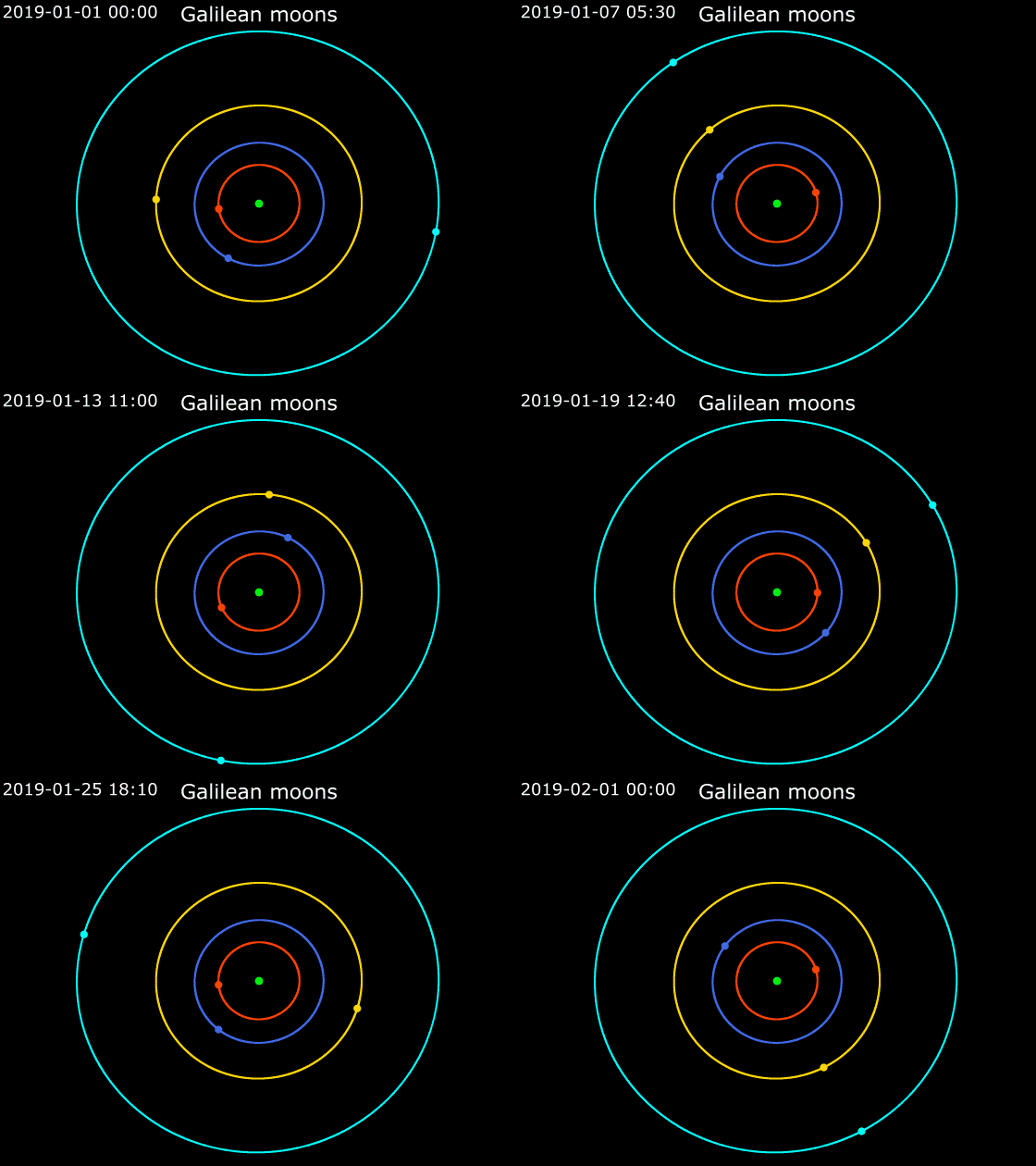
Ganymede orbits Jupiter at a distance of 1,070,400 kilometres (665,100 miles), third among the Galilean moons. It completes a revolution of its parent planet every seven days and three hours. As Ganymede orbits Jupiter, it participates in orbital resonances with two other Galileans: Europa and Io. For every orbit it completes, Europa orbits twice and Io orbits four times. Orbital resonance boosts the gravitational pull the bodies have on one another, forcing their orbits to become slightly elliptical, or eccentric.
Like the other Galileans, Ganymede is tidally locked, with one side always facing towards Jupiter. This means a day on Ganymede lasts exactly the same as its year, the time it takes to orbit Jupiter.
Surface
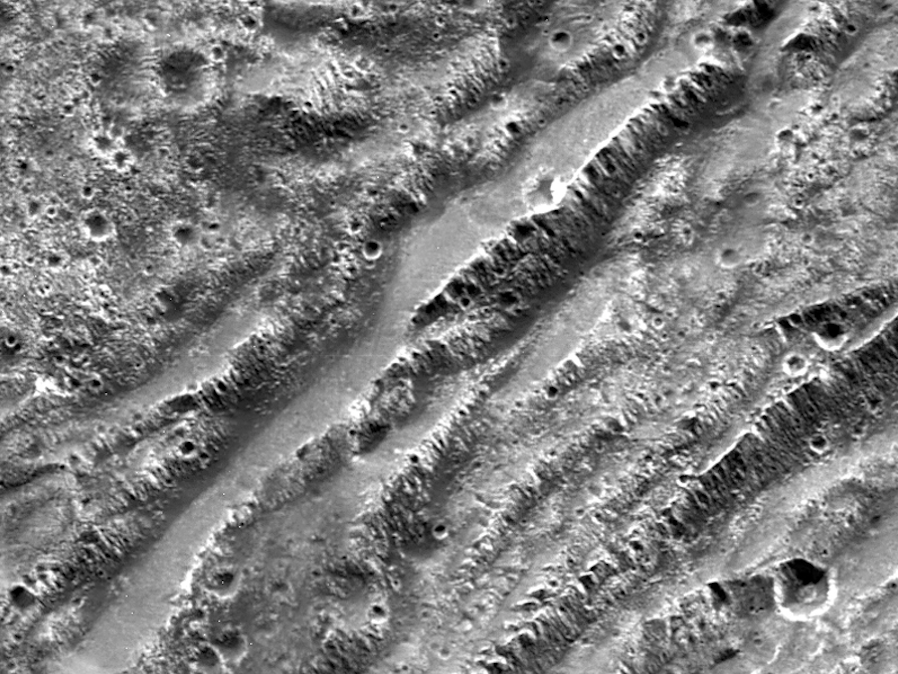
Ganymede's icy surface is a mix of darker and lighter regions. The darker regions—about one third of the moon's total surface area—are highly cratered. The surface contains clays and organic compounds, which could have originated from the asteroids and comets that crashed into it.
Ganymede's lighter regions are marked with extensive grooves and ridges. These may have been formed by movements in Ganymede's interior caused by tidal heating, the result of Jupiter's gravitational pull on the moon. Stresses and strains in the crust may have produced faults, the long grooves visible. Crustal movements could also have created ridges, where rocks are squeezed upwards between parallel faults. This is known as horst and graben faulting.

Composition
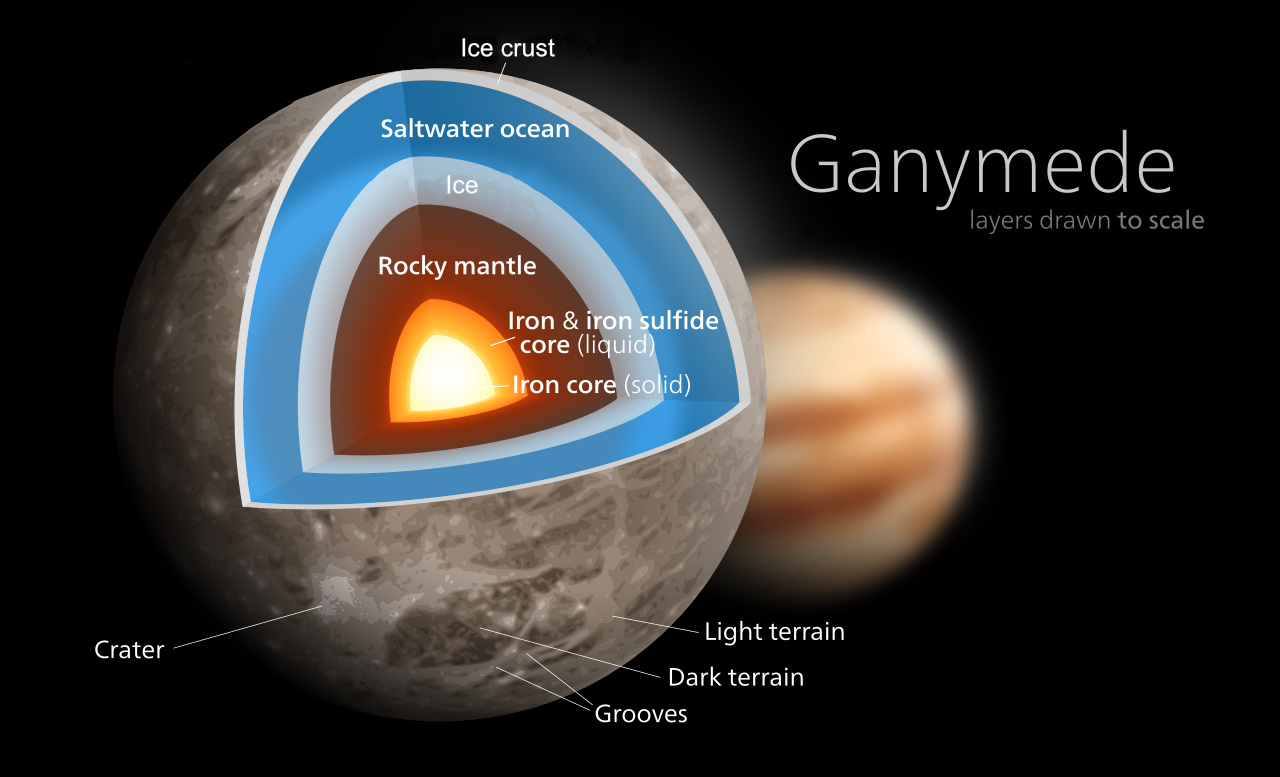

Ganymede is composed of rock and water in approximately equal proportions, although its crust may consist of up to 90% water ice. Its interior has layers in the same way Earth has, with a rocky mantle and an iron-rich core which is liquid on the outside and solid on the inside. As on Earth, the presence of a liquid metallic outer core explains the existence of a magnetic field. Convection currents, the movement of liquid metal circulating between the hot inner core and the cooler mantle above, generate electricity which, in turn, creates a magnetic field.
Ganymede's internal structure differs from Earth's in a key respect. Trapped between the icy crust and an icy layer deeper in the mantle is an ocean of salty liquid water. Ganymede’s ocean is estimated to be about 100 kilometres (60 miles) thick—10 times deeper than Earth's oceans—and is buried under a 150-kilometre (95-mile) thick icy crust.
pics

Without in any way limiting Q-files Ltd’s exclusive rights under copyright, any use of this publication to “train” generative artificial intelligence (AI) technologies to generate text is expressly prohibited. Q-files Ltd reserves all rights to license use of this work for generative AI training and development of machine learning language models.