
Planets and moons

CITE
We have made every effort to follow citation style rules, but there may be some minor differences. If in doubt, please refer to the appropriate citation style manual.
Venus. (2026). In Q-files Encyclopedia, Space, Planets and moons. Retrieved from
https://www.q-files.com/space/planets-and-moons/venus
"Venus." Space, Planets and moons, Q-files Encyclopedia, 25 Mar. 2026.
https://www.q-files.com/space/planets-and-moons/venus.
Accessed 22 Sep. 2026.
Venus 2026. Space, Planets and moons. Retrieved 22 September 2026, from
https://www.q-files.com/space/planets-and-moons/venus
Space, Planets and moons, s.v. "Venus," accessed September 22, 2026.
https://www.q-files.com/space/planets-and-moons/venus


Venus
Venus is the second planet from the Sun. About the same size as Earth, Venus is sometimes referred to as our sister planet. But these sisters have very little else in common. In fact, the planet named after the Roman goddess of love is almost certainly the nastiest place in the Solar System. Venus spins slowly on its axis, actually taking longer to complete one rotation than to circle the Sun. By contrast, its highest clouds race around the planet in just four days (nearer the surface they move more slowly through the thick atmosphere). Unlike all the other planets apart from Uranus, Venus spins not from west to east, but from east to west. No one knows why it spins “backwards”.


Atmosphere
Venus is shrouded in thick, unbroken clouds. They are made not of water but droplets of deadly sulphuric acid. Some 25 kilometres (15 miles) thick, the clouds prevent most sunlight from reaching the surface. But another kind of radiation from the Sun, infrared, does get through and Venus’s dense carbon dioxide atmosphere stops it from escaping. It is the same “greenhouse effect” as happens on Earth, but much more extreme. The result is a constant surface temperature of 464°C (867°F), the hottest in the Solar System. Even the heavy metal lead would melt in that heat.
Any water that once existed on Venus would have evaporated long ago. If any space explorer landing on Venus could somehow resist the heat, they would be suffocated by the unbreathable carbon dioxide air, dissolved by sulphuric acid and crushed by air pressure about 90 times that on Earth.

Life on Venus?
Thanks to its thick, blanket-like atmosphere, Venus has the same temperature day and night and everywhere between its equator and the poles—but only at the surface. About 50 kilometres (30 miles) up in the clouds, the pressure and temperature are roughly the same those on the surface of the Earth. Nutrients and liquid water are also found up here. Venus's clouds may consist of droplets of sulphuric acid, but we know that there are some microscopic living things on Earth that can survive on this chemical. Might it be that, in these more hospitable conditions, life exists in the clouds of Venus?
Seen from Earth
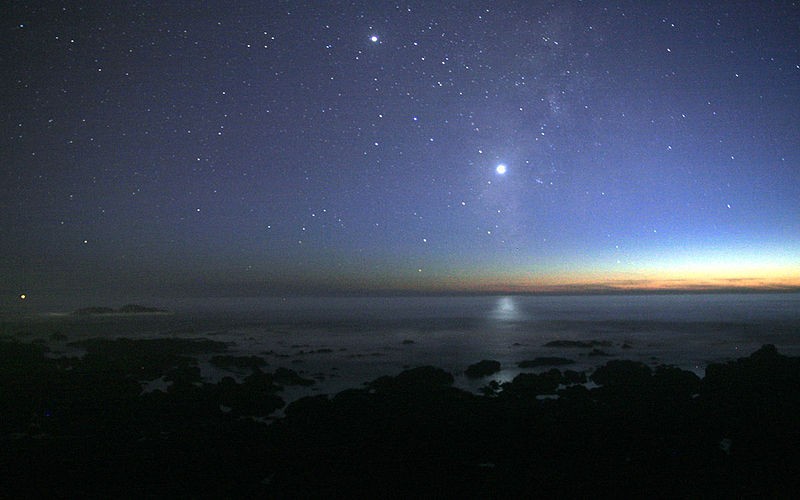
Because its cloud cover reflects the light of the Sun from its surface, Venus is a very bright object in the night sky, the brightest after the Moon. Like the Moon, it appears to us in a sequence of phases when it lies closer to the Earth than the Earth does to the Sun. Then, most of what we see is the night side of Venus; the part of the day side we see is a bright crescent.
This diagram shows the phases of Venus over the course of a month and a half. Venus is a full disc when it lies on the opposite side of the Sun to Earth. As it comes around to the near side between the Earth and the Sun, it becomes more of a crescent shape, getting thinner and thinner, but increasing in size as it does so. The first recorded observations of them were made by Galileo through his telescope in 1610.

Landscape
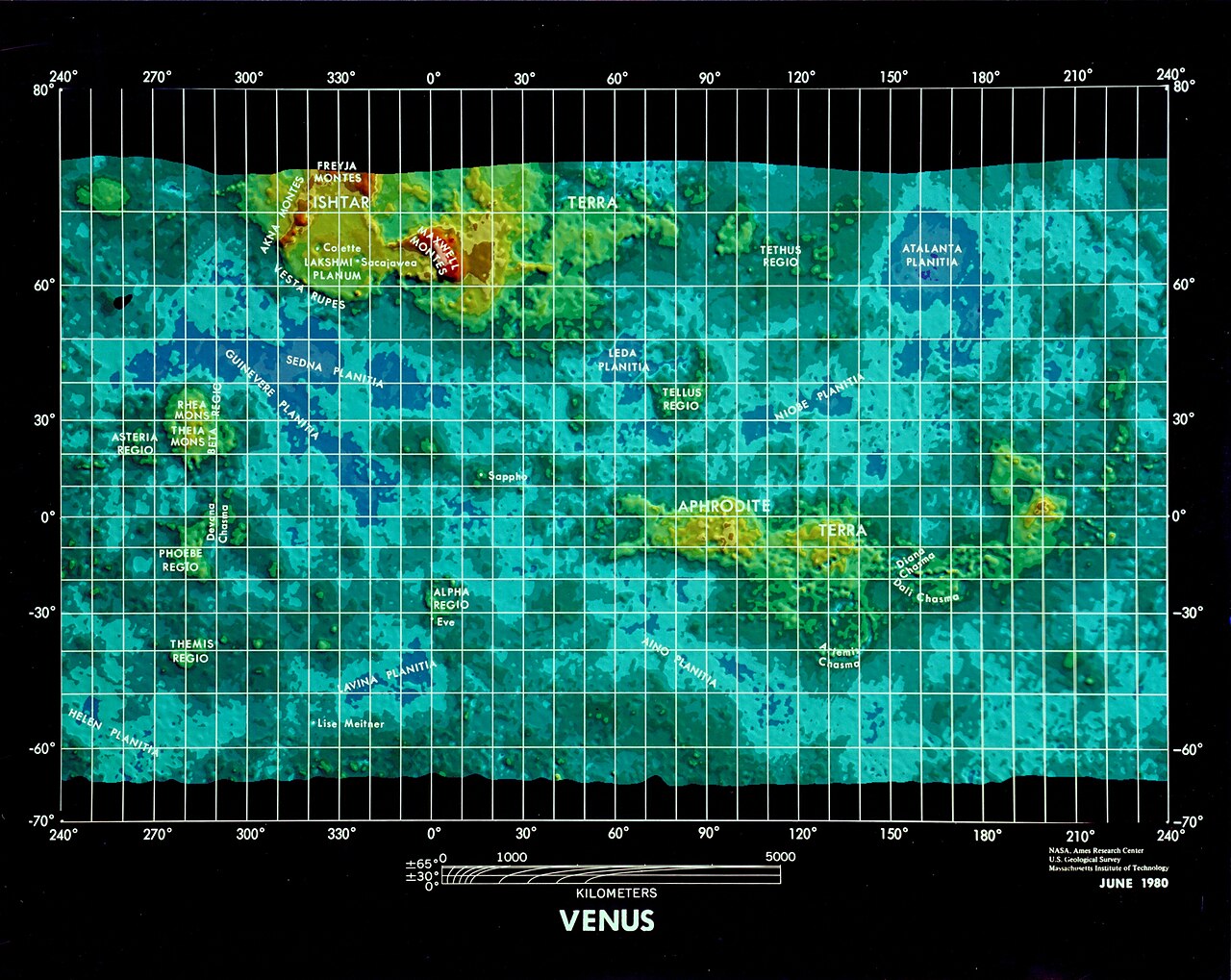
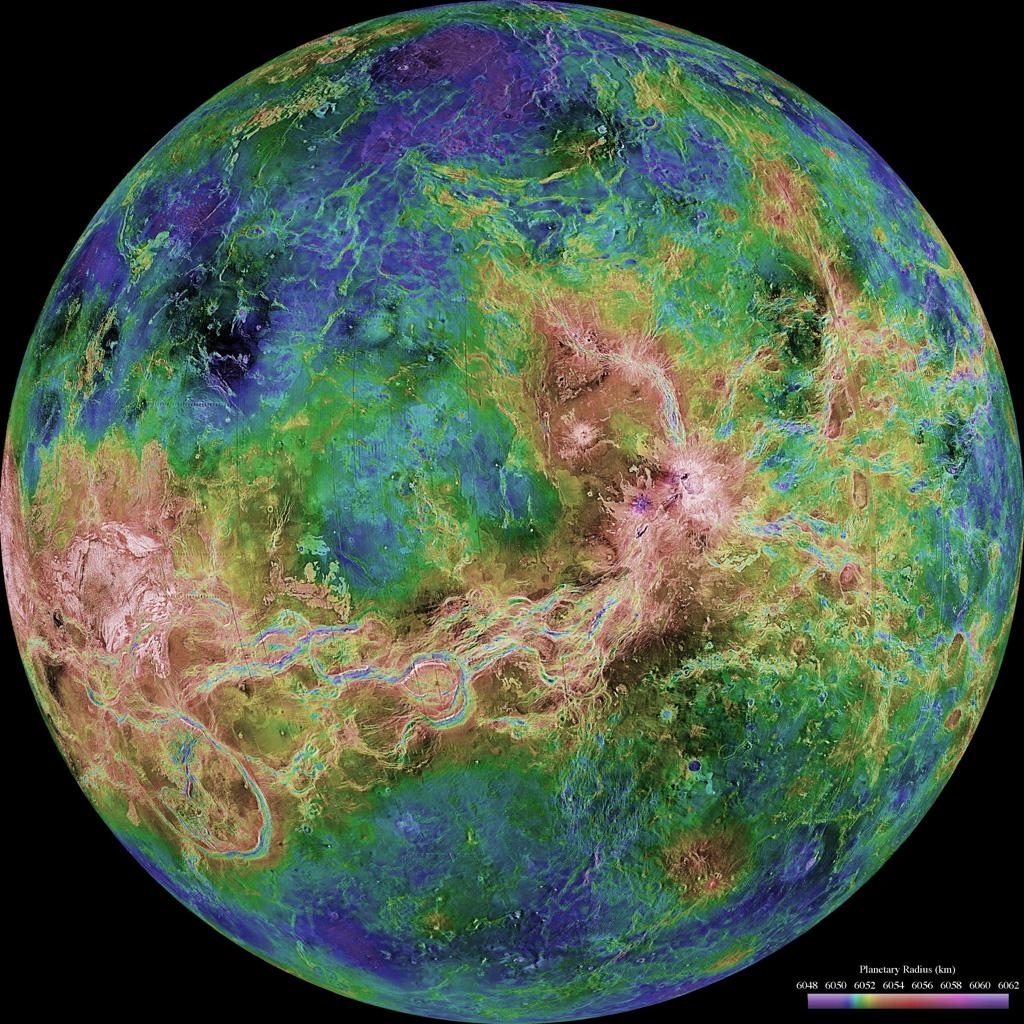
About 80% of the Venusian surface is covered by smooth lava plains, called planitia. Upland areas, including two large "continents", called terrae, and smaller areas, known as regiones, make up the rest. The northern continent is called Ishtar Terra after Ishtar, the Babylonian goddess of love, and is about the size of Australia. Maxwell Montes, the highest mountain range on Venus with a highest point of 11.5 kilometres (7 miles), lies on Ishtar Terra. The southern continent, called Aphrodite Terra after the Greek goddess of love, is the larger of the two continents at roughly the size of South America.

Much of Venus's terrae and regiones (for example, Alpha Regio), together with its smaller upland areas, are made up of what are known as tesserae. (A tessera is the name for an individual tile—usually square—used in creating a mosaic.) Tesserae amount to about 7% of Venus's total area. They come in a variety of shapes and sizes. Rising as plateaus from the surrounding lowlands, they are made of the planet's oldest rocks. They are highly deformed, meaning they are folded into ridges and valleys.
Volcanoes

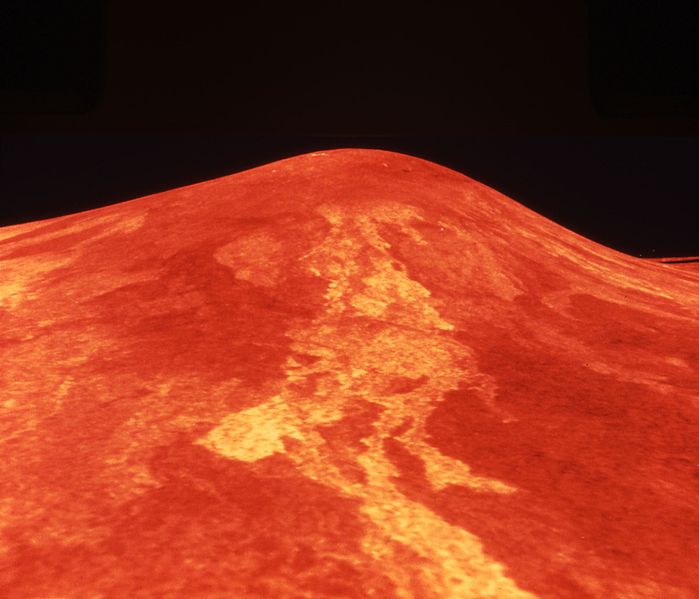
The Venusian surface is almost entirely the product of volcanic activity. Most of its more than 85,000 volcanoes have been extinct for about 500 million years—but not all of them: space probes have detected hot spots on the Venusian surface, which scientists think are evidence of lava recently released by erupting volcanoes.
Lava flows have cut channels in the ground that look similar to river channels. Weird, dome-shaped volcanoes (sometimes called “pancakes”) have been formed by lava oozing to the surface and cooling as it spreads in a circular pattern.
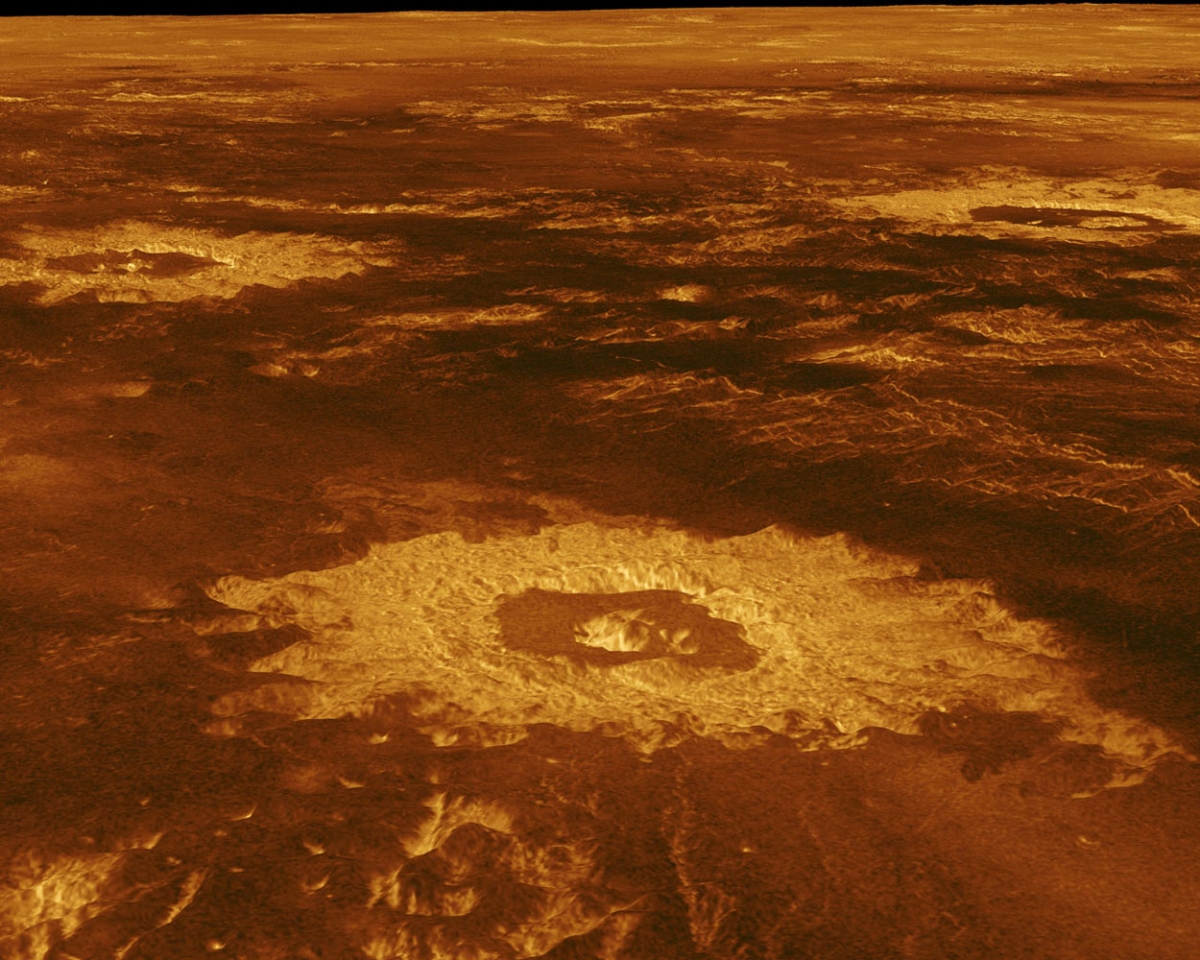
Impact craters
There are almost a thousand impact craters on Venus scattered evenly across its surface. Most of them are in a well preserved condition, indicating they are relatively recent (most craters on Mercury or the Moon, for example, are a result of bombardment billions of years ago). Scientists think that Venus has been resurfaced with fresh lava only a few hundred million years ago, removing evidence of earlier bombardment.
Venusian craters measure between 3 and 280 kilometres (2 to 174 miles) in diameter. No craters are smaller. This is because Venus's dense atmosphere causes smaller meteoroids to burn up high in the sky before reaching the ground.
Tectonic activity
The patterns of ridges and grooves seen on Venus suggest that the planet's surface is divided into "blocks" which appear to have moved against one another like pack ice on a frozen sea. On Earth, the Sichuan Basin in southeastern China and the Amadeus Basin in central Australia—low-lying areas surrounded by small mountain ranges, just as on Venus—are among a number of examples of similar topography. Scientists think it is possible the movement was caused by flowing liquid rock in the underlying mantle. This would mean that there has been some kind of tectonic activity on Venus, either recently or in the distant past.

Venusian snow
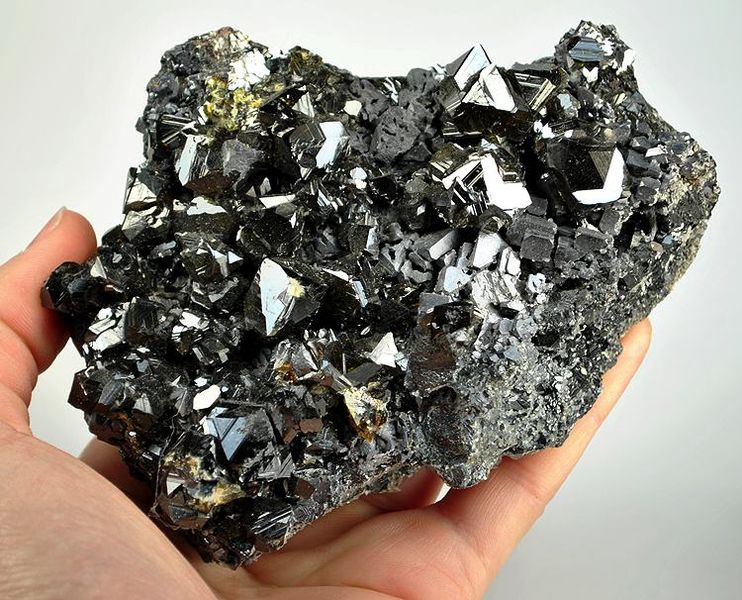
Images of Venusian mountains reveal the existence of much brighter areas at altitudes above 2600 metres (8500 feet). It is as if they are covered with snow. We know it is not water ice, which cannot exist in the extremely hot and dry conditions. The most likely explanation is that galena, the crystal form of lead sulphide (or another metallic compound), found in lower altitudes on Venus, may evaporate (sublimate) in the heat and condense in the slightly cooler highlands, forming silvery-coloured deposits on the ground. This would mirror exactly what happens on Earth with water evaporating and falling as snow on mountaintops.
Imaging the surface
How could images be made of Venus’s surface, permanently obscured by thick cloud? The answer was to use radio waves instead of light waves. The space probe Magellan, launched in 1989, was equipped with radar, the same device used by ships and aeroplanes to detect other craft hidden by cloud or water.
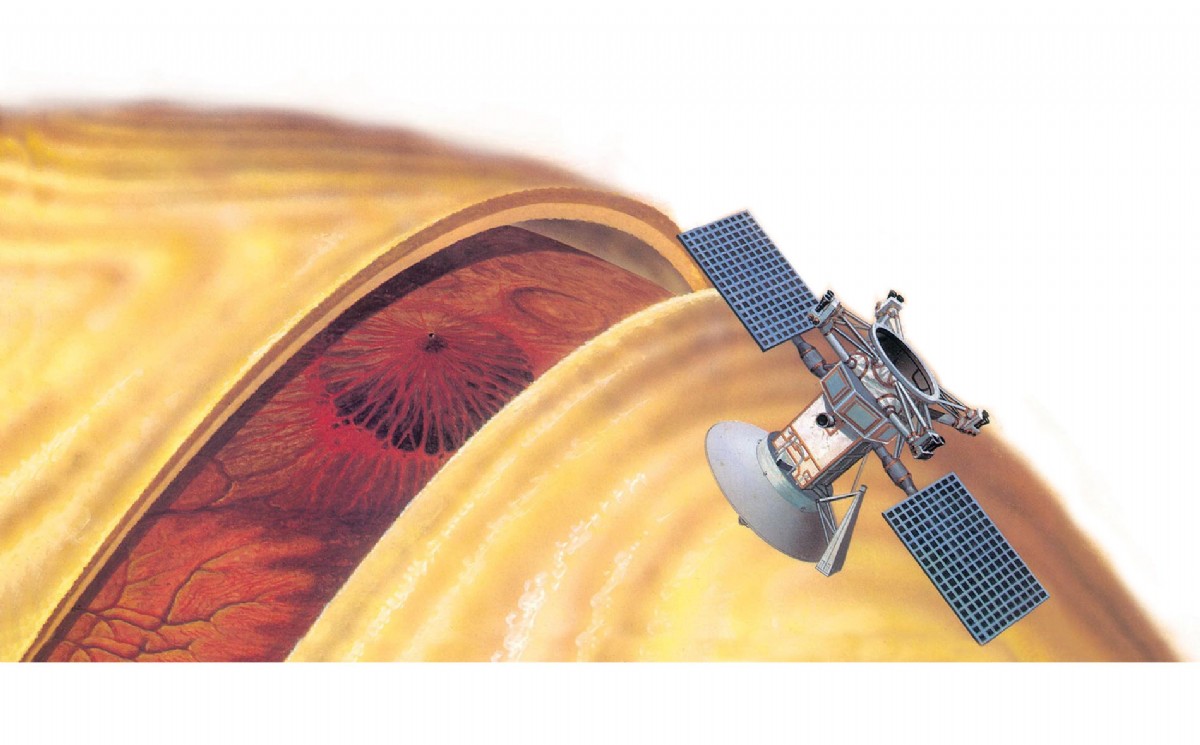
An instrument aboard Magellan sent out billions of radio signals that travelled down through Venus's dense cloud cover, bounced off the surfaces of rocks, cliffs, volcanoes and other landscape features and travelled back to the space probe, where they were picked up by antennae. Computers converted the radio wave reflections into three-dimensional maps and sent them back to Earth. Orbiting the planet repeatedly, Magellan slowly built up a map of the entire globe of Venus.

Transits of Venus
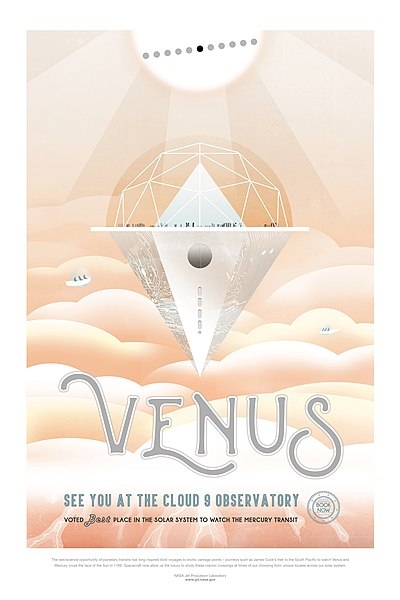
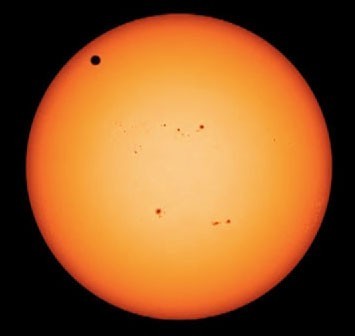
Because Venus's orbit is slightly tilted relative to the Earth's orbit, it does not usually cross the face of the Sun (in what is known as a transit) as viewed from the Earth. Transits of Venus do occasionally take place every few hundred years—and occur in pairs separated by eight years. The latest pair was June 2004 and June 2012. The following pair will occur in December 2117 and December 2125. Captain Cook explored the coast of Australia after he had been ordered to sail to Tahiti to observe a transit of Venus in 1768.
Composition
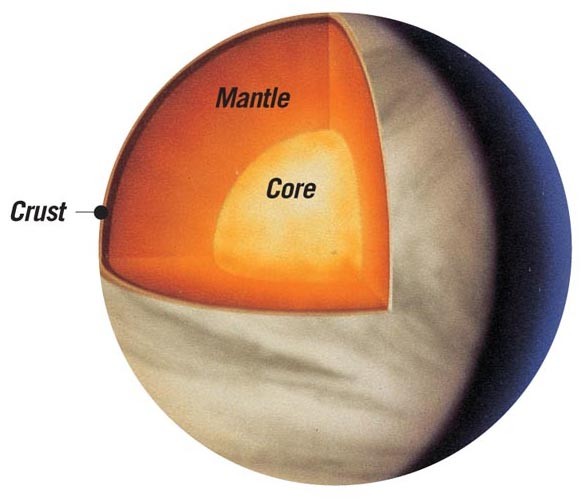
The interior of Venus is quite similar to that of Earth, with a core, mantle and crust. Its core is much larger, and, like that of Earth, at least partially liquid. The Venusian crust is much older than the Earth's, and much more rigid, probably without tectonic plates (but possibly with tectonic activity of some sort, at least in the past). Venus's magnetic field is much weaker than that of Earth's, but astronomers are not sure why that is, given the two planets' similar size and internal structure.
Venus's story
Venus was strikingly similar to Earth for much of its history. Around four billion years ago, the young planet's crust cooled and gases started to bubble up from beneath its surface to form an atmosphere. These gases included water vapour. Rainwater later fell on Venus, eventually creating vast shallow oceans across much of the planet. Perhaps in these stable conditions life could have taken hold on Venus as it did on Earth.
This situation started to change, however, as large amounts of water vapour started to build up in Venus’ atmosphere, due to the evaporation of the oceans caused by the gradual increase in the heat of the Sun. The accumulation of water vapour eventually led to a runaway greenhouse effect: less and less of the Sun's heat escaped back into space, causing global warming. (Global warming on Earth is caused by the build-up of carbon dioxide in the atmosphere, but on Venus, where carbon dioxide forms 96.5% of its atmosphere, it was extra water vapour that led to warming.)
Factfile
Average diameter: 12,105 km (7519 miles)
Mass: 0.81 (Earth = 1)
Average density: 5.2 (water = 1)
Surface gravity: 0.9 (Earth = 1)
Day: 117 days
Year: 225 days
Average speed in orbit: 35 km/sec (22 miles/sec)
Average distance from the Sun: 108 million km (67 million miles)
Surface temperature: 464°C (867°F)
Atmosphere: carbon dioxide, traces of nitrogen
Number of moons: none
Name: the Roman goddess of love

Consultant: Mike Goldsmith
pics

Without in any way limiting Q-files Ltd’s exclusive rights under copyright, any use of this publication to “train” generative artificial intelligence (AI) technologies to generate text is expressly prohibited. Q-files Ltd reserves all rights to license use of this work for generative AI training and development of machine learning language models.