
Romans

CITE
We have made every effort to follow citation style rules, but there may be some minor differences. If in doubt, please refer to the appropriate citation style manual.
Life in the Roman Empire. (2023). In Q-files Encyclopedia, History, Romans. Retrieved from
https://www.q-files.com/history/romans/life-in-the-roman-empire
"Life in the Roman Empire." History, Romans, Q-files Encyclopedia, 30 Aug. 2023.
https://www.q-files.com/history/romans/life-in-the-roman-empire.
Accessed 26 Oct. 2026.
Life in the Roman Empire 2023. History, Romans. Retrieved 26 October 2026, from
https://www.q-files.com/history/romans/life-in-the-roman-empire
History, Romans, s.v. "Life in the Roman Empire," accessed October 26, 2026.
https://www.q-files.com/history/romans/life-in-the-roman-empire


Life in the Roman Empire
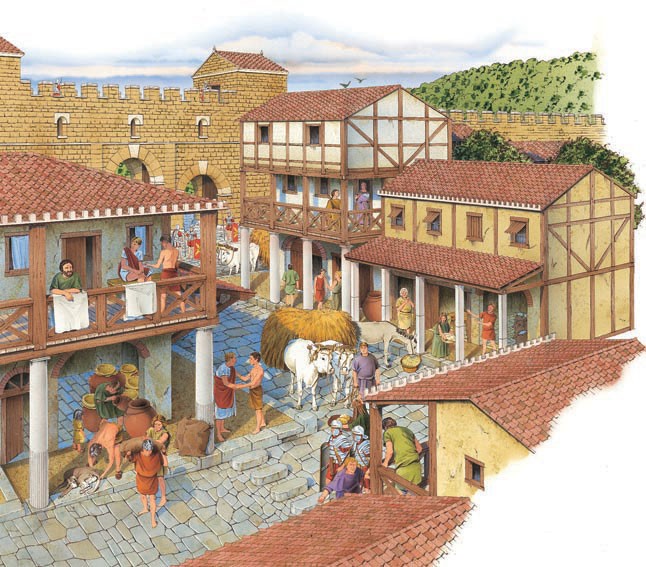
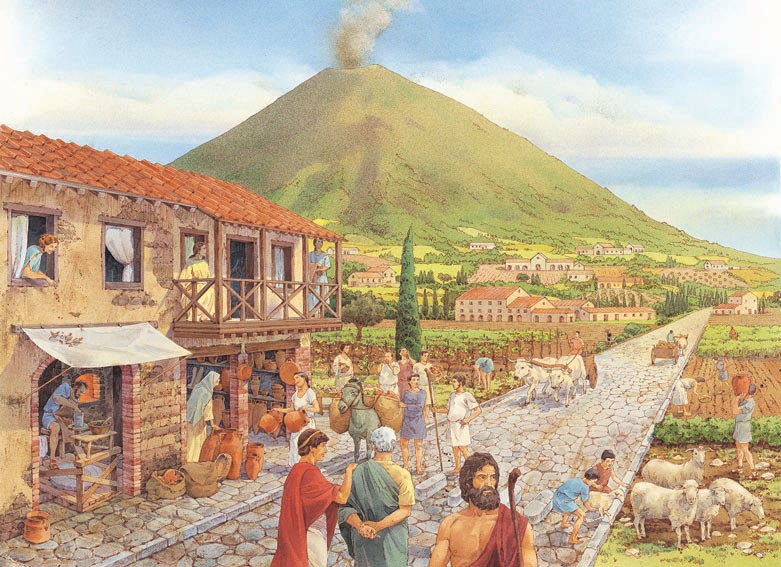
Roman streets were laid out in a grid pattern around the forum, a central meeting square. The basilica, or town hall, and a large public temple overlooked the forum. Each town would have its own bathhouse, theatre, amphitheatre and circus (race circuit). There were also lots of shops, bars, restaurants and craft workshops. Farmers from the countryside brought their produce into the towns to sell at the market. Wealthy Romans lived in comfortable, spacious townhouses or countryside villas, but poor people lived in small and cramped apartments, called insulae.

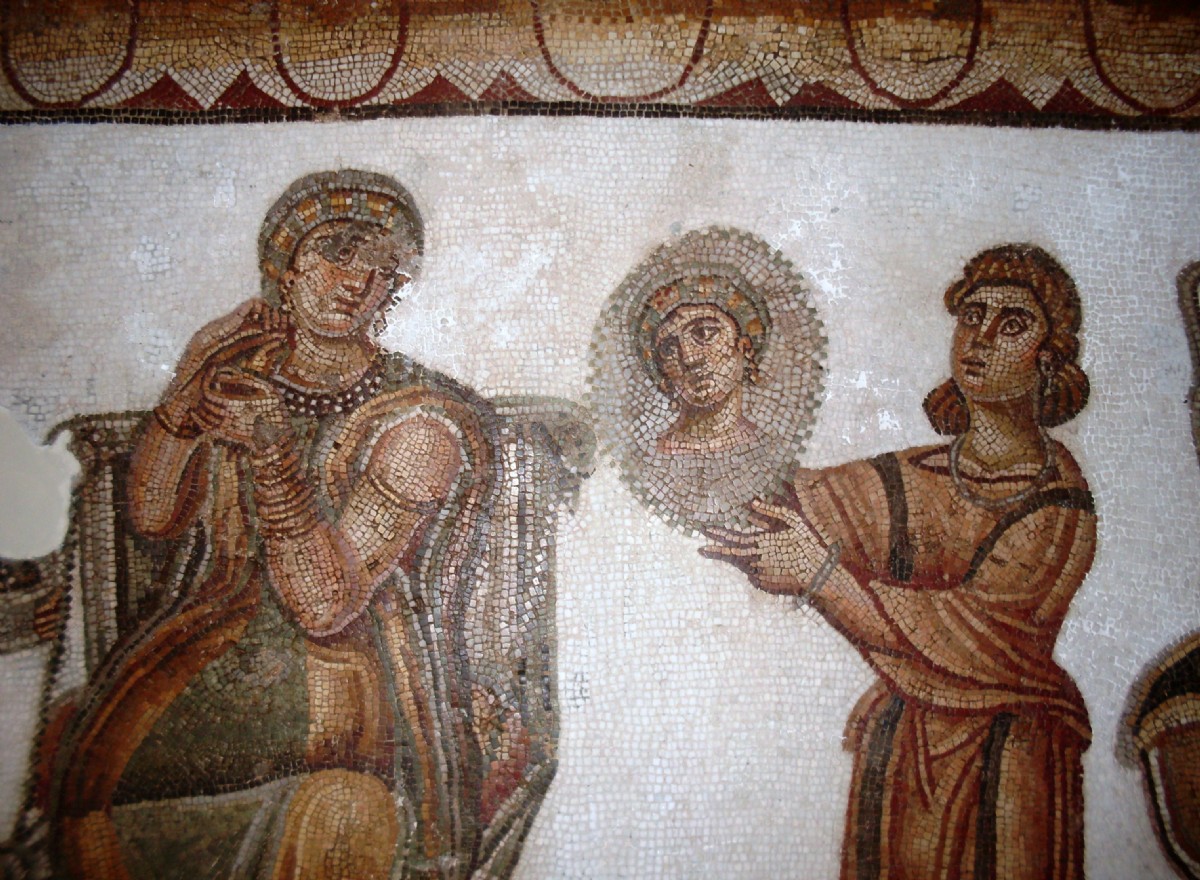
Patricians and plebeians
Roman citizens were divided into two groups. Those descended from noble families were called patricians. All other citizens were plebeians. Gradually a third class emerged, called equestrians (those with enough wealth to provide their own horse). These citizens formed a middle order between patricians and plebeians.
The wealthiest Roman families lived in elegant townhouses, called domus, while others lived in apartment blocks, called insulae. Slaves could not be citizens.
Apartments

Apartment buildings, called insulae, were several storeys high. Poorer families lived in small rooms at the top, while the better-off had large, comfortable rooms on the lower floors. Shops and bars occupied the ground floors of buildings. Most apartments had no running water or toilets, so people used public baths and lavatories, and fetched fresh water from public fountains on street corners. Apartments had no stoves for cooking either, because the risk of fire in these buildings was too great. For a hot dinner, Romans bought takeaways from a thermopolium (snack bar).
Health and hygiene
Roman towns had drains and sewers, but waste was still dumped straight into the street. People crossed streets using stepping stones to avoid getting too dirty. The wealthiest Romans travelled by carriage or in litters (portable chairs) carried by slaves. Clean water was brought into the town from a nearby river or lake through a system of pipes and channels. Because no one knew what caused diseases, Romans blamed evil spirits. Pharmacists made medicines from herbs and minerals. Keeping healthy and clean from frequent visits to the baths was the best remedy.

Meals

The Romans took three meals a day. Poorer families might have a breakfast of bread or biscuits. Better-off Romans enjoyed fresh meat, fish, fruits and vegetables. They used honey to sweeten their food. Lunch was often a cold meal, eaten in the late morning. It usually consisted of bread, fruit, nuts, cheese, olives and salad. After lunch, the Romans enjoyed a midday rest, or siesta. Dinner was eaten at sunset. For the poor, this meal might be a hot wheat porridge, vegetables, fruit and—very rarely—meat. For the rich, dinner was a lavish three-course meal with a variety of meats and fish, accompanied by fine wine.

Bakeries
Bread was a very important part of a Roman’s diet. Roman bakers not only baked and sold bread, but they also ground the grain to produce their own flour. The grain was poured into the funnel at the top of the mill. The upper stone was turned by pushing against a wooden beam. The grain was ground between the turning stone and a fixed one. The flour then fell on to a circular shelf ready for making dough and baking.
Craftworkers
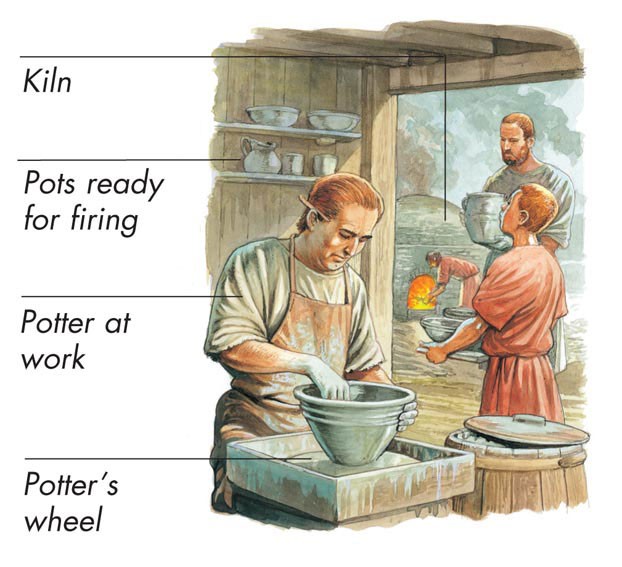
Slaves did all the labouring work in a Roman town, so most ordinary Roman citizens earned their living as shopkeepers or craftworkers. Craft shops were run as family businesses. They produced a wide range of goods and included clothmakers, basketweavers, carpenters, potters and blacksmiths. Skilled Roman craftsmen also produced luxury goods from glass, gold and silver.
Most pottery was made locally. It was usually one colour, and decorations were moulded into the clay. Pots were made on a potter’s wheel or by pushing the clay into plaster moulds.
Reading and writing
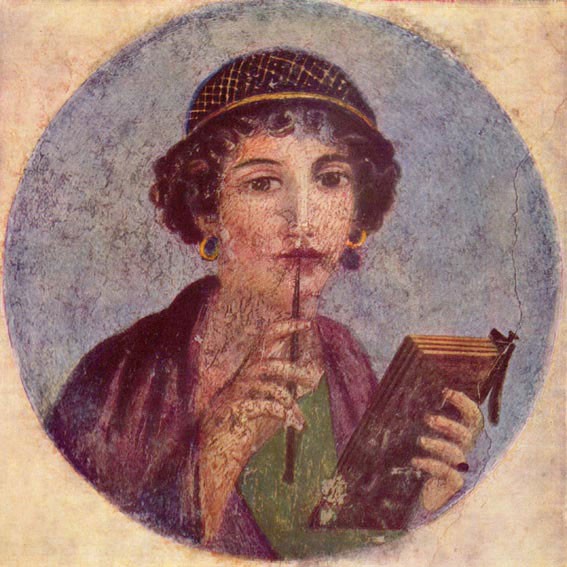
The ability to read and write was highly valued, although no more than a third of people across the empire could do so. The amount of documents, military records and public inscriptions shows how important the written word was. The abundance of graffiti on walls—often mis-spelled—is evidence that many ordinary townspeople were literate. Although books were expensive (printing had not been invented, so each was hand-produced), some wealthy collectors built up personal libraries of codices: books made up of sheets of paper and bound with spines.
Money
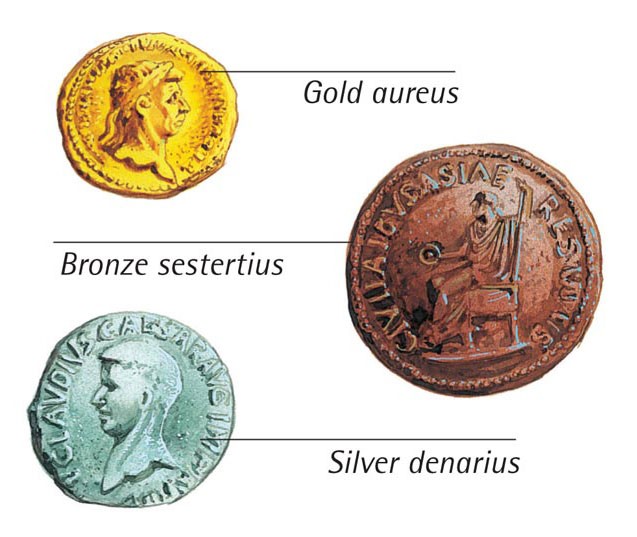
After they were introduced in around 300 BC, Roman coins were used across the whole empire. People bought things for a set price rather than by barter and exchange of goods. Julius Caesar was the first Roman ruler to put his image on a coin: later Roman coins nearly always featured a picture of the emperor.
Everyone in the empire had to pay tax—a portion of their wealth. Some of this went back to Rome, but some was spent locally, for example on building roads. Tax would be taken in the form of crops, goods or coins.

Slaves
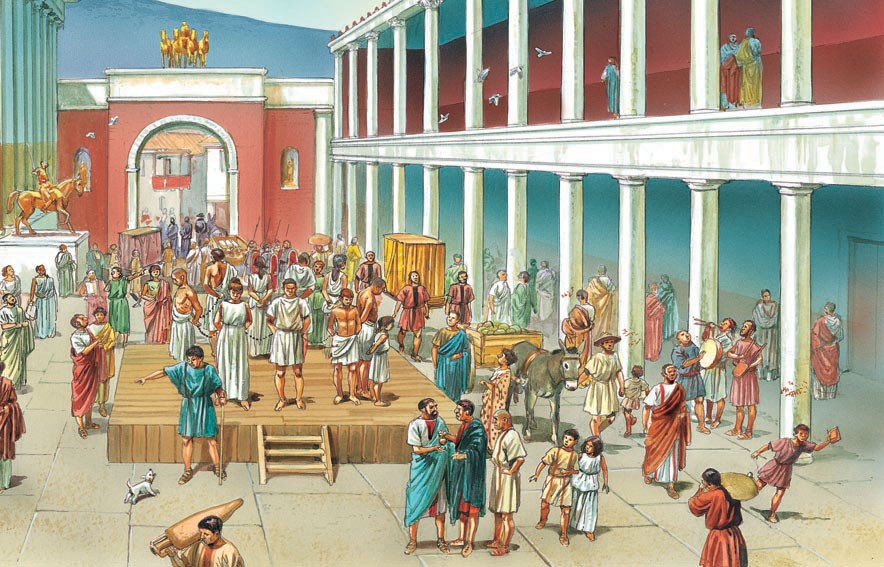
Slaves were men and women with no rights—mostly prisoners captured in battle. They could be bought or sold at a slave market. Slaves did all the labouring work in a Roman town. In the homes of wealthy Romans, they cooked, cleaned and looked after the children. A rich man might have as many as 400 slaves working for him. Slaves were not Roman citizens, so they could not vote.
Buildings

Houses were often made of wattle and daub. Timber frames had panels of woven twigs between them (wattle) while the panels were covered with plaster (daub), then painted. This was a quick and easy way to build, but the wooden structure could easily catch fire. Curved, red-pottery pan-tiles were used to roof most Roman houses. Grand public buildings were made from more hard-wearing materials, such as concrete, brick and stone.
Religion

The Romans worshipped many different gods and goddesses, believing that each one controlled a different aspect of their lives. For example, Neptune was the god of the sea and Vesta was the goddess of the home. The king of the gods was Jupiter. This form of worship remained widespread even after Emperor Constantine converted to Christianity and ended persecution of Christians across the empire in AD 313.
Temple
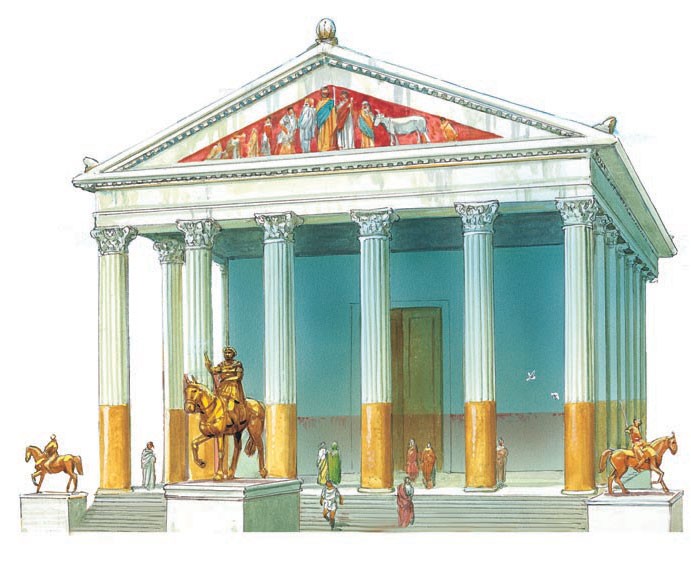
All Roman towns and cities had temples for worship. Every day, Romans took offerings of food, flowers or money, which was kept by priests. The main room of a temple had an image of the god or goddess to whom the temple was dedicated. There was often a small altar for burning sweet-smelling incense. Behind the main room were smaller rooms used by the temple attendants and for storing offerings. Each Roman home also had a room, or shrine, dedicated to its household god—a god that looked after the house and its occupants.

Consultant: Philip Parker
pics
Without in any way limiting Q-files Ltd’s exclusive rights under copyright, any use of this publication to “train” generative artificial intelligence (AI) technologies to generate text is expressly prohibited. Q-files Ltd reserves all rights to license use of this work for generative AI training and development of machine learning language models.