
Crafts

CITE
We have made every effort to follow citation style rules, but there may be some minor differences. If in doubt, please refer to the appropriate citation style manual.
Pottery. (2026). In Q-files Encyclopedia, Culture, Crafts. Retrieved from
https://www.q-files.com/culture/crafts/pottery
"Pottery." Culture, Crafts, Q-files Encyclopedia, 13 May. 2026.
https://www.q-files.com/culture/crafts/pottery.
Accessed 31 Oct. 2026.
Pottery 2026. Culture, Crafts. Retrieved 31 October 2026, from
https://www.q-files.com/culture/crafts/pottery
Culture, Crafts, s.v. "Pottery," accessed October 31, 2026.
https://www.q-files.com/culture/crafts/pottery


Pottery
Pottery is the name given to objects made from clay, such as bowls and plates, pots, cups, teapots and vases. Pottery is also the name of the craft of producing these objects in a ceramics studio or workshop. A person who works in a pottery studio is called a potter. Ceramic tiles and household objects such as flowerpots, toilets and basins are also types of pottery. One of the oldest human activities, the remains of pottery have been found in every civilization on Earth. Some of the oldest pottery ever found was made by Japan's ancient Jōmon people around 16,000 years ago. Today, archaeologists study pottery as a useful way of finding out about the way people lived in ancient times.


Clay
Pottery is made from clay, a soft, sticky mixture of minerals. In its natural, moist state, clay is soft and easy to shape. When it dries, it becomes hard, and when it is heated by a process called firing, it changes permanently into a hard material called ceramic.
Different kinds of clay are used to make different types of pottery. Earthenware was the most common type of pottery until the 18th century. Earthenware is pottery that has been fired so that it is still porous (contains holes). It is fired at temperatures of up to 1200°C (about 2200°F). Terracotta flowerpots and bricks are examples of earthenware.
Stoneware is made from clay that has been fired to an even higher temperature (between 1100–1300°C or about 2000–2400°F) so that it becomes waterproof. Fired stoneware usually has a light greyish colour.

Porcelain is clay that has been heated along with other minerals such as kaolin to reach temperatures of 1200–1400°C (2200–2600°F). When it is fired, it is naturally white. Because of its strength, porcelain can be used to make thin, delicate pieces of pottery. These are translucent when held up to the light. The method for making porcelain was first discovered in China around 2000 years ago, which is why the term “china” is used in English to refer to all types of fine pottery. Bone china was first developed in England in the 18th century. It is made from clay mixed with kaolin and bone ash. Bone china is strong even when fashioned thinly, and has a natural whiteness and translucency.
Making pottery
One of the simplest types of pot—known as a “thumb" or "pinch" pot—is made by pressing a dent into a ball of clay and pinching outwards to form a round pot. Another simple pot is a coil pot, which is made by rolling a piece of clay into a long snake-like piece and coiling it round and round on itself until a pot is formed. Coiling was the main way of making pots for thousands of years.

Smoother and finer clay pieces are made on a potter’s wheel. This is a turntable which the potter spins by pressing down on a foot pedal. As the wheel spins, the potter shapes the clay with his or her hands. Pottery made in this way can be almost perfectly round.


Some pieces, such as teapots, are too complicated to form on a potter’s wheel. These are usually made by a process called slip casting. Liquid clay, known as "slip", is poured into a mould and left to set. Hollow objects can be made by using two moulds, one for each half. As soon as the clay is set, the moulds are removed and the two halves joined together to form the single piece. Once dry, it is ready to fire in a kiln.
Kiln
Clay becomes hard ceramic when it is heated to a very high temperature—above 600°C (about 1100°F). This process is called firing, and it is done using a kiln, a special oven designed to fire clay pots. Modern kilns can reach temperatures of up to 1500°C (about 2700°F).
Most ceramic pieces are fired in the kiln twice. The first firing, called “biscuit” firing, dries the clay out completely. The clay is heated slowly, because heating too quickly could cause any water left in the clay to escape suddenly as steam, which could make the pots explode. At 499°C (930°F), the clay starts to solidify and it becomes hard ceramic.

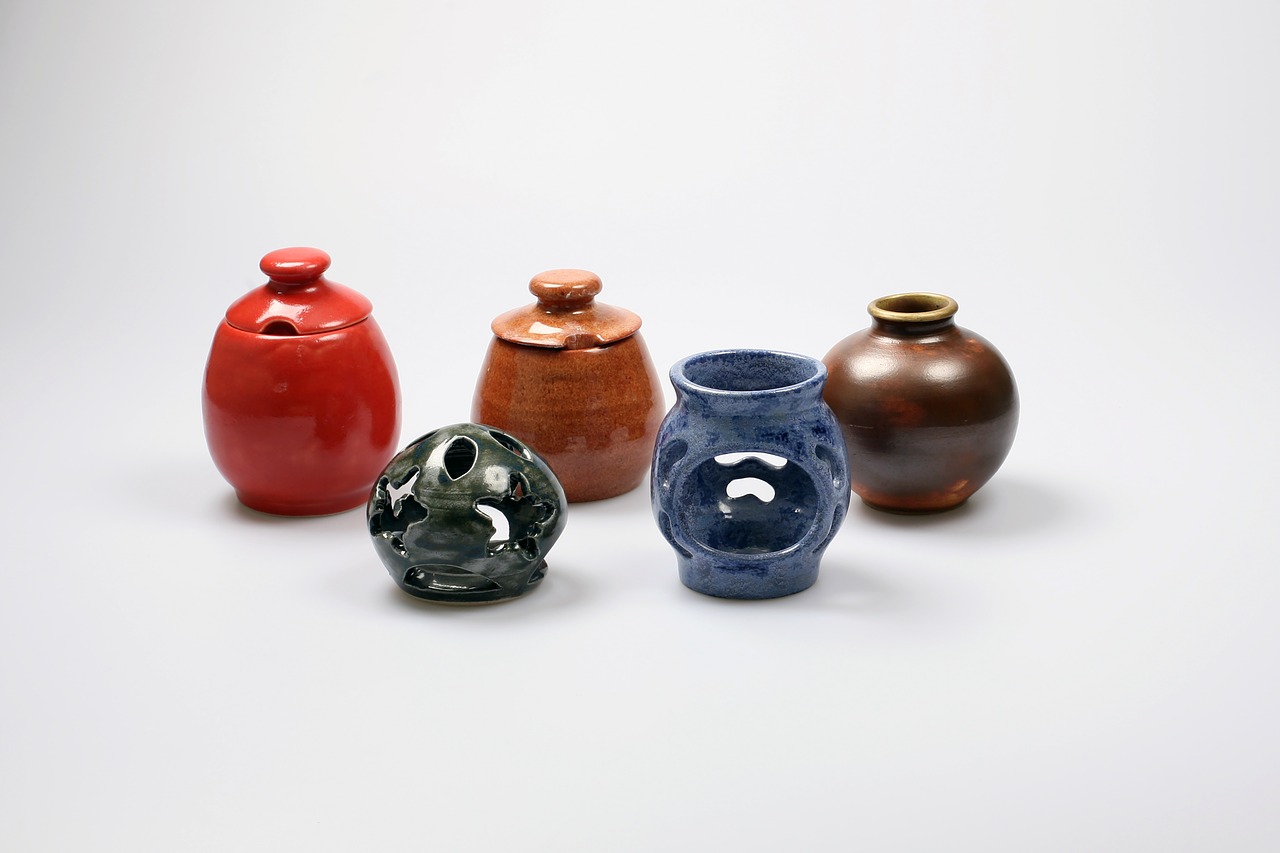
Glazing
After pottery has been biscuit fired, it is ready to be glazed. Glazing gives the pot its shiny coating. Glaze is a mixture of finely powdered glass. It is usually clear, but different pigments can be mixed with it to make coloured glazes. A piece of pottery can be painted before a layer of glaze is applied over the top of the design. Then the pot is fired again to fix on the glaze.
Decorating
The oldest method of decorating pottery is to paint the design straight on to the piece between the first and second glazes. Turning the piece on a potter's wheel can help the potter to paint even bands of colour on a striped bowl or vase. Another ancient method still in use today is decorating with coloured slips (mixtures of liquid clay). Scratching designs into the coloured coating is a type of decoration called sgraffito.
Transfer printing, invented in the 1750s, is a way of applying designs to pottery. The designs are printed on to tissue paper then transferred, sticky-side-down, on to the ceramic surface. This technique replaced the slow work of hand painting pots, making it possible to mass-produce decorated pieces commercially.


The decoration of a finished piece can be added using the firing process itself. Raku is a traditional Japanese technique that became popular in the West in the 20th century. In raku firing, a biscuit-fired piece is coated with mineral glazes before being fired in the flames of a combustion chamber. Once it is red hot, the piece is removed and cooled very quickly by plunging it into straw, sawdust or water. The oxidation that takes place in the chamber combined with the sudden cooling process causes the glazes to react in unpredictable ways and gives each piece a unique crackled appearance. Some potters add horsehair or other organic materials to the surface of the pots as they cool to create unusual effects.
Ancient pottery
Some of the oldest artefacts we have today are pieces of pottery made in ancient times. The first kilns were fire pits dug in the ground and stacked with pots. Some of these kilns could reach temperatures of 900°C (1650°F).
In the 1st and 2nd centuries AD, the Romans built kilns into sloping hillsides. With a fire burning at the bottom of the slope, the heat at the top of these chambers could reach up to 1300°C (2400°F), hot enough to fire porcelain. These ancient kilns were enormous, holding thousands of pots at a time. A classic piece of both ancient Greek and Roman pottery was the amphora, a two-handled clay jar designed to hold olive oil, water or wine.
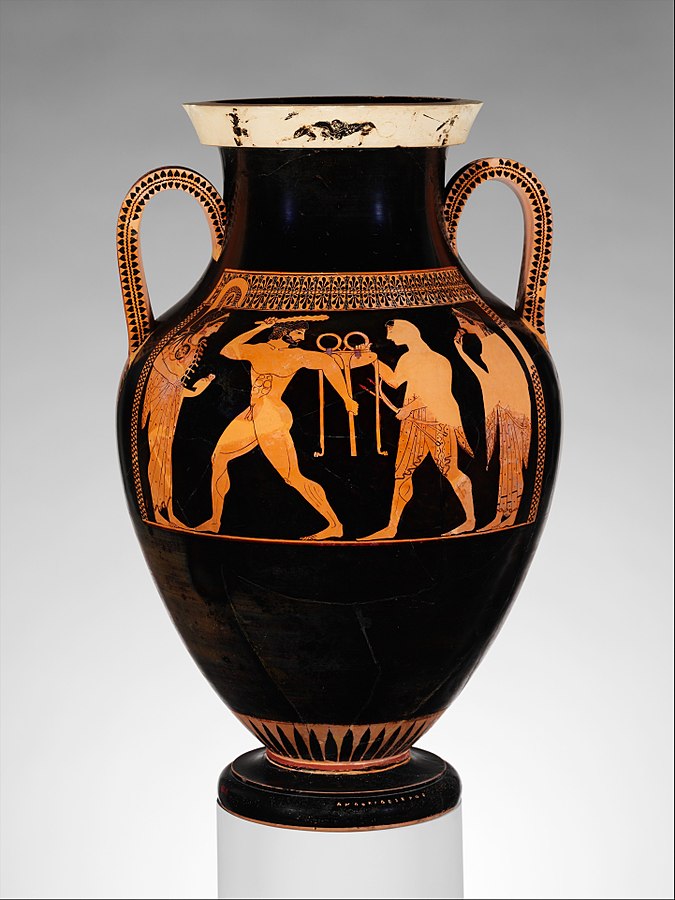
Wedgwood
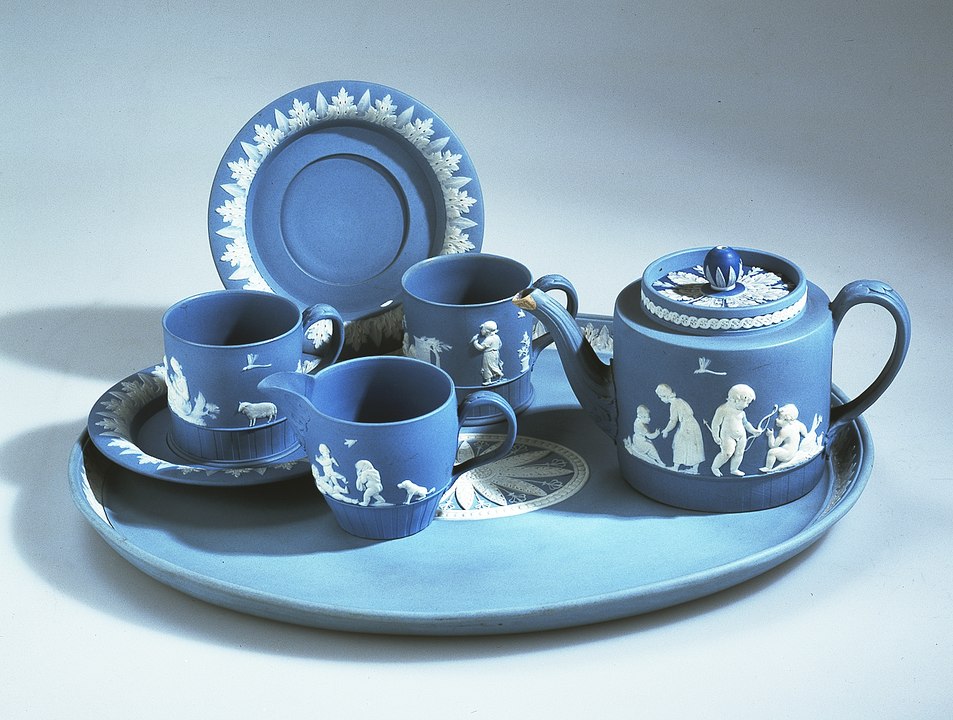
Josiah Wedgwood (1730–95) was a British potter who, during the Industrial Revolution, started to produce pottery on an industrial scale, one of the first to do so. From the 1770s, he made plates, vases, tea sets and ornaments in his factory in Burslem, a town in a part of Staffordshire that became known as the Potteries, with a range of designs inspired by ancient Egyptian, Greek and Roman pottery. Wedgwood pottery became hugely popular all over the world.
Potters
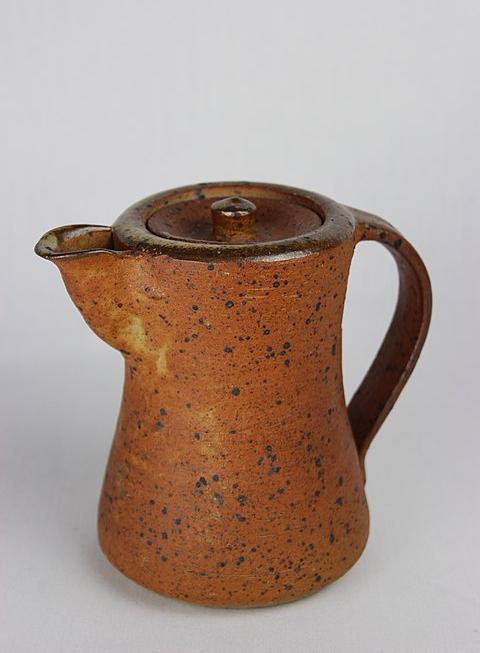
An artist who uses clay to make their artwork is called a potter or a ceramicist. Pots by the British potter Bernard Leach (1887–1979) were were some of the first in the 20th century to be exhibited as works of art. Lucie Rie (1902–95) created elegant, long-necked vases in shapes in the Modernist style. Ruth Duckworth (1919–2009) made abstract pieces inspired by nature. Toshiko Takaezu (1922–2011) was famous for her series of “Moonpots”, jars with openings at the top so small that they appear to be closed. Contemporary artist Grayson Perry (born 1960) paints scenes of modern life on the surfaces of ceramic vases.
pics


Without in any way limiting Q-files Ltd’s exclusive rights under copyright, any use of this publication to “train” generative artificial intelligence (AI) technologies to generate text is expressly prohibited. Q-files Ltd reserves all rights to license use of this work for generative AI training and development of machine learning language models.