
China

CITE
We have made every effort to follow citation style rules, but there may be some minor differences. If in doubt, please refer to the appropriate citation style manual.
Ming dynasty. (2025). In Q-files Encyclopedia, History, China. Retrieved from
https://www.q-files.com/history/china/ming-dynasty
"Ming dynasty." History, China, Q-files Encyclopedia, 6 Oct. 2025.
https://www.q-files.com/history/china/ming-dynasty.
Accessed 21 Sep. 2026.
Ming dynasty 2025. History, China. Retrieved 21 September 2026, from
https://www.q-files.com/history/china/ming-dynasty
History, China, s.v. "Ming dynasty," accessed September 21, 2026.
https://www.q-files.com/history/china/ming-dynasty


Ming dynasty
In 1368 a new dynasty of rulers took over from the old Mongol government in China. The Ming dynasty was founded by a Buddhist monk, Zhu Yuanzhang, who took the name of Hongwu Emperor. During the Ming period, the capital was established in Beijing and the Forbidden City, the imperial residence, constructed. The Grand Canal was restored and the Great Wall rebuilt, to become the structure as it is today. During the 16th century, the expansion of trade with Europe brought an influx of silver from the export of Chinese goods. But in the early 1600s, the Ming dynasty began to weaken. A series of poor harvests, famine and massive corruption crippled the government and fuelled rebellions. As a consequence, the Ming could not resist the invasion of the Manchu, who founded the Qing dynasty from 1644.


Fall of the Yuan
China under the Yuan dynasty was riven by numerous rebellions in response to famine and over-taxation. The flooding of the Yellow River, caused by the abandonment of irrigation works, devastated the local population. The Mongol rulers of Yuan China also stirred resentment among the majority Han Chinese population by deliberately excluding them from positions of power.
With the Yuan dynasty crumbling, competing rebel groups began fighting for control of the country. One, the Red Turban Movement, an offshoot of the Buddhist White Lotus Movement, became active in northern China in the 1350s. Zhu Yuanzhang, once a peasant and a Buddhist monk, became leader after defeating his rivals. When he led an army against Beijing in 1368, the capital, the Yuan emperor and his court fled north to Mongolia.


Hongwu Emperor
Zhu was now the most powerful leader in China. He declared himself emperor, taking the name Hongwu, and founded a new dynasty, the Ming. Over the course of his 30-year reign, the Hongwu Emperor (ruled 1368–98) set about unifying the country and consolidating his grip on power. He did this by forming a strong government with capable administrators based in his capital of Nanjing.
Hongwu established a strict law code, called the Grand Pronouncements. Suspicious of any disobedience among his officials, he set up a network of secret police called the Embroidered Uniform Guard. Through a series of purges, he had many thousands of people he distrusted executed. Believing foreign influences to be a threat to his rule, Hongwu banned international trade. He also reformed the army, abolishing senior posts that had once gone to nobles, and expanded the numbers of troops to more than a million. Successful campaigns in southwestern China against forces loyal to the Yuan (1381) and in Manchuria (1387) strengthened his rule over his empire.

Mindful of his own background as a poor villager, Hongwu took steps to redistribute land from wealthy landowners to peasants and limited the practice of forced labour. To improve the lot of country folk, he ordered public works projects, including the construction of irrigation systems and dykes, to be undertaken. He also encouraged new farming methods, such as crop rotation.
Yongle Emperor
At the end of his life, Hongwu Emperor announced that his grandson Zhu Yunwen, rather than any of his sons, would succeed him. Zhu ascended the throne as the Jianwen Emperor (ruled 1398–1402). But determined to seize power for himself, Hongwu's fourth son, Zhu Di, a skilled military leader, plotted a rebellion against Jianwen, sparking a three-year civil war. It ended with the imperial palace in Nanjing being burned to the ground, along with Jianwen and his family.
Zhu Di then became the Yongle Emperor (ruled 1402–24). He proceeded to purge the government of Jianwen's supporters as well as corrupt and disloyal officials. Over the years, he rewarded his own trusted courtiers, giving them important roles. One was Zheng He (see below), who led several important diplomatic missions to countries bordering the Indian Ocean, part of Yongle's campaign to have the Chinese Empire acknowledged as the world's mightiest power.
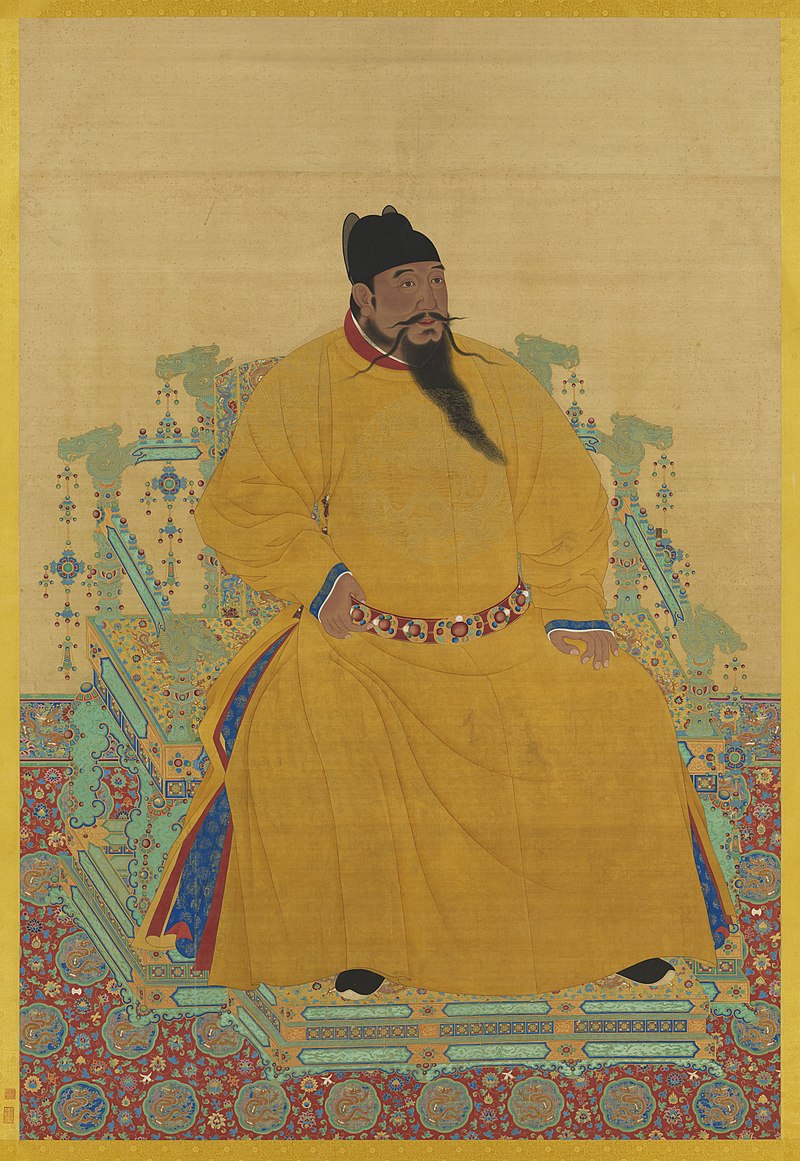

A major threat to China was posed by the Mongols to the north. The Yongle Emperor personally led five military campaigns against them and oversaw the reconstruction of the Grand Canal—widened and deepened so that grain ships could travel along it, a crucial supply line for his armies. He also made Beijing his principal capital (Nanjing remained a secondary capital) so he and his allies could be located much closer to the threat from the north. Yongle moved his court there in 1421.
Beijing
Construction of the new city of Beijing on the site of the old Yuan city of Dadu began in 1407. The work employed hundreds of thousands of workers for many years. The city was enlarged and surrounded by a 10-metre high circuit wall. At its centre was the Imperial City, home to government buildings and officials' residences. At the centre of that was the Forbidden City, the palatial residence of the emperor and his family. The Hall of Supreme Harmony, where imperial receptions were held, was built at the very heart of the complex, on the most elevated site. It was called "forbidden" because only high-ranking officials and invited ambassadors were permitted within its walls.


Zheng He
The Yongle Emperor was eager to place China at "the centre of the world" and build diplomatic relations with other countries in Asia. To that end, he ordered the shipyards of Nanjing to build him a vast navy. Between 1403 and 1419, some two thousand vessels were constructed, including massive junks (Chinese sailing ships) measuring 112 to 134 metres (367–440 feet) in length and 45 to 54 metres (148–177 feet) in width. Yongle appointed Zheng He (1371–1433), a Muslim, to be admiral of the imperial fleet. Yongle (and, later, his grandson Xuande, who ruled as emperor 1425–35) sent Zheng on seven voyages between 1405 and 1433, each involving several hundred ships.
His ships laden with silk, tea and porcelain, Zheng sailed to the islands of the South China Sea, the coast of India, the Persian Gulf—even as far as the east coast of Africa. The precious goods were intended as gifts to foreign rulers, encouraging them to send ambassadors to the imperial court in Beijing and acknowledge the Yongle Emperor as the greatest ruler on Earth.
The ships were heavily armed and Zheng scored several naval victories, serving to demonstrate China's military power. The expeditions also brought back gifts such as giraffes, gems and spices from rulers eager to pay tribute to the Chinese emperor.


Great Wall
The constant threat from the Oirats (Western Mongols) to the north was not quelled by the Yongle Emperor's five military campaigns launched against them. After the Zhengtong Emperor was captured by the Oirats in 1449, later Ming emperors vowed to rebuild the Great Wall to provide sturdy defence against future invasions.
The construction programme extended well into the 16th century, with the period between 1544 to 1549 seeing the greatest progress. After a minor Mongol raid broke through a gap in the wall in 1576, the Ming decided to close all gaps while strengthening the walls. The earthen defences around Beijing were replaced by stone bricks. The Great Wall was even extended through mountainous areas, snaking up over high summits and down through deep valleys. Wall construction continued until the Ming dynasty came to an end in 1644.
Wealth and trade

During the 16th century, new crops from the Americas, the New World recently "discovered" by Europeans, found their way to China. They included plants such as sweet potatoes, maize, tomatoes, peanuts and tobacco. Many could grow in parts of China not suitable for homegrown crops, leading to massive increase in food production. This, in turn, led to the population of China more than doubling, from around 80 million to 200 million.
Trade with Europe, chiefly Spain, Portugal and the Netherlands, also expanded in Ming times, with Chinese products, such as silk and porcelain, exchanged for massive amounts of silver, principally from Spanish-ruled Peru and Mexico. Silver became the new currency of China, taking over from paper money which was no longer trusted. Even after direct trade with Japan was banned, Portuguese traders acted as intermediaries, buying Chinese silks from China and selling them to Japan for silver. The Portuguese eventually gained consent from the Ming court in 1557 to settle Macau, an island in the Pearl River estuary, as their permanent trading base.


Ming China's prosperity created, in turn, a boom in the arts as newly wealthy people who had money to spend acquired beautiful paintings and other items to impress visitors to their homes.
Porcelain
The Ming period is well-known for porcelain, a hard, pure white ceramic material, also called "china". The major centres of production for porcelain were Jingdezhen in Jiangxi province, famous for blue and white pottery (created by adding a blue cobalt pigment) and Dehua in Fujian province. The white porcelains designed for export to Europe, known as Blanc de Chine ("White from China") were made at the Dehua factories.
Wanli Emperor
The 48-year reign of the Wanli Emperor (ruled 1572–1620) was the longest of all the Ming dynasty emperors. Ascending the throne at the age of nine, the young emperor was ably assisted by Grand Secretary Zhang Juzheng, a skilled administrator who had succeeded in rooting out corruption. The country was still prosperous and powerful with flourishing industry, agriculture and trade—although most peasants and labourers continued to live in poverty.
Following Zhang's death in 1582, Wanli withdrew from court affairs, preferring to stay out of sight behind the walls of the Forbidden City. The power vacuum was filled by Wanli's quarrelling officials, who were unable to deal with the financial crisis that arose from several hugely expensive wars fought against the Mongols and the Japanese in Korea. When the Tianqi Emperor came to the throne in 1620, the corrupt official Wei Zhongxian became a dominant figure and had his political rivals tortured to death. The Ming dynasty fell into rapid decline.


Fall of the Ming
In the 1620s and 30s, a long period of unusually dry and cold weather (an event now known as the Little Ice Age) set in across northern China causing the growing season to shorten. Harvests began to fail leading to frequent famines. Matters got worse when the Great Plague spread across China from Zhejiang to Henan in the 1630s, killing hundreds of thousands—maybe millions—of people.
An economic crisis also struck in the 1630s. Both the Japanese and the Spanish in the Philippines cut off the shipments of silver to China. This caused the value of silver to shoot up, making it impossible for Chinese farmers to pay their taxes.
By 1640 impoverished, starving peasants, no longer in fear of the severely weakened imperial army, began to form into huge bands of rebels. The Chinese military, unable to defeat the advancing Manchu raiders from the north and powerless to hold back huge peasant revolts in the provinces, fell apart. In 1644 the Ming dynasty finally lost power altogether.

pics


Without in any way limiting Q-files Ltd’s exclusive rights under copyright, any use of this publication to “train” generative artificial intelligence (AI) technologies to generate text is expressly prohibited. Q-files Ltd reserves all rights to license use of this work for generative AI training and development of machine learning language models.