
China

CITE
We have made every effort to follow citation style rules, but there may be some minor differences. If in doubt, please refer to the appropriate citation style manual.
Silk Road. (2024). In Q-files Encyclopedia, History, China. Retrieved from
https://www.q-files.com/history/china/silk-road
"Silk Road." History, China, Q-files Encyclopedia, 23 Oct. 2024.
https://www.q-files.com/history/china/silk-road.
Accessed 7 Aug. 2026.
Silk Road 2024. History, China. Retrieved 7 August 2026, from
https://www.q-files.com/history/china/silk-road
History, China, s.v. "Silk Road," accessed August 7, 2026.
https://www.q-files.com/history/china/silk-road


Silk Road
The Chinese of the Han dynasty were traders whose merchants took silks from China to the West. An overland road, known as the Silk Road, stretched from the Chinese capital, Chang’an, to Damascus, not far from the Mediterranean coast, a distance of 6400 kilometres (4000 miles). Marco Polo was one of the first Europeans to travel its entire length in the 1270s.


Origins
Long before the arrival of European travellers, such as Marco Polo, the Chinese had already explored much of Asia. The expansion of the Chinese Empire began during the reign of the Han dynasty (206 BC–AD 220). In 138 BC, Emperor Wu sent one of his court officials, Zhang Qian, into central Asia. The purpose of his mission was to find allies against the Xiongnu (probable ancestors of the Huns), a nomadic tribe who had been making raids in north China. Instead, Zhang was captured by the Xiongnu and held as their prisoner for the next 10 years. However, Zhang was allowed to travel extensively during his captivity. When he finally returned to China after 13 years, he brought valuable information about trading opportunities with the West.

Merchants soon began to transport their goods across the Gobi Desert to Kashgar, a trading post at the foot of the Pamir Mountains. Here, they met merchants from the Middle East. Chinese silk and spices were exchanged for gold, silver, cotton and other goods from the west. Some of the silks and spices were then sold on to distant cities, such as Rome. The trade route became known as the Silk Road.
Both China and the West had a thriving trade with India, from where pepper, spices, ivory, cotton, gems, teak and sandalwood were imported. Many goods from China reached the West via the ports of Gujarat on India's western coast. In fact, much of the silk that reached the West was manufactured in Gujarat.
Merchants
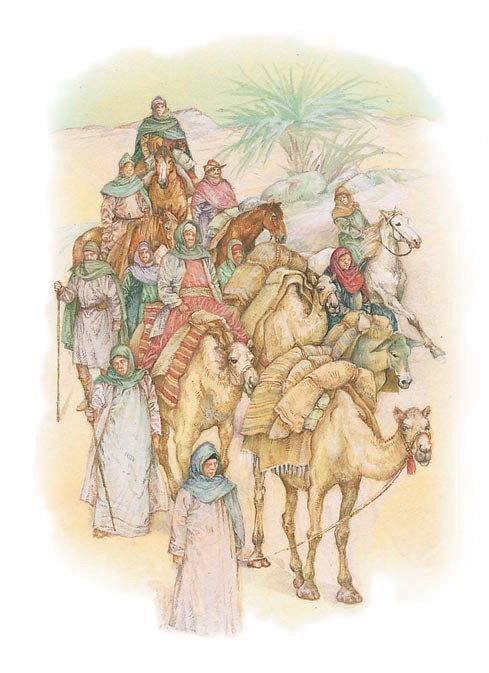
The Silk Road passed through dangerous territory where bandits waited to rob travellers. The merchants rode on camels and travelled in groups called “caravans” for protection. They carried silks, spices and bronze articles to trade in the West. The merchants came to various cities along the Silk Road and had to obtain permission to pass. The cities demanded a portion of the merchants’ goods in payment before letting them through. In this way these cities became rich because of the Silk Road.
Spread of Buddhism
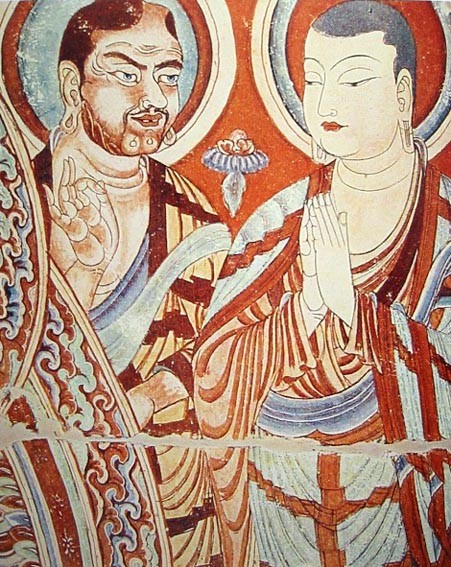
It was not only goods that were transported along the Silk Road, but also ideas and beliefs. Buddhism was brought to China by Indian monks in about AD 100. In AD 399, Fa Xian, a Chinese monk, travelled along the Silk Road in search of religious knowledge. He spent several years in India, studying in Buddhist monasteries.
About 200 years later, another scholarly monk, Xuan Zang, made a pilgrimage to the Buddhist University of Nalanda near the city of Rajagriha (now Rajgir) in the Kingdom of Magadha on India's Ganges Plain. He spent 16 years studying and translating hundreds of holy books at the library, the greatest collection of Buddhist texts of all.

Discovering China
It was through the merchants that some of China’s secrets began to reach the West. Merchants would return to Europe with tales of what they had seen in this mysterious, unknown land and some of the amazing things the people had invented. Marco Polo set off from Venice in 1271 when he was just 17 years old. He journeyed with his father, Niccolo, and uncle, Matteo, along the Silk Road. On arriving in China, he met the great Mongol emperor, Kublai Khan, and travelled widely around the empire between 1275 and 1292. As trade increased between East and West, more and more foreign merchants travelled to China, and many lived in Chang’an and other cities. Chang’an grew to be the largest city in the world.
Decline
Merchants continued to travel along the Silk Road for hundreds of years but it had become less important by about AD 1000. The cities along the route had become more and more powerful and could control the trade that passed through. There was always the threat of attack by bandits or groups of nomads who set upon the merchant caravans. As sea travel became safer and cheaper, that became the more popular way of transporting goods. Ships could also carry much larger cargoes and travel much more quickly than donkeys or camels.
Consultant: Philip Parker
pics
Without in any way limiting Q-files Ltd’s exclusive rights under copyright, any use of this publication to “train” generative artificial intelligence (AI) technologies to generate text is expressly prohibited. Q-files Ltd reserves all rights to license use of this work for generative AI training and development of machine learning language models.