
China

CITE
We have made every effort to follow citation style rules, but there may be some minor differences. If in doubt, please refer to the appropriate citation style manual.
Chinese inventions. (2022). In Q-files Encyclopedia, History, China. Retrieved from
https://www.q-files.com/history/china/chinese-inventions
"Chinese inventions." History, China, Q-files Encyclopedia, 10 Feb. 2022.
https://www.q-files.com/history/china/chinese-inventions.
Accessed 6 Aug. 2026.
Chinese inventions 2022. History, China. Retrieved 6 August 2026, from
https://www.q-files.com/history/china/chinese-inventions
History, China, s.v. "Chinese inventions," accessed August 6, 2026.
https://www.q-files.com/history/china/chinese-inventions


Chinese inventions
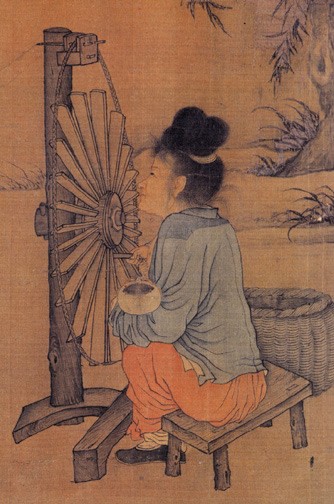
If you go out and and buy a book with paper money, if you put up an umbrella, strike a match, fly a kite or push a wheelbarrow, you have the Chinese to thank. These things are so familiar to us today we scarcely wonder where they came from. But it was the Chinese who first invented them. The iron plough, steel manufacturing, printing, the rocket and many other important inventions were all thought up by the Chinese many centuries before they appeared in the West. The mechanical clock, magnetic compass, suspension bridge, playing cards, parachute, paddlewheel boats, even the decimal system—all first appeared in China.

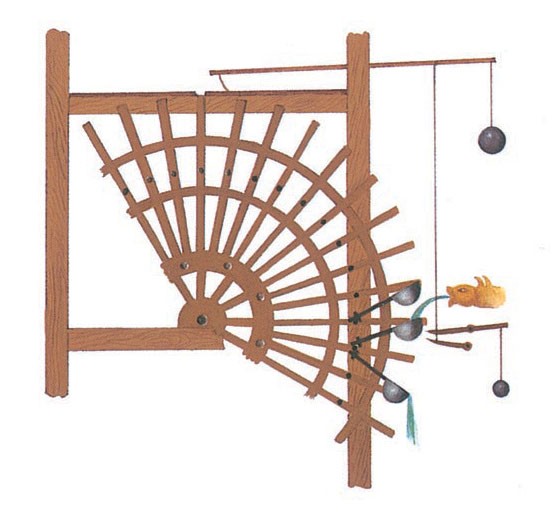
Mechanical clock
The world’s first mechanical clock was built by a Buddhist monk named Yi Xing in AD 725. A vertical waterwheel that had cups instead of paddles fixed to its blades turned when one of them filled up with water. The weight became too heavy for a pin holding it steady, the wheel moved forwards one notch, then was held by a pin until the next cup was filled, and so on. Rods and gears attached to the wheel moved the "hands" which told the time.
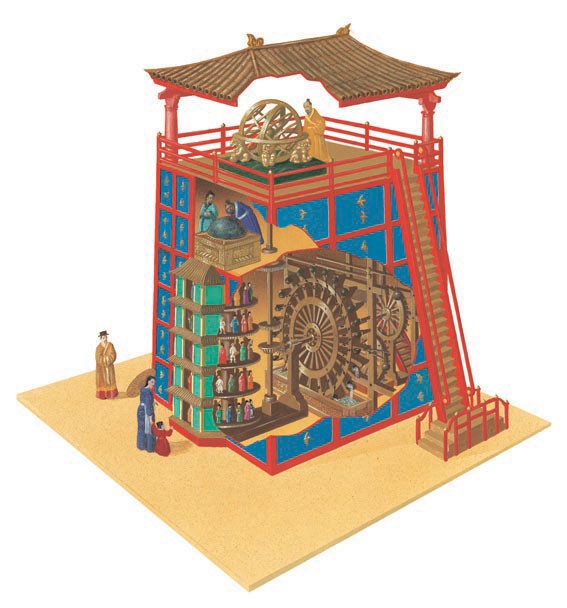
Yi Xing’s clock went out of use soon after it was built. Su Song’s clock of 1092, which had a similar mechanism, ran for nearly 50 years. Called a "Cosmic Engine", detailed descriptions were written about it. About 12 metres (40 feet) high, the wheel drove two globes for observing the positions of the stars, as well as a five-storey pagoda in which different figures appeared at the window to point out the hours of the day.

Seismograph
The seismograph was invented in AD 132. It is a vessel with eight dragons’ heads around the bowl and toads sitting below. When the machine is shaken during an earthquake, a rod inside swings and opens one of the dragons’ jaws. A ball falls out and drops into the mouth of the toad sitting directly below, recording the direction of the earthquake.
Wheelbarrow
The Chinese wheelbarrow is, in some ways, actually an improvement on the type we use today. It was invented in around AD 200. The things being carried in the barrow were distributed on either side of a large wheel so that the weight was balanced. The barrow had long handles and was easier to push than modern versions.

Inventions imported into Europe
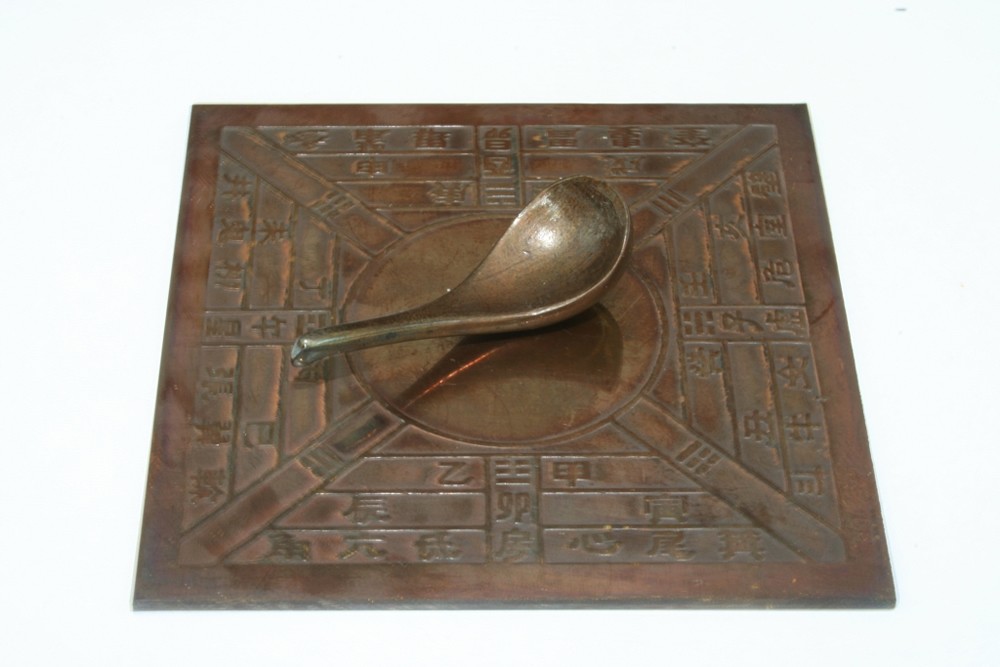
Some Chinese inventions found their way to Europe through reports from travellers, while others were later "invented" by Europeans unaware that they were already in existence. Seed drills, iron ploughs, collar harnesses and the technique of growing crops in rows—all ideas that had been developed in China centuries before—helped farmers. The magnetic compass, the ship’s rudder, and other nautical improvements guided European explorers across the world’s oceans in the 15th century. Gunpowder greatly strengthened armies. Printing presses spread learning around the world.
Consultant: Philip Parker
Timeline of invention
Magnetic compass
3rd century BC (known in Europe 11th century)
Paper
2nd century BC (first paper made in Europe in 12th century)
Rudder
1st century AD (adopted by Europeans in about 1180)
Suspension bridge
1st century AD (suspension bridge built in United States 1801)
Fishing reel
3rd century AD (known in Europe 17th century)
Umbrella
4th century AD (known in Europe 18th century)
Matches
6th century AD (made in Europe 19th century)
Printing
8th century AD (first European presses in 14th century)
Playing cards
9th century AD (known in Europe 13th century)
Paper money
9th century AD (made in Sweden in 1661)
Gunpowder
9th century AD (used in Europe 13th century)
Rocket
12th century AD (made in Europe 14th century)
pics

Without in any way limiting Q-files Ltd’s exclusive rights under copyright, any use of this publication to “train” generative artificial intelligence (AI) technologies to generate text is expressly prohibited. Q-files Ltd reserves all rights to license use of this work for generative AI training and development of machine learning language models.