
China

CITE
We have made every effort to follow citation style rules, but there may be some minor differences. If in doubt, please refer to the appropriate citation style manual.
Terracotta Army. (2022). In Q-files Encyclopedia, History, China. Retrieved from
https://www.q-files.com/history/china/terracotta-army
"Terracotta Army." History, China, Q-files Encyclopedia, 10 Feb. 2022.
https://www.q-files.com/history/china/terracotta-army.
Accessed 6 Aug. 2026.
Terracotta Army 2022. History, China. Retrieved 6 August 2026, from
https://www.q-files.com/history/china/terracotta-army
History, China, s.v. "Terracotta Army," accessed August 6, 2026.
https://www.q-files.com/history/china/terracotta-army


Terracotta Army
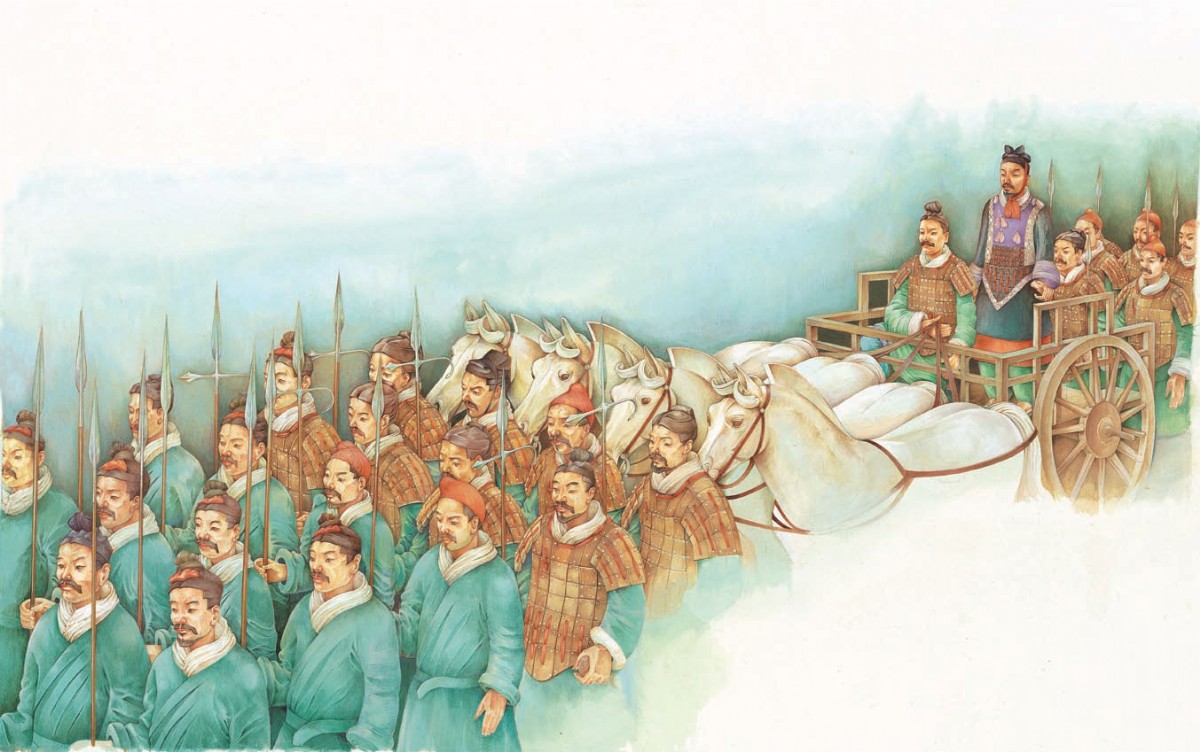
Qin emperor Shi Huangdi was a ruthless, determined man, but he had one great fear: death. In ancient times, people worshipped many different gods. Most people also believed in an afterlife. But this was the unknown and many feared what might happen to them. Shi Huangdi was no exception. Soon after he became emperor in 221 BC, he began to plan his tomb and 700,000 workers were ordered to build it. The emperor wanted his tomb to be guarded by an army of 8000 life-size soldiers made of a baked clay called terracotta. They were there to protect the emperor’s spirit. When he died in 210 BC, thousands of statues of soldiers were buried alongside him in his tomb.

Discovery of the tomb
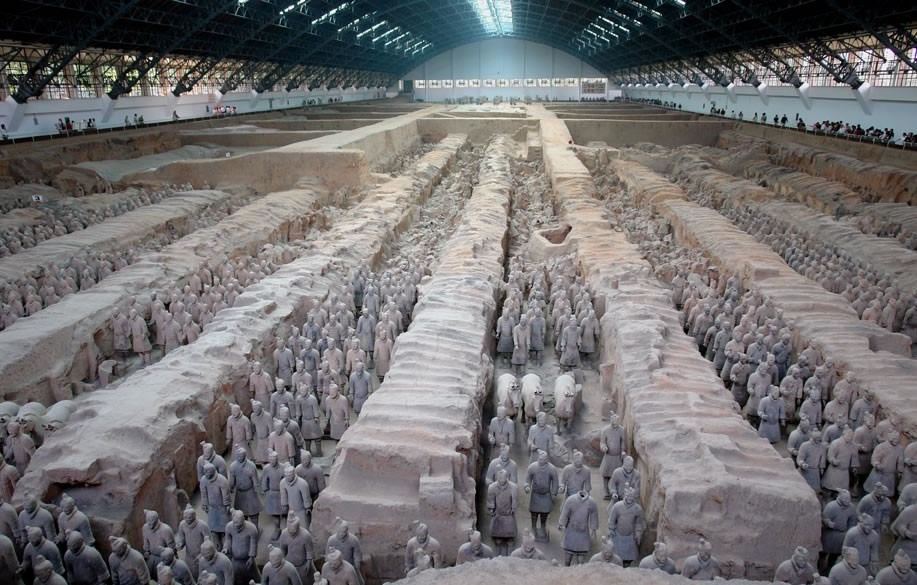
Shi Huangdi’s Terracotta Army lay undisturbed for many hundreds of years until some Chinese labourers found some statues while digging a well. Archaeologists began to excavate the area and in 1974 they discovered the emperor’s tomb. Since then, scientists have uncovered several pits containing about 8000 clay soldiers, chariots and horses. Many of the statues were broken when discovered, and their colours (all had been painted) had almost disappeared.
Appearance of the statues

The army of warriors, some of them on horseback and carrying weapons, were in sufficiently good condition to show us what soldiers looked like at the time. Each soldier has a different face, so it is likely they were portraits of soldiers in the emperor’s real army. It is clear that Shi Huangdi wanted an army to defend him at all times—even in his tomb. The soldiers held bronze weapons such as swords, spears and arrows, some of which are still sharp after 2000 years.
Consultant: Philip Parker
pics
Without in any way limiting Q-files Ltd’s exclusive rights under copyright, any use of this publication to “train” generative artificial intelligence (AI) technologies to generate text is expressly prohibited. Q-files Ltd reserves all rights to license use of this work for generative AI training and development of machine learning language models.