
China

CITE
We have made every effort to follow citation style rules, but there may be some minor differences. If in doubt, please refer to the appropriate citation style manual.
Shang dynasty. (2024). In Q-files Encyclopedia, History, China. Retrieved from
https://www.q-files.com/history/china/shang-dynasty
"Shang dynasty." History, China, Q-files Encyclopedia, 7 Oct. 2024.
https://www.q-files.com/history/china/shang-dynasty.
Accessed 22 Sep. 2026.
Shang dynasty 2024. History, China. Retrieved 22 September 2026, from
https://www.q-files.com/history/china/shang-dynasty
History, China, s.v. "Shang dynasty," accessed September 22, 2026.
https://www.q-files.com/history/china/shang-dynasty


Shang dynasty
As the Chinese civilization developed, ruling families, or dynasties, began to take power. The Shang dynasty is the earliest ruling dynasty of China recorded in history, although the Xia dynasty, founded by the legendary Yu the Great, is said to have come before it. By Shang times, some fairly large towns had grown up in China. Here, people carried out different trades and crafts. Metalworkers used bronze, an alloy (mixture) of copper and tin, to make vessels for the king and noblemen. Bronze vessels and carved bones found in Chinese burial grounds of this period have inscriptions on them, showing that the Shang had developed their own form of writing. During Shang times there were advances in maths, astronomy, crafts and military technology.

Rise of the Shang
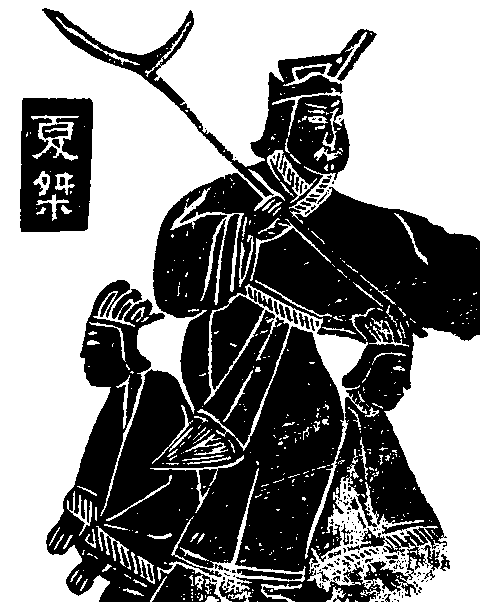
The Shang came to power in about 1600 BC, succeeding the Xia as rulers in the Yellow River valley region of northern China. At the Battle of Mingtiao, a Shang tribal chief named Tang defeated the army of the Xia dynasty, which was ruled by Jie, a cruel tyrant. Jie survived the battle—which was fought during a thunderstorm—but died later of illness.
Tang ruled wisely. He reduced taxes and lowered the number of people required to become soldiers. When drought threatened his people with starvation, he ordered golden coins to be made and distributed to poor families who had been forced to sell their children, enabling them to buy their children back.
Army
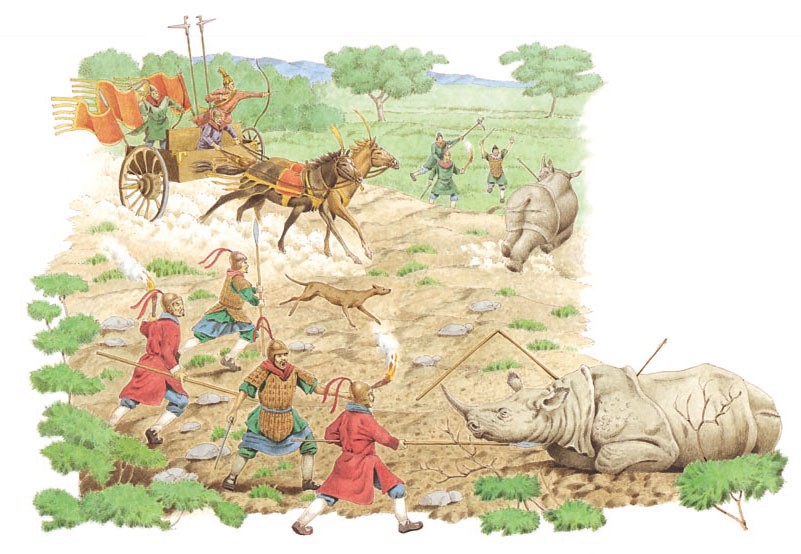
Over the centuries, Shang troops fought many wars with neighbouring peoples, such as the Rong Fang, Dan, Qiang and Ba. Prisoners of war were used as slaves or sometimes slaughtered for sacrifice. Under the direct command of the king, Shang armies consisted of the nobility, townspeople and peasants. They fought with máo (bronze-tipped spears), yuè (halberds or pointed axes), gē (dagger-axes) and bows and arrows.

From around 1200 BC, during the reign of King Wu Ding, noble soldiers were equipped with horse-drawn chariots.

Yin
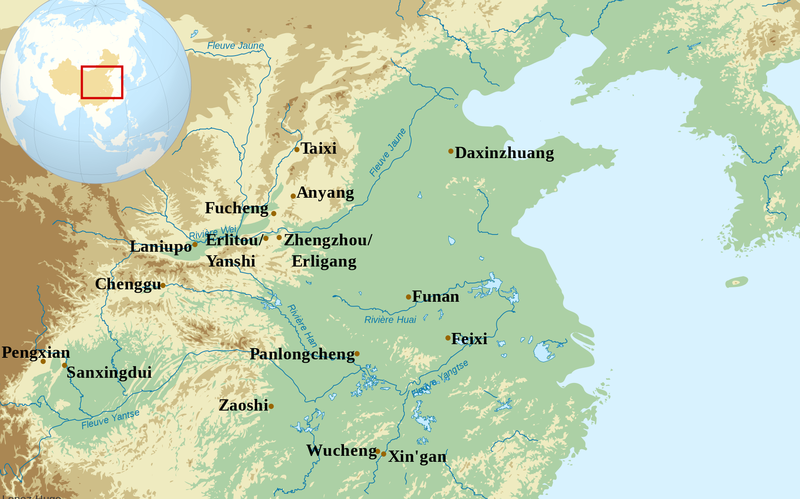
Anyang, then called Yin, became the Shang capital in around 1250 BC under King Pan Geng. At its centre were temples and palaces, surrounded by the workshops and dwellings of stone carvers, bronze workers and potters.
The ruins of Yin were rediscovered in 1899. The archaeological site, where so many finds of Shang objects have been made, is today known as Yinxu.

Fu Hao
It was not impossible for women in Shang times to reach high office and wield great power. Fu Hao (the word Fu means "Lady"), who lived around 1250–1200 BC, was one of 64 wives of Wu Ding, a king who ruled for 59 years. Wu Ding won the allegiance of neighbouring tribes by marrying one woman from each of them. Fu Hao entered the royal household through such a marriage. She became one of the king's three main consorts and achieved the status of high priestess, landowner and military general. A victor in many battles, at one point Fu Hao had 13,000 troops under her command.
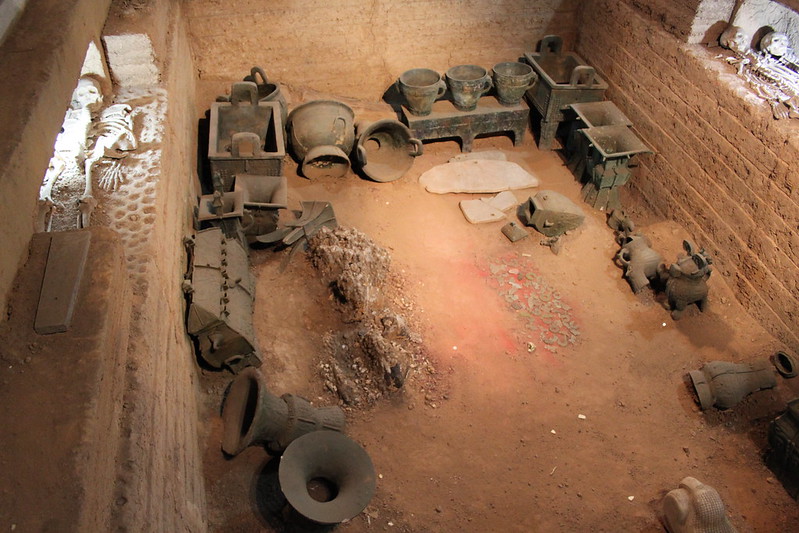
After her death, Fu Hao was buried in a tomb across the river from the main royal cemetery in Yin, an unusual event, since Shang royal families were normally buried together. It is because of its location that Fu Hao's tomb is the only royal Shang tomb to have been left intact until it was unearthed by archaeologists in 1976.
Discovered in the tomb were hundreds valuable objects, including ornaments and weapons made from bronze and jade, sculptures, bronze wine vessels, bone hairpins and arrowheads and several ivory carvings. The grave also contained 16 human sacrifices and 6 dogs. Oracle bone inscriptions revealed details of a number of military campaigns. The discovery of Fu Hao's tomb has given us insight into her extraordinary life

Bronze and crafts
The use of bronze meant that people in Shang China could make strong tools and weapons. Copper is a soft metal, but when mixed with tin to make bronze, it becomes much stronger. The Bronze Age had already begun in other lands, but the Chinese developed bronze independently. They made bronze weapons for hunting as well as warfare. Noblemen enjoyed hunting rhinoceros and tigers. Craftsmen worked in many other materials besides bronze. They made wooden chariots for nobles and officials to ride around in, and ornaments in jade, a semi-precious stone.
Oracle bones
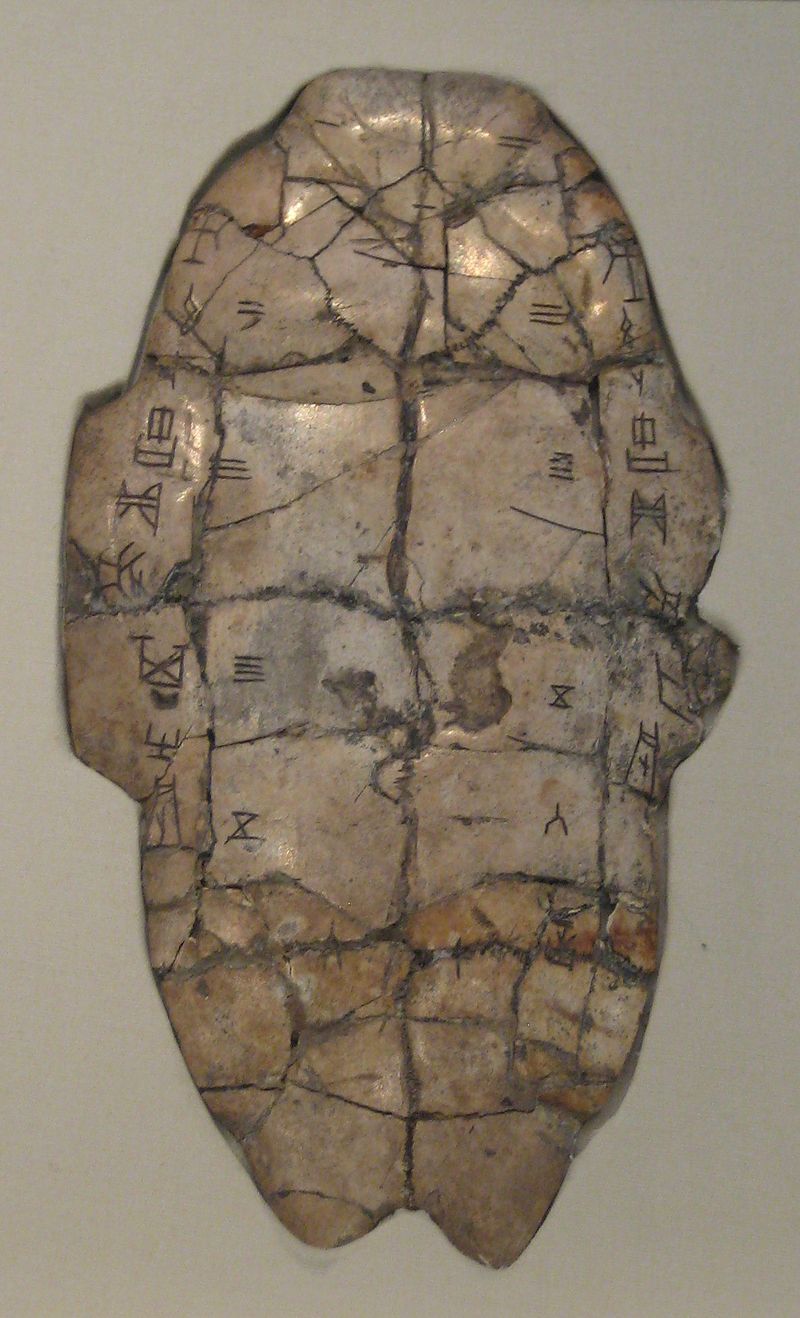
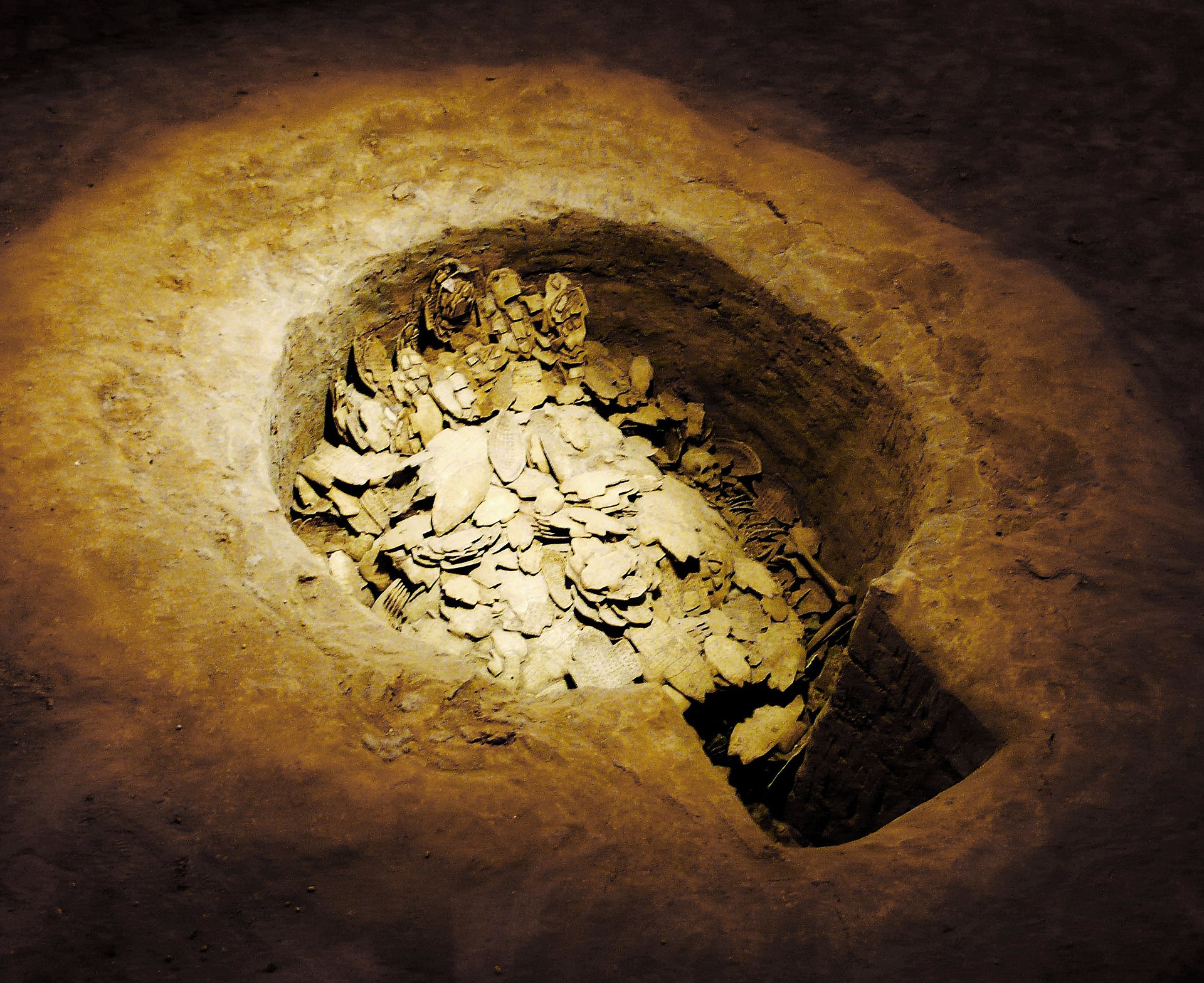
Soothsayers, or fortune-tellers, in Shang times foretold the future by reading oracle bones found at Yinxu. These were ox bones (or tortoise shells) that had questions, in the form of picture symbols, inscribed (carved) on them. The bones were smoothed to make them easy to carve. They were then heated over a fire until cracks appeared. The places where the cracks crossed the inscriptions were supposed to give the answers from the ancestral gods. The symbols, some 5000 of them in all, are the first known examples of writing in ancient China.
The bones tell us about the Shang dynasty rulers, politics, warfare, religion, agriculture—even the weather—and give historians a detailed picture of history and what life was like in Shang times.

Religion
The Shang believed that the supreme god, Di (also known as Shangdi) controlled victory in battle, the harvest and the floods of the Yellow River—all things that directly affected people's lives. They believed that it was their ancestors, along with the gods of nature, who carried out Di's wishes. So they performed rituals, including sacrifices of animals and humans, in order to win their ancestors' approval. The ancestors' desires were received by the oracle bone soothsayers and interpreted by the king, acting as high priest.
Afterlife
From the evidence of burial tombs built for rulers, it is probable that the Shang believed in an Afterlife. Ornaments made of jade—a type of stone believed to protect against decay—along with useful items such as chariots, utensils and weapons would be left in a ruler's tomb. Servants and horses were also buried alive with the king, to accompany him into the Afterlife. One tomb in Anyang dating to around 1200 BC contained the ruler's dead body accompanied by 74 human bodies as well as horses and dogs.

Life in Shang times

Most people living in Shang times farmed the land, raised livestock and hunted animals. Their simple dwellings were built from mud. People in those days did not eat rice or drink tea but ate bread and drunk beer. Their utensils and tools were made from stone or wood: bronze was generally reserved for precious items used for religious ceremonies.
Craftworkers and labourers made bronze vessels and weapons. Many people also worked in the mines quarrying the copper, tin and lead needed to make bronze.

Fall of the Shang
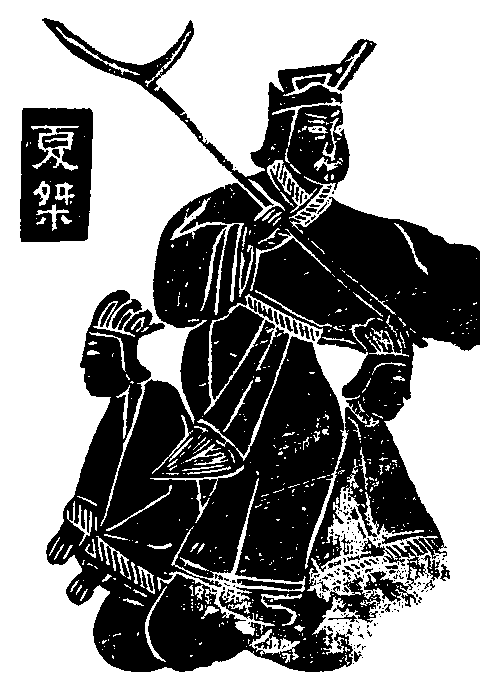
The last Shang king, Di Xin, was said to be a cruel leader who enjoyed torturing his enemies. Many people, including his own soldiers, called for the end of his rule—and played a key role in bringing this about.
In the 1000s BC, Zhou was an increasingly powerful kingdom living to the west of the Shang kingdom. Its capital was called Fenghao (on the site of present-day Xi'an). Around 1046 BC, the Zhou king Wu led an army of 45,000 men and 300 chariots across the Yellow River towards the Shang capital, Yin. They were met by Di's 530,000-strong army at the Battle of Muye. Many of Di’s troops refused to fight for him, holding their spears upside down. Some even joined the other side. Wu’s troops made a successful chariot charge, scattering Di's army and forcing Di to retreat.
The Shang king committed suicide by setting fire to his palace. The new Zhou dynasty would rule for more 800 years from Fenghao. Yin was abandoned to fall into ruin.
Consultant: Philip Parker
pics


Without in any way limiting Q-files Ltd’s exclusive rights under copyright, any use of this publication to “train” generative artificial intelligence (AI) technologies to generate text is expressly prohibited. Q-files Ltd reserves all rights to license use of this work for generative AI training and development of machine learning language models.