
China

CITE
We have made every effort to follow citation style rules, but there may be some minor differences. If in doubt, please refer to the appropriate citation style manual.
Great Wall of China. (2025). In Q-files Encyclopedia, History, China. Retrieved from
https://www.q-files.com/history/china/great-wall-of-china
"Great Wall of China." History, China, Q-files Encyclopedia, 13 Sep. 2025.
https://www.q-files.com/history/china/great-wall-of-china.
Accessed 21 Sep. 2026.
Great Wall of China 2025. History, China. Retrieved 21 September 2026, from
https://www.q-files.com/history/china/great-wall-of-china
History, China, s.v. "Great Wall of China," accessed September 21, 2026.
https://www.q-files.com/history/china/great-wall-of-china


Great Wall of China
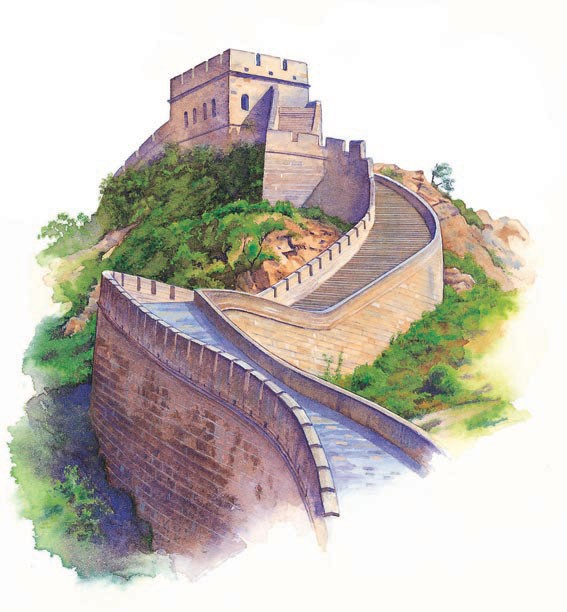
The Qin dynasty, under its leader Shi Huangdi, took control of China in 221 BC. Despite Shi Huangdi’s power and his army, his new empire was under constant threat from tribes such as the Xiongnu (probably the ancestors of the Huns), nomads who lived to the north of China. These fierce horsemen did not live in one place but moved around, raiding and plundering towns and villages, taking whatever they wanted and killing the inhabitants. In 214 BC Shi Huangdi decided to build a massive wall across China’s northern border to keep the invaders out. The section of wall built during his rule stretched for 2400 kilometres (1500 miles). It ran from the Yellow Sea in the east to the deserts of Central Asia in the west.


After Shi Huangdi
Shi Huangdi died suddenly in 210 BC and the Qin dynasty was replaced by a new dynasty, the Han, in 206. Work on the Great Wall went on for centuries after the death of the emperor who had started it. Most of the original wall (actually several walls joined together) has worn away over the centuries, with very few sections surviving. Much of the wall we see today was built between the 14th and the 16th centuries AD, during the Ming dynasty, with some sections restored recently.
By the time the wall had been rebuilt and added to, it was now 6000 kilometres (3700 miles) long—more than two-thirds the distance across the United States. It is 10 metres (33 feet) high. It remains the largest structure ever built by people.
Western Great Wall
Most of the Great Wall does not wind through mountains, but runs across plains or deserts. In these areas, the builders of the Wall made use of local soil (including loess, made of dust from the Gobi Desert blown by the wind) rather than stone. They used a technique called "rammed earth", compressing a damp mixture of soil and sand or gravel into a wooden frame. Adding lime helped the mixture become hard when it dried. Walls built of earth are more easily eroded, so very few sections remain today.


Building the wall
More than 300,000 soldiers, peasants and convicts helped to build the Great Wall. They used stone from nearby quarries, wood and earth. Many died in the process and their bodies were buried inside the wall. The wall was built along the tops of mountain ranges to make it even more difficult for raiders to invade so every piece of stone had to be carried in baskets up steep mountainsides.
Defending the wall
The wall had watchtowers every 200 metres (650 feet), which also served as the living quarters of the soldiers who guarded it. Watching from the battlements, they could see attackers approaching. When an attack came, they lit a fire as a signal. Messages could travel from one end of the wall to the other in less than a day. Soldiers from other parts of the wall rushed to help other guards under attack. Protected by battlements, they fired their arrows down on the enemy warriors trying to climb the wall. They also had giant catapults for hurling stones. In more peaceful times, the soldiers repaired the wall or worked in the fields close by.

Consultant: Philip Parker
pics




Without in any way limiting Q-files Ltd’s exclusive rights under copyright, any use of this publication to “train” generative artificial intelligence (AI) technologies to generate text is expressly prohibited. Q-files Ltd reserves all rights to license use of this work for generative AI training and development of machine learning language models.