
China

CITE
We have made every effort to follow citation style rules, but there may be some minor differences. If in doubt, please refer to the appropriate citation style manual.
Qin dynasty. (2022). In Q-files Encyclopedia, History, China. Retrieved from
https://www.q-files.com/history/china/qin-dynasty
"Qin dynasty." History, China, Q-files Encyclopedia, 10 Feb. 2022.
https://www.q-files.com/history/china/qin-dynasty.
Accessed 6 Aug. 2026.
Qin dynasty 2022. History, China. Retrieved 6 August 2026, from
https://www.q-files.com/history/china/qin-dynasty
History, China, s.v. "Qin dynasty," accessed August 6, 2026.
https://www.q-files.com/history/china/qin-dynasty


Qin dynasty
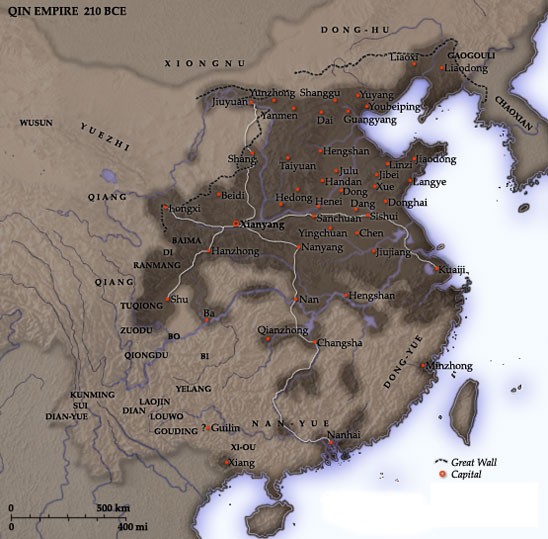
There was a long period of unrest in China between 475 and 221 BC, called the Warring States period. The Zhou were still in power but the separate states in China gradually became independent and began to fight each other. China became united again under a powerful group of warriors from the state of Qin (pronounced “chin”). Under their leader, King Zheng, they subdued the power of the warring states and brought them under Qin rule. After a series of battles over a nine-year period, Zheng assumed the role of emperor in 221 BC. Now called Qin Shi Huangdi, he was first emperor of all China.

Qin Shi Huangdi
Zheng, the leader of the Qin called himself Qin Shi Huangdi, which means “first emperor of the Qin”. Shi Huangdi ruled over a vast empire from his capital city, Xianyang.
Shi Huangdi was a very powerful man: under his command were a million armoured soldiers, a thousand chariots and 10,000 horses. He ended years of war in China and kept order by executing anyone who opposed him. His laws were very strict. He made everyone pay tax and use the same sort of money, weights and way of writing. Shi Huangdi also built new roads across the country.
Qin warriors
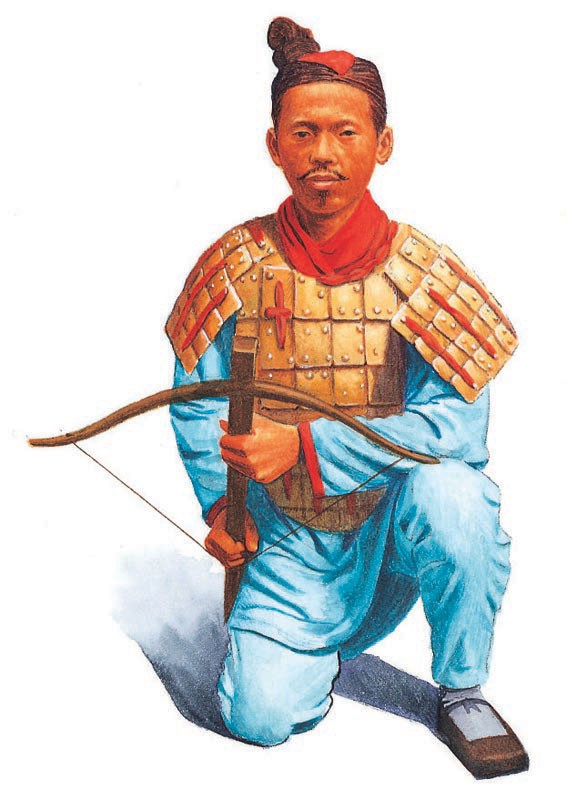
The Qin emperor had to keep up a large army to protect his new empire. His warriors were armed with bronze spears and swords. Each soldier’s clothing was a sign of his importance. Unlike the noble charioteers and Emperor’s bodyguard, an ordinary soldier did not have an elaborate headdress. His hair was coiled up into a top-knot. He was protected by body armour made of metal scales riveted together. He wore a scarf to prevent his metal and leather armour rubbing his neck.
One of the Chinese warrior’s most effective weapons was the crossbow, a powerful and accurate means of firing arrows. The deadly arrows had sharp bronze or iron tips. Other soldiers fought face-to-face with their opponents using long, narrow swords.
Terracotta Army
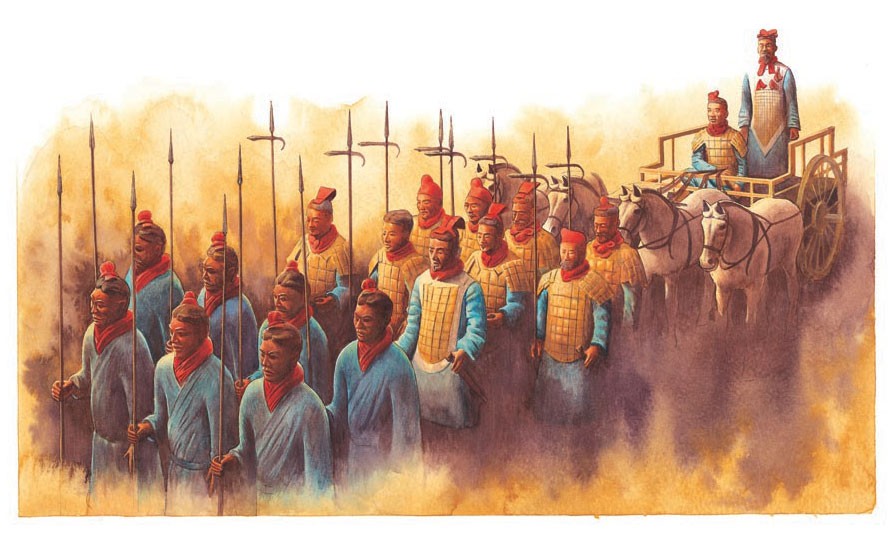
In 210 BC Shi Huangdi died. Buried with him were thousands of statues made of terracotta (baked clay). They include soldiers, horses and chariots—an incredible copy of the Emperor’s army. They can be seen today, giving us a clear picture of what the warriors really looked like.
Great Wall of China
Despite Shi Huangdi’s power and his army, his new empire was under constant threat from tribes such as the Xiongnu (probably the ancestors of the Huns), nomads who lived to the north and west of China. In 214 BC he decided to build a massive wall across China’s northern border to keep the invaders out. By the time it was finished, the first Great Wall of China stretched for about 2400 kilometres (1500 miles).

Consultant: Philip Parker
pics


Without in any way limiting Q-files Ltd’s exclusive rights under copyright, any use of this publication to “train” generative artificial intelligence (AI) technologies to generate text is expressly prohibited. Q-files Ltd reserves all rights to license use of this work for generative AI training and development of machine learning language models.