
China

CITE
We have made every effort to follow citation style rules, but there may be some minor differences. If in doubt, please refer to the appropriate citation style manual.
Ancient China. (2025). In Q-files Encyclopedia, History, China. Retrieved from
https://www.q-files.com/history/china/ancient-china
"Ancient China." History, China, Q-files Encyclopedia, 19 Feb. 2025.
https://www.q-files.com/history/china/ancient-china.
Accessed 6 Aug. 2026.
Ancient China 2025. History, China. Retrieved 6 August 2026, from
https://www.q-files.com/history/china/ancient-china
History, China, s.v. "Ancient China," accessed August 6, 2026.
https://www.q-files.com/history/china/ancient-china


Ancient China
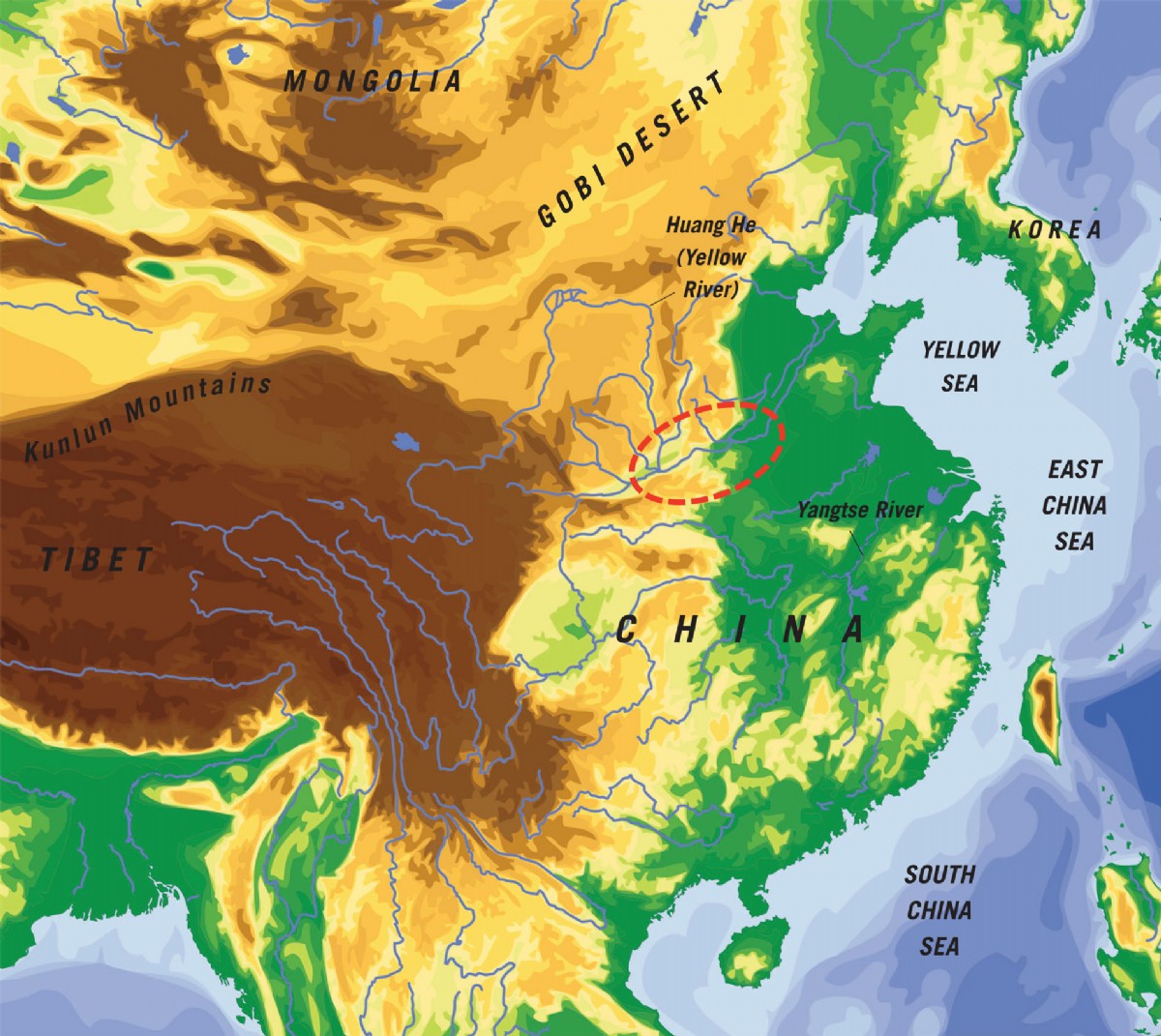
The Chinese civilization grew up on the banks of the Huang He (Yellow) River in northern China more than 7000 years ago. It developed in isolation from the rest of the world for thousands of years. Indeed, the Chinese people did not even realize that there were other civilized people in the world until the second century BC. Until then, the only other people they came across were nomads from lands to the north and east.

First settlers


Modern humans first arrived in China around 100,000 years ago. Around 7500 years ago, farmers started to cultivate crops in the deep, fertile soil on the banks of the Yellow River. It was the colour of the soil, called loess, that gave the river its name. The people lived in small villages of huts made from mud and sticks. At the centre of each village was a large pyramid-shaped hut where people gathered to talk.
Their main crops were millet, a kind of cereal they used to make bread, and hemp, from which they made clothes. Farming methods became more efficient so farmers could produce enough food to feed people outside their own families. Some of these learned useful crafts such as pottery or weaving. The population increased and began to spread to other parts of China. Eventually the land became a kingdom under the rulers of the Shang dynasty in about 1600 BC.

Consultant: Philip Parker
pics
Without in any way limiting Q-files Ltd’s exclusive rights under copyright, any use of this publication to “train” generative artificial intelligence (AI) technologies to generate text is expressly prohibited. Q-files Ltd reserves all rights to license use of this work for generative AI training and development of machine learning language models.