
Mongols

CITE
We have made every effort to follow citation style rules, but there may be some minor differences. If in doubt, please refer to the appropriate citation style manual.
Mongol Empire. (2026). In Q-files Encyclopedia, History, Mongols. Retrieved from
https://www.q-files.com/history/mongols/mongol-empire
"Mongol Empire." History, Mongols, Q-files Encyclopedia, 1 May. 2026.
https://www.q-files.com/history/mongols/mongol-empire.
Accessed 6 Aug. 2026.
Mongol Empire 2026. History, Mongols. Retrieved 6 August 2026, from
https://www.q-files.com/history/mongols/mongol-empire
History, Mongols, s.v. "Mongol Empire," accessed August 6, 2026.
https://www.q-files.com/history/mongols/mongol-empire


Mongol Empire
Under the leadership of Genghis Khan (1162/7–1227), the Mongols became an organized army that nobody could resist. In 1211 they defeated the Jin Empire of northern China. Then Genghis turned against the Muslim powers of Central Asia and the Middle East. His armies surged across Russia into Europe. The conquest of China was completed by Genghis’s grandson, Kublai Khan (1215–1294). In the 14th century, another Mongol leader, Tamerlane (1336–1405), repeated Genghis’s conquests. He was a brilliant warrior but a poor governor. His empire collapsed at his death.
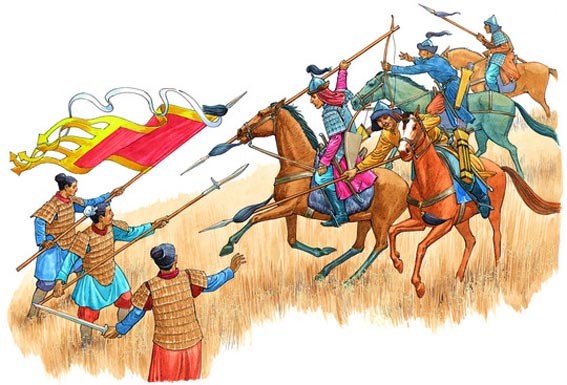

The Mongols
The Mongols were a nomadic (wandering) people who lived on the steppe grasslands of Central Asia, from the Ural Mountains to the Gobi Desert. They moved from place to place with their herds of sheep, goats and cattle and they were skilful and daring on horseback. The Mongol peoples lived in tents made from felt, called yurts. Besides providing good protection from the weather, yurts were easy to take down and put up again.
Genghis Khan
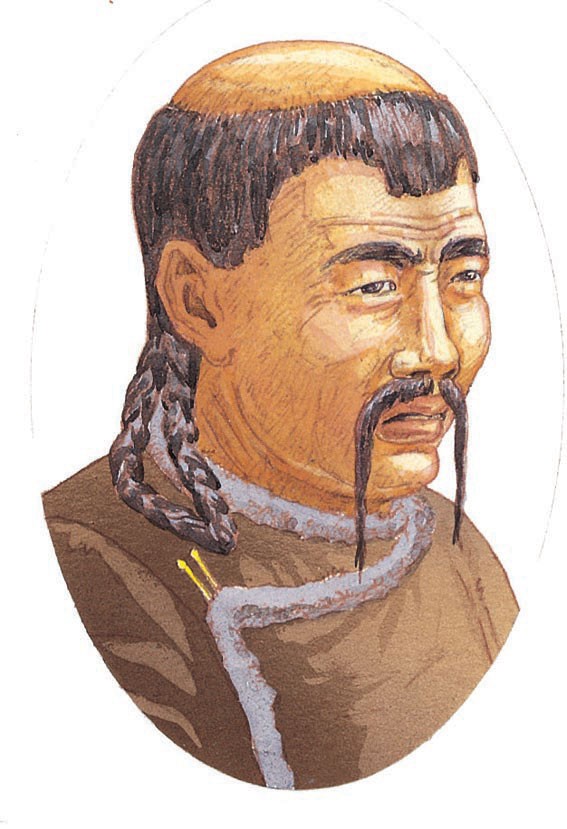
The Mongols were fierce warriors, and members of one tribe often raided another tribe to accumulate wealth and prestige. In 1206, a Mongol leader named Temüjin rose to power and brought all the Mongol tribes under his control. Temüjin became known as Genghis Khan, which meant "Ruler of All".
Genghis Khan was born in either 1162 or 1167. His early life was one of poverty, existing on roots, nuts and berries. We know about his life from the Mongol chronicle, known in English as the Secret History of the Mongols, which was written in about 1240. He was the first leader to bring the Mongols together as one nation, and to organize the Mongol armies in large-scale and successful campaigns.
Early conquests
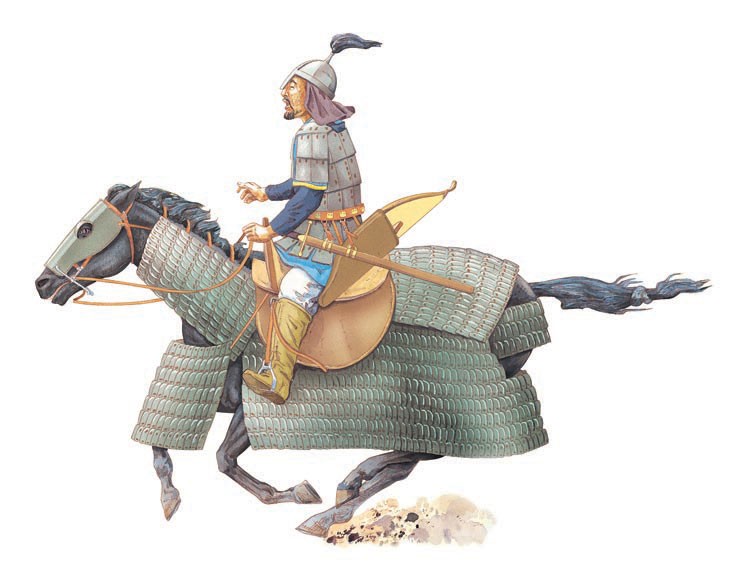
Under Genghis's rule the Mongols attacked northern China as well as the lands that lay to the west. The Mongol armies rampaged across Russia and came within reach of Constantinople (modern-day Istanbul, in Turkey). Everywhere they went, the Mongols inspired terror, as they looted, destroyed and slaughtered without mercy.
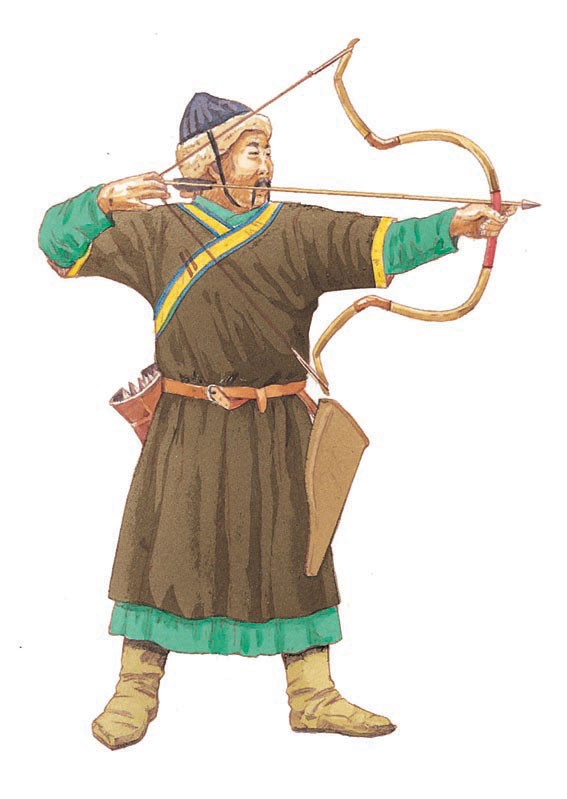
Mongol warriors
The Mongols were expert riders and archers. They often took their enemies by surprise with the speed of their fierce attacks. Early in an attack, Mongol riders fired arrows at their enemies while galloping at top speed. When the enemy was at closer range, they used heavier, armour-piercing arrows. Every archer carried a bow and two quivers, containing about 30 arrows in total. Their short bows were specially designed to fire arrows with great power and accuracy.
Any cities that tried to defend themselves against the Mongol onslaught were burnt down. Mongol warriors also had giant catapults for attacking walled cities.


Golden Horde
In 1223, Mongols attacked Russia, nearly reaching the capital city of Kiev. In further attacks in 1237 the Mongols sacked the city and devastated much of the land. Russia became part of the Mongol Empire, included in a region known as the Golden Horde.
Much of the Mongols' success was down to Subutai (1175–1248), one of their army's greatest generals. He directed more than 20 campaigns in which he conquered 32 nations—more territory than any other commander in history. Victorious in 65 battles, Subutai gained his achievements by means of clever strategies and plotting the movements of armies hundreds of kilometres apart. Having devastated Russia, he also fought against the forces of Poland and Hungary.
Kublai Khan
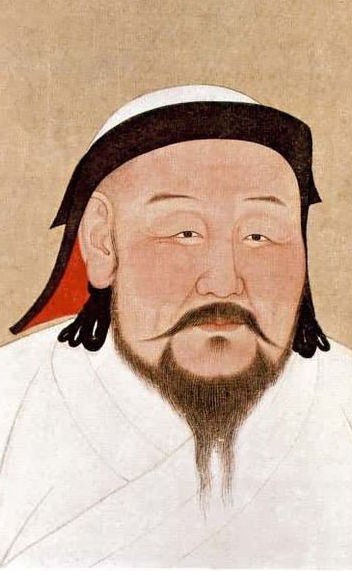
When Genghis Khan died in China in 1227, the Mongol Empire passed to his three sons. One, Ögödei, dominated the rest and continued his father’s campaigns in Europe. Ögödei died in 1241 and, after much feuding, a grandson of Genghis Khan, Kublai Khan, eventually achieved power in 1264. He was determined to conquer all of China, and he finally succeeded in 1279.
Kublai Khan was a tolerant ruler. He permitted the existence of various religions in China, includingBuddhism, Islam and Christianity. He organized food stores for times of famine, and he improved the road system so that trade could increase. He also tried to extend Mongol power to Japan, but his fleets were defeated in 1274 and 1281.
Mongol khanates
After Kublai's death in 1294 the Mongol Empire split into four separate empires, called khanates. They were: the Golden Horde khanate in the northwest (including Russia), the Chagatai Khanate in Central Asia, the Ilkhanate in the southwest (including Persia), and the Yuan dynasty of China in the east. The three western khanates adopted Islam as their religion. Wars were fought between them until 1304, when all of the khanates accepted Yuan emperor Yesün Temür's supremacy, although they continued to act as independent states.
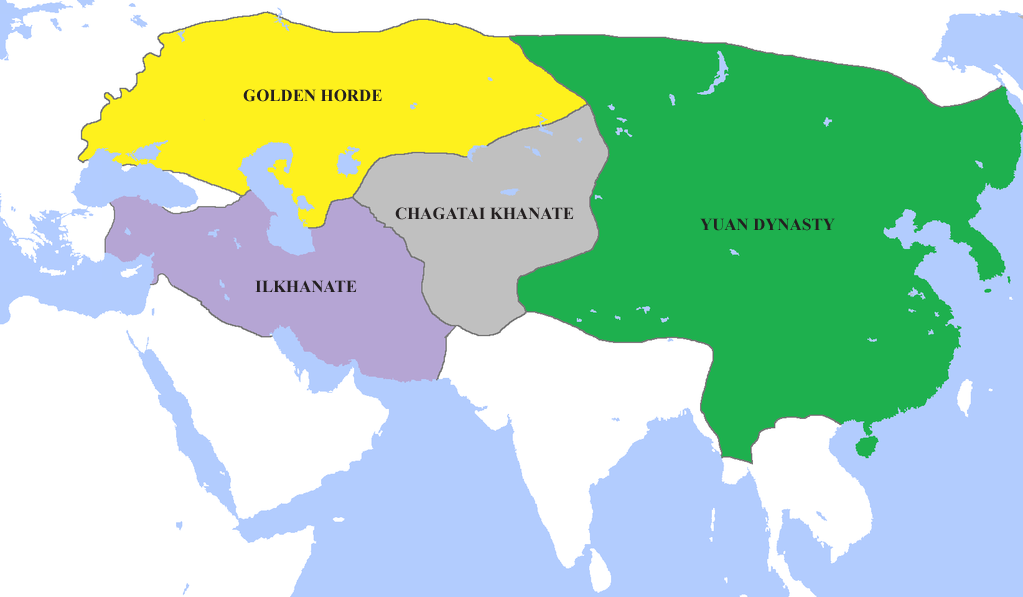

Mongol rule in each of the khanates collapsed during the 1300s. The Black Death plague, which started in the Mongol dominions and later spread to Europe, devastated their populations. The Ilkhanate was divided up between warlords after 1335. The Golden Horde lost its western dominions, including modern Belarus and Ukraine, to Poland and Lithuania between 1342 and 1380. Princes of the Chagatai Khanate warred with each other from 1334 to 1360.
The Yuan emperor of China, Toghan Temür, was overthrown by Ming forces in the "Red Turban Rebellion" and in 1368 fled back to the Mongol heartland of Mongolia.
Fall of the Golden Horde
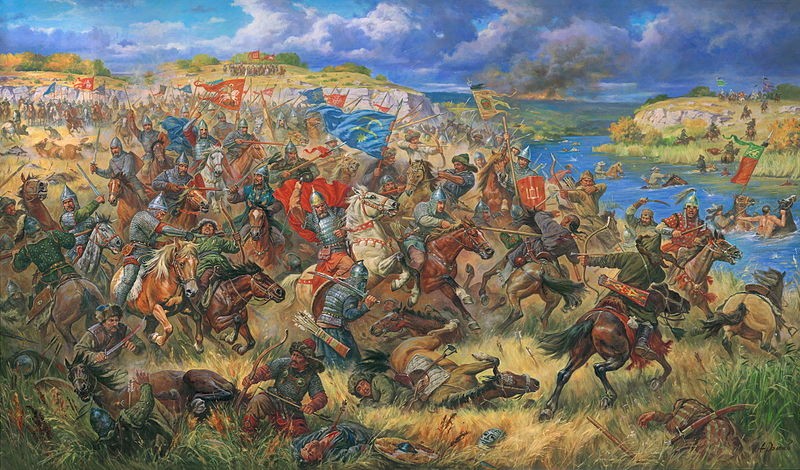
The Mongols’ control over the Golden Horde grew weaker in the 1300s. The Mongols forced their subject peoples to pay heavy taxes and in 1328 they began to entrust the task of collecting these taxes in Russia to the Grand Duke of Moscow, Ivan I. The Grand Duchy of Moscow began to emerge as a threat to Mongol rule. In 1380 an army led by Prince Dmitri of Moscow defeated the Mongols at Kulikovo, although the Mongols later managed to reassert their control. Soon after Tamerlane invaded in 1396, the Golden Horde broke up into smaller khanates, which declined steadily in power. A century later (in 1480), under the rule of Ivan III, Russia finally broke free of Mongol rule.
Tamerlane
Born in 1336 in a region of what is today Uzbekistan, Tamerlane (also known as Timur the Lame) seized control of the western Chagatai Khanate in 1369. He was descended from Mongol rulers—although not Genghis Khan himself. Tamerlane's aim was to restore the Mongol Empire to its past greatness. Based in his capital of Samarkand, Tamerlane extended his power southwards and westwards, creating an empire that reached from Turkey in the west to the borders of China in the east. He invaded the Golden Horde in 1396 and India in 1398, sacking Delhi.
After his death in 1405, Tamerlane’s empire quickly fell apart. In 1526 one of Tamerlane’s descendants became the first Great Mughal, ruler of the Mughal Empire in India.

Consultant: Philip Parker
pics

Without in any way limiting Q-files Ltd’s exclusive rights under copyright, any use of this publication to “train” generative artificial intelligence (AI) technologies to generate text is expressly prohibited. Q-files Ltd reserves all rights to license use of this work for generative AI training and development of machine learning language models.