
Japan

CITE
We have made every effort to follow citation style rules, but there may be some minor differences. If in doubt, please refer to the appropriate citation style manual.
Medieval Japan. (2025). In Q-files Encyclopedia, History, Japan. Retrieved from
https://www.q-files.com/history/japan/medieval-japan
"Medieval Japan." History, Japan, Q-files Encyclopedia, 6 Oct. 2025.
https://www.q-files.com/history/japan/medieval-japan.
Accessed 30 Oct. 2026.
Medieval Japan 2025. History, Japan. Retrieved 30 October 2026, from
https://www.q-files.com/history/japan/medieval-japan
History, Japan, s.v. "Medieval Japan," accessed October 30, 2026.
https://www.q-files.com/history/japan/medieval-japan


Medieval Japan
Until the 6th century AD, few people from the outside world had ever visited Japan. But after about 550, Japan began to fall under the influence of its much larger neighbour, China. Buddhist monks from China persuaded the Japanese emperor to adopt Buddhism as the national religion. Scholars taught the Japanese to read and write Chinese. From 1192 to 1867, powerful generals called shoguns ruled Japan as regents (acting rulers) for the emperors. During shogun rule, warriors called samurai became a powerful force in Japan, enforcing law and order on behalf of Japan's local lords, called daimyo. Rivalry and fighting between daimyo was commonplace.


Prince Shotoku
Prince Shotoku (AD 572–622) was born in a stable but grew up to become one of the great men of Japan. He lived at a time when the religion of Buddhism was spreading to Japan from China. Prince Shotoku built the first Buddhist monasteries. Rebuilt after a fire in 670, the pagoda of the Horyuji temple at Nara is the oldest surviving wooden building in the world. A pagoda is a tower with several storeys. All pagodas are said to contain a relic of Buddha (something used by or associated with him).
Prince Shotoku also wrote a set of principles for the bureaucracy. These were organized along Chinese lines, concentrating power on the emperor himself. By 800 the Japanese way of life was very similar to that of China.
Shogun rule
In 858 a powerful man called Fujiwara Yoshifusa became regent for a nine-year-old emperor. He was supposed to rule Japan only while the emperor was a child, but he continued in power as a dictator even after the emperor became an adult. For many centuries after that, Japan was ruled by powerful military men. Wars broke out between rival clans bidding for power. In 1160, the Fujiwara clan lost out to the Taira, who in turn were defeated by the Minamoto. Minamoto Yoritomo took on the title of shogun (great general) in 1192. Shoguns, who were nominally appointed by the emperors, continued to rule Japan until 1867. The emperors themselves were little more than figureheads.

The samurai

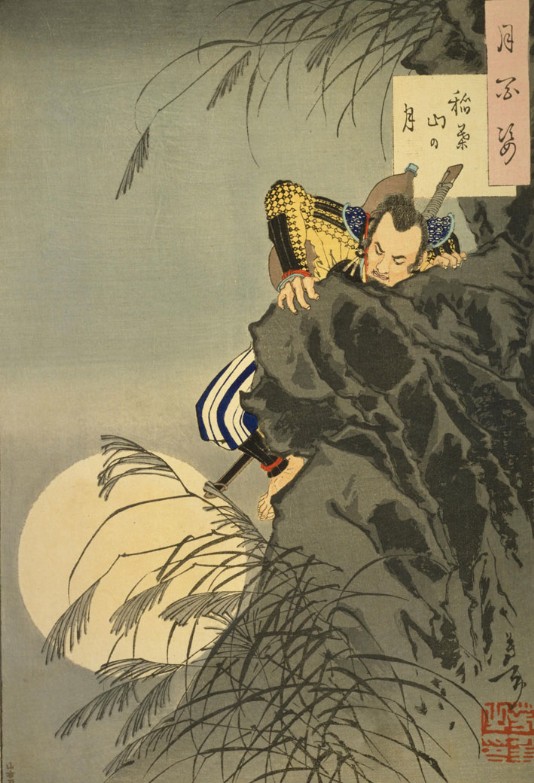
During shogun rule, a powerful force in Japan were the samurai. These warrior knights enforced law and order in the land on behalf of local lords (daimyo) and were on hand to fight for the shogun if called upon. Samurai warriors followed a code of honour known as the bushido. They wore armour made of metal plates. For weapons they used swords, lances and bows and arrows.

Mongol invasion
The samurai were summoned to fight the Mongol armies that tried to invade Japan in 1274. The Mongol fleet was destroyed in a storm, but a new, even larger invasion was mounted in 1281. This time, a typhoon (tropical cyclone) devastated the Mongol force and Japan was saved. The Japanese called these storms kamikaze (“divine winds”).
Civil wars
Rivalry between clans continued, and some daimyo became too powerful for the shogun to control. From the 14th to 16th centuries, the Sengoku period, wars frequently broke out between them, the fiercest being the Onin War (1467–77). Eventually, unity was restored and the daimyo Toyotomi Hideyoshi became undisputed master of all Japan in 1591. Although he was never shogun, he ruled as regent for the emperors.
Hideyoshi dreamed of conquering China and launched two invasions of Korea starting in 1592. But he failed to defeat the Chinese and Korean armies and the war ended after his death in 1598. Another civil war then broke out, this time between supporters of Hideyoshi's infant son Hideyori and those loyal to daimyo Tokugawa Ieyasu.
Tokugawa Ieyasu won a decisive victory at the Battle of Sekigahara in 1600 and was appointed shogun by the emperor three years later. So began 268 years of uninterrupted rule of Japan by the Tokugawa clan.

Nanban trade
The Portuguese became the first Europeans to reach Japan when their merchants arrived off the far south of the Japanese archipelago in 1543. By agreement with the local rulers, they established a port in Hirado and soon began trading with China and Malacca (a city on the Malay Peninsula the Portuguese had captured in 1511). The Chinese had banned trade with Japan because of piracy, so the Portuguese acted as "middlemen" between the two. Trade with China was boosted by the founding of Macau in 1557. This trade network between Japan and the outside world was called Nanban boeki, meaning "Southern barbarian trade".
By far the most valuable commodities traded during this period were Chinese silks for Japanese silver. The Portuguese also introduced firearms to Japan, along with Christianity, which soon gained a considerable following in Japan.
In 1571, the Portuguese relocated their trading post to nearby Nagasaki, then a small fishing village. A few years later its daimyo, Omura Sumitada, a Christian convert himself, leased a parcel of land to the Jesuits. Nagasaki grew into a bustling international city with an entirely Christian population. An artificial island in Nagasaki harbour, called Dejima, was constructed for the Portuguese traders in 1634.

The Nanban trade declined in the early Edo period: the Tokugawa shogunate feared the influence of Roman Catholicism of the Portuguese in Japan. The Portuguese were finally banished from the country in 1638 on the grounds that they smuggled priests into Japan aboard their vessels.
Consultant: Philip Parker
pics

Without in any way limiting Q-files Ltd’s exclusive rights under copyright, any use of this publication to “train” generative artificial intelligence (AI) technologies to generate text is expressly prohibited. Q-files Ltd reserves all rights to license use of this work for generative AI training and development of machine learning language models.