
Japan

CITE
We have made every effort to follow citation style rules, but there may be some minor differences. If in doubt, please refer to the appropriate citation style manual.
Samurai. (2022). In Q-files Encyclopedia, History, Japan. Retrieved from
https://www.q-files.com/history/japan/samurai
"Samurai." History, Japan, Q-files Encyclopedia, 10 Feb. 2022.
https://www.q-files.com/history/japan/samurai.
Accessed 30 Oct. 2026.
Samurai 2022. History, Japan. Retrieved 30 October 2026, from
https://www.q-files.com/history/japan/samurai
History, Japan, s.v. "Samurai," accessed October 30, 2026.
https://www.q-files.com/history/japan/samurai


Samurai
The samurai were brave Japanese warriors. Originally farmers and landowners, the samurai first emerged in the 8th century. At this time, Japan was beset by many wars between rival clans, led by daimyo, or lords. The samurai fought for their local daimyo. In 1192 a samurai leader, Minamoto Yoritomo, became Japan's first shogun, military dictator. He had even more power than the emperor, the official ruler of Japan. Because Japan was made up of hundreds of islands, it could be difficult to govern, so the shoguns relied on the samurai warriors to maintain law and order all over the country. Although samurai only ever numbered about one out of every ten people in Japan, their code of honour, bushido, was very influential.

Castles

Samurai and daimyo who were loyal to the shogun were rewarded with land on which they could build grand castles. Proud samurai landowners built many castles throughout Japan. To deter attacks from rival samurai groups, rebels or invaders, their castles were built with strong defences including high walls, barred windows and a moat. To show off the samurai’s power, the tenshu (central building) was several storeys high, with beautiful painted woodwork and roof ornaments. Inside there were courtyards and gateways.

Training
To be a samurai you had to be the son of samurai parents. The boys were prepared for their warrior life from birth. They were trained to be skilled fighters. A samurai boy was given his first sword at the age of 15. Reading, writing and good manners were taught at school, but the most important lessons were in attack and self-defence—the martial arts. A sword-master taught special methods of sword-fighting based on fast, animal-like movements. Archery was practised using live animals such as dogs as targets. Samurai also had to be skilled in unarmed combat. The boys frequently broke each other’s bones when learning how to wrestle.
Bushido
The samurai warriors followed a code of honour known as the bushido (meaning "the way of the warrior"). As a trained warrior, the samurai had to be loyal and very courageous. He must choose his own death rather than any dishonour. The most honoured warrior was the one that cut off the most heads in battle. Although samurai were always expected to be fierce and honourable, the bushido code did not fully develop until the 16th century.

Weapons
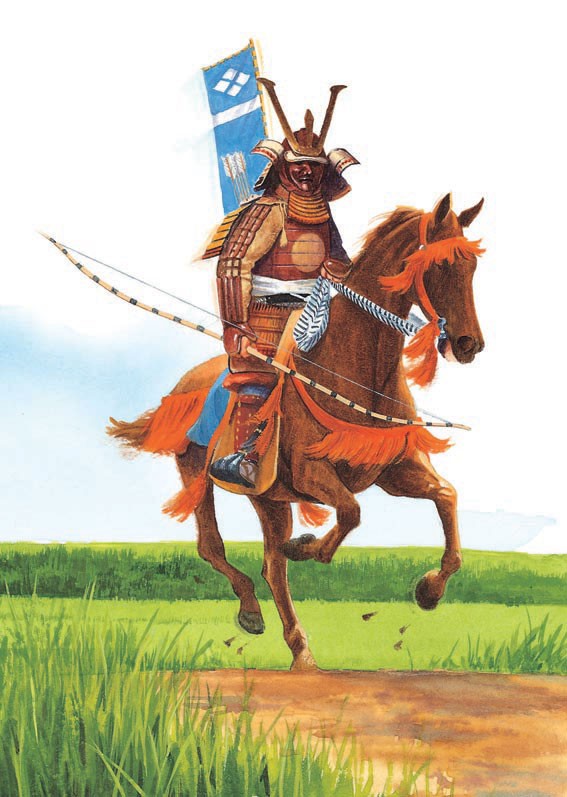
For their weapons, the samurai used swords, bows and arrows, and lances. Guns were not used until the 16th century. The samurai’s favourite weapons were their swords. They were often given names, such as "Knee-Severer", and were thought to have superhuman powers. The samurai’s bow was taller than a man and fired arrows sharp enough to penetrate metal armour.
Samurai wore protective suits of armour that were made of many panels of metal which needed to be fitted together. It could take an hour or more to dress for battle.
Consultant: Philip Parker
pics

Without in any way limiting Q-files Ltd’s exclusive rights under copyright, any use of this publication to “train” generative artificial intelligence (AI) technologies to generate text is expressly prohibited. Q-files Ltd reserves all rights to license use of this work for generative AI training and development of machine learning language models.