
Archaeology

CITE
We have made every effort to follow citation style rules, but there may be some minor differences. If in doubt, please refer to the appropriate citation style manual.
Discovery of Pompeii. (2026). In Q-files Encyclopedia, History, Archaeology. Retrieved from
https://www.q-files.com/history/archaeology/discovery-of-pompeii
"Discovery of Pompeii." History, Archaeology, Q-files Encyclopedia, 3 Jun. 2026.
https://www.q-files.com/history/archaeology/discovery-of-pompeii.
Accessed 13 Sep. 2026.
Discovery of Pompeii 2026. History, Archaeology. Retrieved 13 September 2026, from
https://www.q-files.com/history/archaeology/discovery-of-pompeii
History, Archaeology, s.v. "Discovery of Pompeii," accessed September 13, 2026.
https://www.q-files.com/history/archaeology/discovery-of-pompeii


Discovery of Pompeii
Much of our evidence about life in Roman houses and towns comes from the ruins of two cities, Pompeii and Herculaneum, which were destroyed in AD 79, when the nearby volcano Vesuvius erupted. Pompeii was buried under hot ash, while Herculaneum disappeared under mud washed down from the volcano. Although attempts were made to evacuate the cities, thousands of people were killed. The lost cities remained forgotten for many centuries. Since the 18th century, when the earliest excavations began, whole streets of shops and houses have been uncovered by archaeologists working in both cities.
Updated 20th August 2025

Pompeii

The prosperous city of Pompeii, home to between 10,000 and 20,000 inhabitants, was typical of a Roman market town. A busy harbour brought in ships full of goods from overseas. Wealthy Pompeii merchants traded local produce—wine, cloth and garum (a fish sauce)—for glassware, jewels and spices. People crowded the town’s bars, shops and taverns. Pompeii was located on the Bay of Naples, 200 kilometres (125 miles) southeast of Rome. The bay had good harbours for seagoing ships and the surrounding farmland was very fertile. For these reasons, this area has always had a large population.
Pompeii was built on the southern slopes of Mount Vesuvius, an active volcano. The land was made rich by nutrients in volcanic ash, spread over the land from earlier eruptions. But few people in Pompeii realised that “their” mountain was an active volcano.

Vesuvius erupts
Pompeii and other local towns were destroyed in AD 79, when the volcano Vesuvius erupted. It was once thought that Pompeii was simply buried beneath layers of pumice and ash. Now the evidence strongly suggests that avalanches of rock, glowing red-hot, surged down the slopes of Vesuvius and destroyed the city. Scientists call these avalanches pyroclastic flows (the word “pyroclastic” means “shattered by fire”). They happen when the great cloud of ash and pumice that blasts into the sky after a volcano erupts collapses back down to earth.
Uncovering the ruins
In 1709 a local man digging a well on the spot where Herculaneum once stood found several slabs of marble buried deep in the ground. The remains of the town's theatre were dug up and the city was soon discovered. As soon as the news broke that an ancient city might be buried under the ground near Vesuvius, travellers rushed to the area to see the remains for themselves.
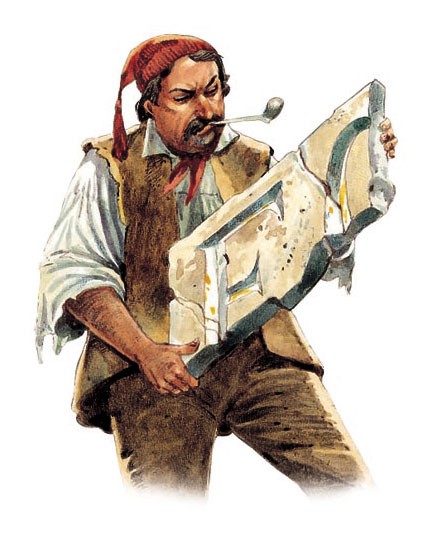

Digging on the site of Pompeii began in 1748. Some of Pompeii’s visitors were treasure hunters, with wheelbarrows and spades. But other people came to study the ruins in order to find out about the past. They made drawings, and tried to imagine what Pompeii’s buildings would have looked like before they were destroyed.

Fiorelli's excavations
In 1860 the archaeologist Giuseppe Fiorelli (1823–1896) was appointed to supervise the excavation of Pompeii. He made sure that proper scientific records were made of Pompeii’s ruins.
First of all, mounds of ash were cleared away. Teams of workers (some were convicts) carried away pumice and ash in straw baskets, watched over by supervisors. They made sure nothing
was stolen.


Fiorelli divided up the site into nine areas (regiones). Every block (insula) and building (domus) inside each region was given a number. This meant that whenever an object was found, its precise position could be recorded. Now scientists could find out much more about how people lived in Roman times. Under Fiorelli's successors, the entire west section of the city was excavated. Significant areas remain unexcavated to this day.

Plaster casts
Giuseppe Fiorelli devised a way of making plaster casts of dead people and animals found at Pompeii. They were the unfortunate ones who could not escape the glowing avalanches that engulfed Pompeii. This woman was buried by ash and pumice (1). The layers of ash and pumice set hard around her body. The soft parts of her body later rotted away, leaving a body-shaped hollow. This was filled with liquid plaster by Fiorelli's workers (2). After the plaster had set hard, the ash was dug away, leaving a perfect cast of the body that once filled the hollow (3). Nowadays, casts are made using a tough, transparent material so we can see the bones inside.


The ruins of Pompeii
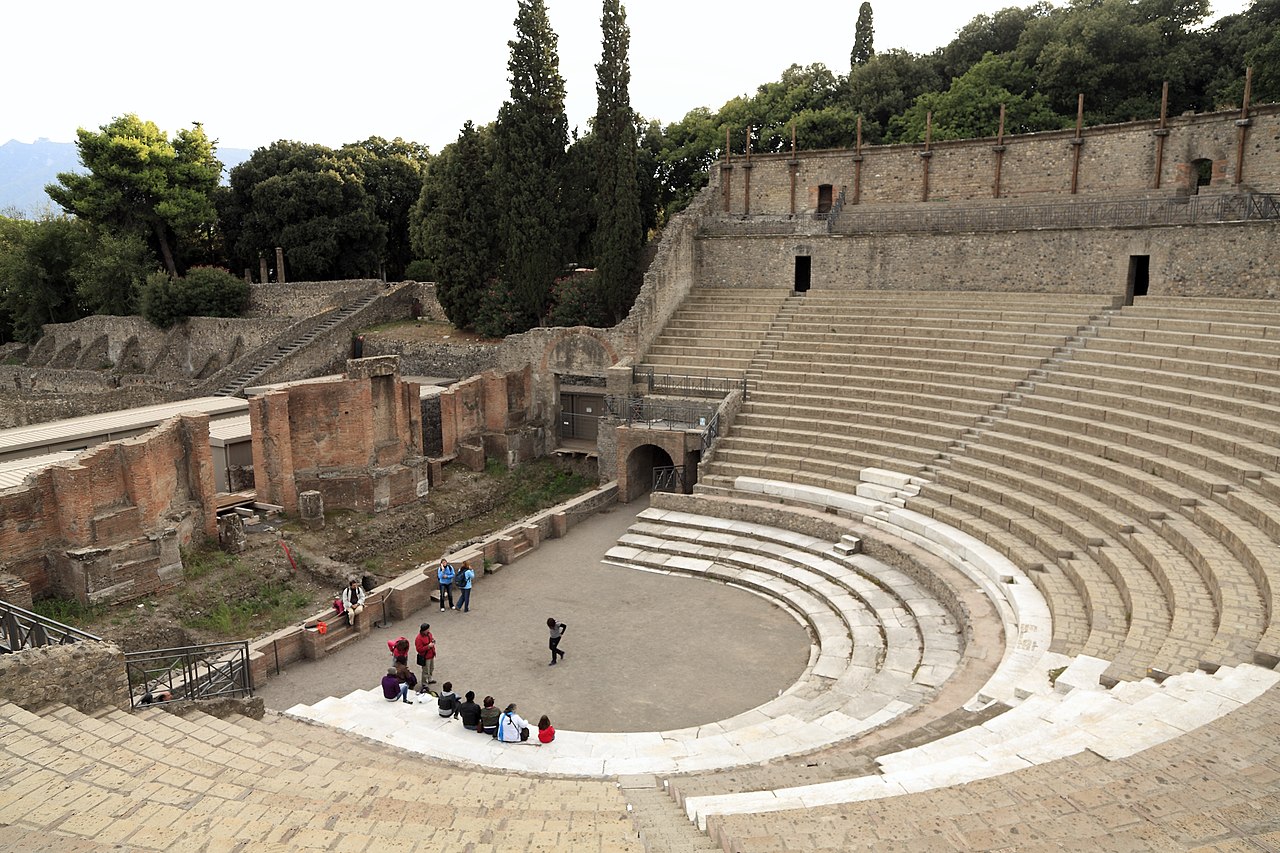
Well-preserved for 2000 years under the ash, Pompeii offers a unique snapshot of life in the Roman Empire, frozen at the moment it was buried. A relatively small provincial city, apart from its amphitheatre Pompeii lacked large buildings on the scale of other Roman cities. It did, however, have a gymnasium with a central natatorium or swimming pool, two theatres, the Eumachia Building—possibly a venue for markets—and at least four public baths. There were at least 31 bakeries, nearly 100 thermopolia (inns or snack bars in which hot food and drinks were sold) and several workshops for the processing of local produce such as wool and garum.
Today, two-thirds of Pompeii has been excavated. The rest, occupying an area of around 22 hectares, is still covered in debris from the eruption. Since being exposed to the weather, the ruins of the ancient city have been steadily deteriorating. The severe earthquake of 1980 and the wear and tear from tourism—around 2.5 million people visit the site each year—have also taken their toll. Today, archaeologists are focused on slowing the decay of the ruins and reconstructing what has been already excavated. Until recently, there were no plans for any further excavation.


Great Pompeii Project
In 2010, one of the excavated buildings in Pompeii, the Schola Armaturarum (gladiators' barracks), collapsed. This event prompted the Italian government and the European Union to fund preservation efforts to save Pompeii for future generations. Called the Grande Progetto Pompei (Great Pompeii Project), its aim was to restore and preserve those parts of the city that had already been uncovered.
Experts realised that the damage to the exposed structures was being caused by the deep layers of earth and rubble in the unexcavated part of northern Pompeii (known as Regio V) pushing against the fragile ruins standing close by. Rainwater seeping through from this unexcavated area was particularly damaging to the site.
So, in order to stabilize the excavated part of the city, a three-kilometre perimeter around Regio V was to be dug out. This would leave a clear space between Regio V's unexplored area and the ruins. It meant a small area of unexplored Pompeii would be newly excavated.
The works, which went on until October 2023, revealed many new treasures and frescoes. The remains of several victims of the eruption were also uncovered, including two men believed to have been a master and a younger man he enslaved. At the Casa del Giardino, archaeologists found a charcoal graffiti inscription dated mid-October AD 79, indicating that the eruption of Vesuvius actually took place on 24th October, not 24th August as was understood from the first-hand account by the Roman writer Pliny the Younger.

Insula 10

With the neighbouring insulae on the Via di Nola in Pompeii's Regio IX having long been exposed, Insula 10, which was still buried under layers of earth and rubble, jutted out like a tongue of land after the Great Pompeii Project had been completed. So it was decided that, in order to protect the surrounding ruins in this area, new excavation work should be carried out on Insula 10. This work began in February 2023.

Insula 10 was found to contain the private home of a wealthy politician named Aulus Rustius Verus. Named Casa del Tiaso (House of Thiasus), it was divided into a residential part adorned with frescoes (wall paintings) and a bakery with a single barred window, where enslaved people were forced to grind the grain needed to produce bread. Skeletons of two adults and a child crushed by falling stones—possibly slaves who were trapped and could not flee the eruption—were discovered in the bakery.
Revealed on a wall in the home’s hallway was a fresco showing a lavish meal with a pizza-like bread at its centre. A banqueting hall—painted black, possibly to hide the traces of soot from the lighting fixtures—has a mosaic floor contains more than a million tiny white tiles. The room is dominated by two frescoes. In one, the god Apollo is seen trying to woo the priestess Cassandra (her rejection of him, according to legend, caused Apollo to ensure her prophecies would never be believed).

In the other, the Trojan prince Paris meets the beautiful Helen, Queen of Sparta. As Cassandra knows, their relationship will trigger the Trojan War. The paintings, experts believe, were intended to provide talking points among the guests during feasts.

Later excavations of the Casa del Tiaso in 2025 uncovered another banqueting hall. This one is ruby-red with large colourful frescoes on three of the walls depicting scenes of the cults of Dionysus, the Greek god of wine. A spacious private bathhouse, complete with hot, warm and cold rooms and a huge plunge pool, was also revealed.

Herculaneum
The ancient Roman town of Herculaneum was, like Pompeii, buried under volcanic ash and pumice in the eruption of Vesuvius. But, unlike Pompeii, the pyroclastic flows that covered Herculaneum turned many wooden objects such as roofs, beds and doors, as well as food and papyrus scrolls (see below) into charcoal. Herculaneum was only mildly affected by the first phase of the eruption. While roofs in Pompeii collapsed under the weight of falling ash and pumice, only a few centimetres of ash fell on Herculaneum, causing little damage. Nevertheless, most of its inhabitants fled. A series of pyroclastic flows then engulfed the town, burying it to about 20 metres (66 feet) depth, preserving structures, objects and victims almost intact.
The remains of Herculaneum were discovered earlier than Pompeii, officially in 1709 when workers were drilling a well, but unofficially by local people during earlier earthworks. Regular excavations began in 1738 and have continued ever since, although still only a fraction of the ancient site has been revealed. A seaside retreat for the Roman elite, Herculaneum was a wealthier town than Pompeii—as demonstrated by the rows of luxurious houses clad in marble.


Herculaneum scrolls
The Herculaneum papyri are more than 1800 papyrus scrolls accidentally discovered by workers in 1752 in what is now known as the Villa of the Papyri in Herculaneum. Subjected to the intense heat of the pyroclastic flows, the scrolls resemble lumps of charcoal at first glance. On closer inspection, the faint trace of lettering seen on the blackened masses reveal their true nature.
Early attempts in the 19th century to open the scrolls—often involving the use of various substances such as mercury or warm water—ended up damaging or destroying them completely. Even if a scroll were successfully opened, the original ink, when exposed to air, began to fade, making it indecipherable. The few fragments of papyri scholars could read were found to contain a number of ancient Greek philosophical texts, many of them written by the 1st-century BC philosopher and poet Philodemus, a resident of Herculaneum.
Modern technology has greatly advanced scholars' ability to read the scrolls. They can be unrolled virtually using 3D X-ray software to extract text from high-res CT scans. Artificial Intelligence algorithms can detect ink on the blackened pages, often by spotting minute changes in the patterns of the papyrus fibres. AI also helps with filling in words missing from the readable text, enabling complete passages to be reconstructed.


In research published in 2024, newly deciphered text appeared to shed light on the final hours of Plato, one of the great philosophers of ancient Greece. It tells how he, a dying man, spent his last evening listening to music played on a flute by a Thracian slave girl. The scroll also reveals Plato's burial place: in the garden of his Athens Academy.
Consultant: Philip Parker
pics


Without in any way limiting Q-files Ltd’s exclusive rights under copyright, any use of this publication to “train” generative artificial intelligence (AI) technologies to generate text is expressly prohibited. Q-files Ltd reserves all rights to license use of this work for generative AI training and development of machine learning language models.