
Romans

CITE
We have made every effort to follow citation style rules, but there may be some minor differences. If in doubt, please refer to the appropriate citation style manual.
Roman baths. (2022). In Q-files Encyclopedia, History, Romans. Retrieved from
https://www.q-files.com/history/romans/roman-baths
"Roman baths." History, Romans, Q-files Encyclopedia, 10 Feb. 2022.
https://www.q-files.com/history/romans/roman-baths.
Accessed 22 Sep. 2026.
Roman baths 2022. History, Romans. Retrieved 22 September 2026, from
https://www.q-files.com/history/romans/roman-baths
History, Romans, s.v. "Roman baths," accessed September 22, 2026.
https://www.q-files.com/history/romans/roman-baths


Roman baths
Few Roman houses had bathrooms. Instead, people paid daily visits to the public baths. All Roman towns had at least one bathhouse and many had several. They were not only places to wash. Baths were also places to exercise, play games, meet people or discuss business. Most Romans, rich and poor, went every day, women in the morning, men in the afternoon. Wealthier Romans brought one or two slaves with them to carry their towels, help wash them and bring them refreshments. The Romans invented an underfloor heating system, or hypocaust, for heating their baths. The water for baths and all other purposes was brought along aqueducts.

Inside a bathhouse

The baths had several rooms and the bathers passed through each one. They undressed and left their clothes in the apodyterium (changing room). From here they might have visited the sudatorium, a hot, steamy room quite like a sauna. They could also enjoy a massage. A door led from the apodyterium to the tepidarium, a warm room where the bathers could relax and get used to the heat.
Next, they moved to the caldarium. This had a hot pool and was the place where people cleaned themselves. Finally, the bathers entered the frigidarium, where there was a cold bath to plunge into. Cold water closed the pores of the skin. In between visiting these rooms, people sat and chatted. People also might do some vigorous exercise, such as going to the gym (the palaestra), before visiting the baths.
Hypocaust
The Romans invented an underfloor heating system, or hypocaust, for heating their baths. The floor was raised on pillars of tiles. Hot air, heated by a furnace in the basement, flowed around the empty spaces between the pillars. The furnace also heated the water for the baths. Servants kept the furnace alight with firewood. Some of the floors were so hot that bathers wore wooden clogs to protect their feet.


Toilets
There was also a public toilet at the baths. Instead of using separate cubicles, people hiked up their togas or tunics, sat down together on long wooden benches with holes cut out, and chatted. Afterwards, they wiped themseves clean with wet sponges on sticks. The waste was carried away to a nearby river by underground sewage channels.
Roman baths today
The Romans built public baths in towns throughout their empire. Some of these can still be seen today. The water in the Great Bath at Bath, England, still flows along the channels made by the Romans. The Romans first built a temple on the site of hot springs there in around AD 70. The temple was itself on the site of a Celtic shrine to their goddess Sulis.
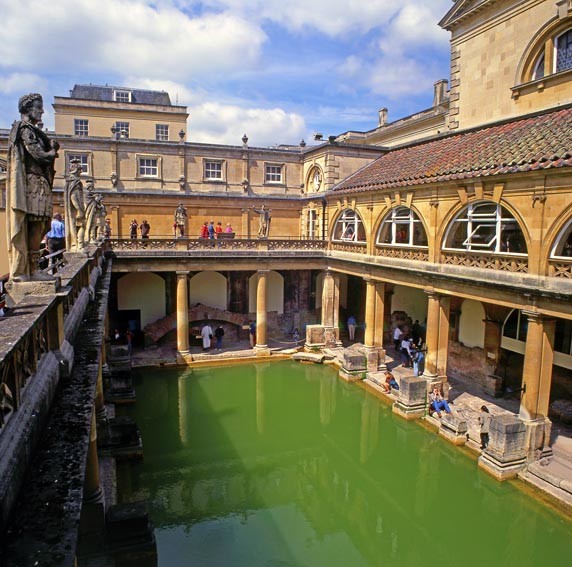
Over the next 300 years, the Romans built up a stately bath complex there, including a great hall over the main bath that rose to a height of 40 metres (130 feet)—making it the tallest building most of its visitors had ever entered.
Consultant: Philip Parker
pics

Without in any way limiting Q-files Ltd’s exclusive rights under copyright, any use of this publication to “train” generative artificial intelligence (AI) technologies to generate text is expressly prohibited. Q-files Ltd reserves all rights to license use of this work for generative AI training and development of machine learning language models.