
Romans

CITE
We have made every effort to follow citation style rules, but there may be some minor differences. If in doubt, please refer to the appropriate citation style manual.
Roman townhouse. (2022). In Q-files Encyclopedia, History, Romans. Retrieved from
https://www.q-files.com/history/romans/roman-townhouse
"Roman townhouse." History, Romans, Q-files Encyclopedia, 10 Feb. 2022.
https://www.q-files.com/history/romans/roman-townhouse.
Accessed 5 Nov. 2026.
Roman townhouse 2022. History, Romans. Retrieved 5 November 2026, from
https://www.q-files.com/history/romans/roman-townhouse
History, Romans, s.v. "Roman townhouse," accessed November 5, 2026.
https://www.q-files.com/history/romans/roman-townhouse


Roman townhouse
Very rich Roman citizens lived in a townhouse, called a domus. It was richly decorated and furnished. It also had a peaceful walled garden, or peristyle, where the owners could relax. Slaves cooked, cleaned and looked after the children. Much information about life in a domus comes from studying wall paintings in the ruins of the town of Pompeii. The town was buried under hot ash in AD 79 when the volcano Vesuvius erupted. Whole streets of shops and houses have been excavated.

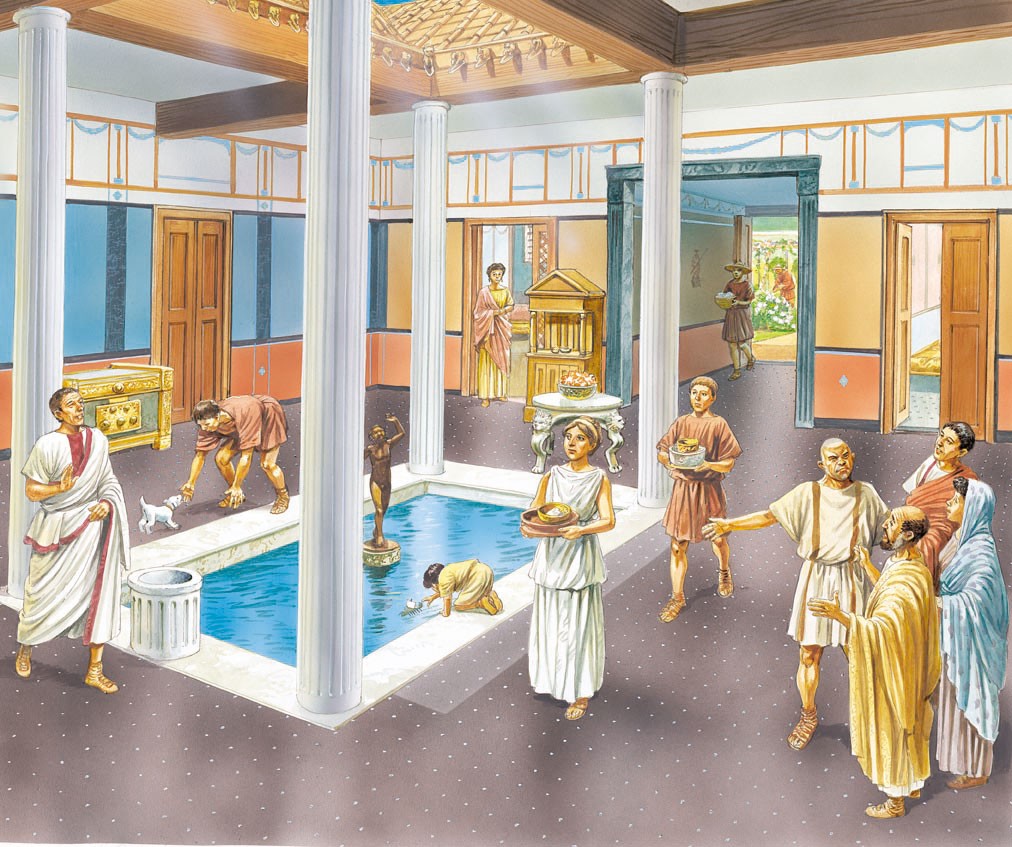
Inside a domus
Although plain on the outside, the inside of a domus was richly decorated and furnished. The rooms were arranged around an atrium, a central area with an open roof to let in light. This had a pool called an impluvium to catch the rainwater that came in through the open roof. The atrium was where visitors were received. The shrine to the lar, the household god, was also kept here. There would be a dining room (triclinium), kitchen, storeroom, bedrooms, offices and toilets. The very richest houses also had a bathroom.
Luxury living

Townhouses were beautifully decorated with paintings on the walls and mosaics on the floors. People lay on couches to eat their meals, which were laid out on low tables by slaves. Clothes, food and books were stored in wooden cupboards and chests. Women and honoured guests could sit on chairs, but everyone else sat on stools. Besides these, there was little furniture. Very wealthy houses had libraries. The inhabitants of the house could stroll in a courtyard, or worship at the shrine of the household god. Villas in cold provinces, such as Britain, had central heating to keep them warm.
Dining
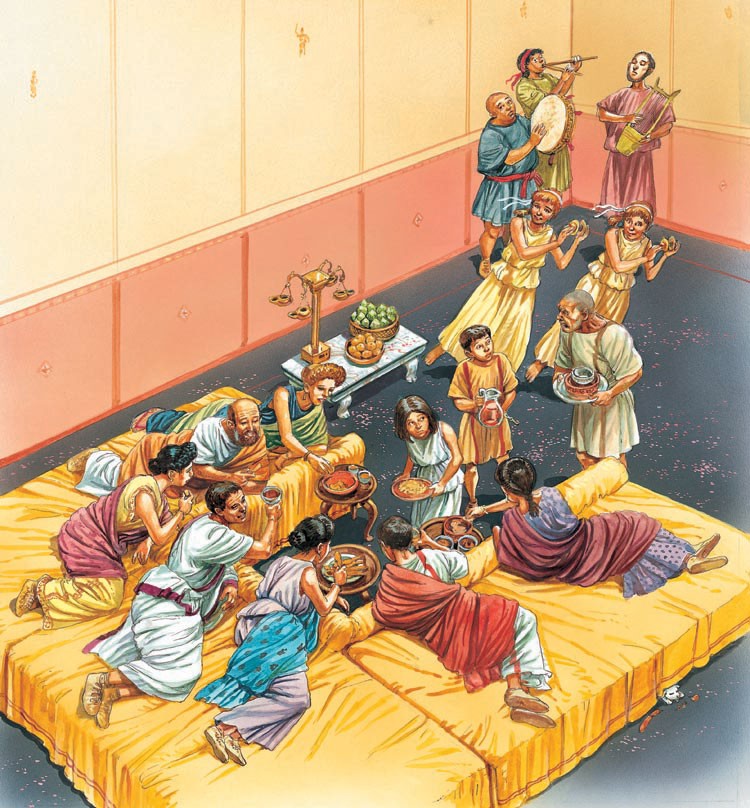
For rich Romans, dinner was a lavish three-course meal with a variety of meats and fish, accompanied by fine wine. It was eaten in the dining room (triclinium). Guests lay on cushioned couches and ate with their fingers, while slaves filled the table with a wide selection of exotic food. On the menu might be such luxuries as pigs' udders, snails, dormice and flamingos’ tongues. In contrast, for poor Romans, dinner might be hot porridge, vegetables, fruit and—on rare occasions—meat.
Peristyle
The richest houses had a peaceful walled garden, or peristyle, where the owners could relax and entertain guests, away from the bustle of the town. Gardens typically had a water feature, trimmed hedges and trees, herbs, grape vines, statues, wall paintings and a colonnade (columned walkway).

Outer rooms
Even the wealthiest Romans often rented the outer rooms of their domus to shops and businesses. These rooms had separate doors that opened on to the street and did not connect with the rest of the house. The shops, called tabernae, also buffered the house from the activity, noises and smells of the street outside. The windows on the domus's outside wall were usually small and high up, so that the noises and smells of the street did not get into the house, and no one could look in. The richest houses had small panes of glass in their windows. Otherwise they used animal hide stretched taut across the window.
Consultant: Philip Parker
pics
Without in any way limiting Q-files Ltd’s exclusive rights under copyright, any use of this publication to “train” generative artificial intelligence (AI) technologies to generate text is expressly prohibited. Q-files Ltd reserves all rights to license use of this work for generative AI training and development of machine learning language models.