
History of London

CITE
We have made every effort to follow citation style rules, but there may be some minor differences. If in doubt, please refer to the appropriate citation style manual.
Roman London. (2026). In Q-files Encyclopedia, History, History of London. Retrieved from
https://www.q-files.com/history/history-of-london/roman-london
"Roman London." History, History of London, Q-files Encyclopedia, 24 Apr. 2026.
https://www.q-files.com/history/history-of-london/roman-london.
Accessed 6 Aug. 2026.
Roman London 2026. History, History of London. Retrieved 6 August 2026, from
https://www.q-files.com/history/history-of-london/roman-london
History, History of London, s.v. "Roman London," accessed August 6, 2026.
https://www.q-files.com/history/history-of-london/roman-london


Roman London
London was founded by the Romans, conquerors of Britain around 2000 years ago. Although there is evidence of scattered Celtic settlements in the area, the first major settlement, Londinium, was built by the Romans soon after the invasion of AD 43. They may have named it after a British Celtic placename, Londonjon. Before the Roman settlement, the River Thames (somewhat wider than it is today) meandered through a sparsely populated area of marshes and woodland.


Prehistory
About 120,000 years ago, during the Pleistocene Ice Ages, woolly mammoths and rhinoceroses roamed across the valley of the Thames in the area that is now London. They were hunted by early humans. Much later, around 6500 years ago, people started to farm the land, make weapons and tools, and build small villages in the area. Archaeologists have found the remains of a wooden bridge near Vauxhall, which was probably built in about 1500 BC. It may have crossed the Thames, or just led to an island in the river which has now been lost. By the beginning of the Iron Age, around 650 BC, what is now the sprawling metropolis of Greater London was a patchwork of woodland, marshland, mudflats, fields and scattered farming communities.
Londinium

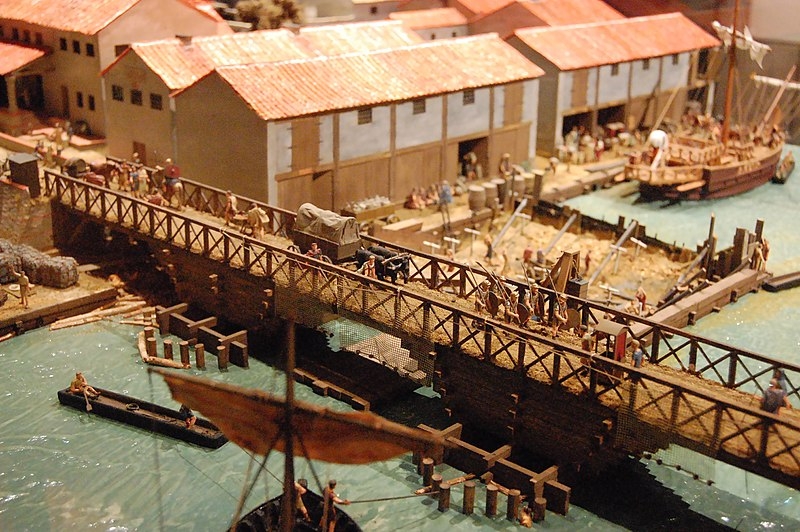
London was founded by the Romans, who saw the opportunity to establish a port on the River Thames. They built their first settlement, in around 50 AD, on a level area of slightly elevated, well-drained land on the north banks of the river (the site of the City of London today). Sailing inland from the sea up the Thames Estuary, it was the first point where the river was narrow enough to be bridged. The first settlement was shortlived, however: during an attack by the Iceni tribe led by Queen Boudicca in 60 AD, it was burned to the ground.
The second settlement, which the Romans named Londinium, grew up around a port rebuilt later in the 1st century. The Romans also constructed a fort, an amphitheatre, a forum and public baths and made Londinium the capital city of the province of Britannia. People came from all over the Roman Empire, including northern Africa, to live there, and so it became one of the empire’s most multicultural cities. By 150 AD London had a population of around 30,000.

Wall
Around the year 200 AD, the Romans built a defensive stone wall around Londinium. It was about 5.5 metres (18 feet) high, equivalent to the height of three adult men. The wall would survive for another 1600 years and define the city's boundary for centuries. The remains of this wall can still be seen today, not far inside the boundary of the modern-day City of London, the financial district in the heart of London. The gates are marked by the names of London districts or streets today: Ludgate, Bishopsgate, Aldgate, Moorgate, Billingsgate and others.

By 410, the Roman garrison had left Britain, and the Emperor Honorius decided no more Roman troops would be sent to defend it from attacks by Saxon and other German tribes. By the end of the 5th century, eastern Britain was under Anglo-Saxon control, and London, now deserted, was left to ruin.
Consultant: Philip Parker
pics
Without in any way limiting Q-files Ltd’s exclusive rights under copyright, any use of this publication to “train” generative artificial intelligence (AI) technologies to generate text is expressly prohibited. Q-files Ltd reserves all rights to license use of this work for generative AI training and development of machine learning language models.