
Planets and moons

CITE
We have made every effort to follow citation style rules, but there may be some minor differences. If in doubt, please refer to the appropriate citation style manual.
Callisto. (2026). In Q-files Encyclopedia, Space, Planets and moons. Retrieved from
https://www.q-files.com/space/planets-and-moons/callisto
"Callisto." Space, Planets and moons, Q-files Encyclopedia, 25 Mar. 2026.
https://www.q-files.com/space/planets-and-moons/callisto.
Accessed 22 Sep. 2026.
Callisto 2026. Space, Planets and moons. Retrieved 22 September 2026, from
https://www.q-files.com/space/planets-and-moons/callisto
Space, Planets and moons, s.v. "Callisto," accessed September 22, 2026.
https://www.q-files.com/space/planets-and-moons/callisto


Callisto
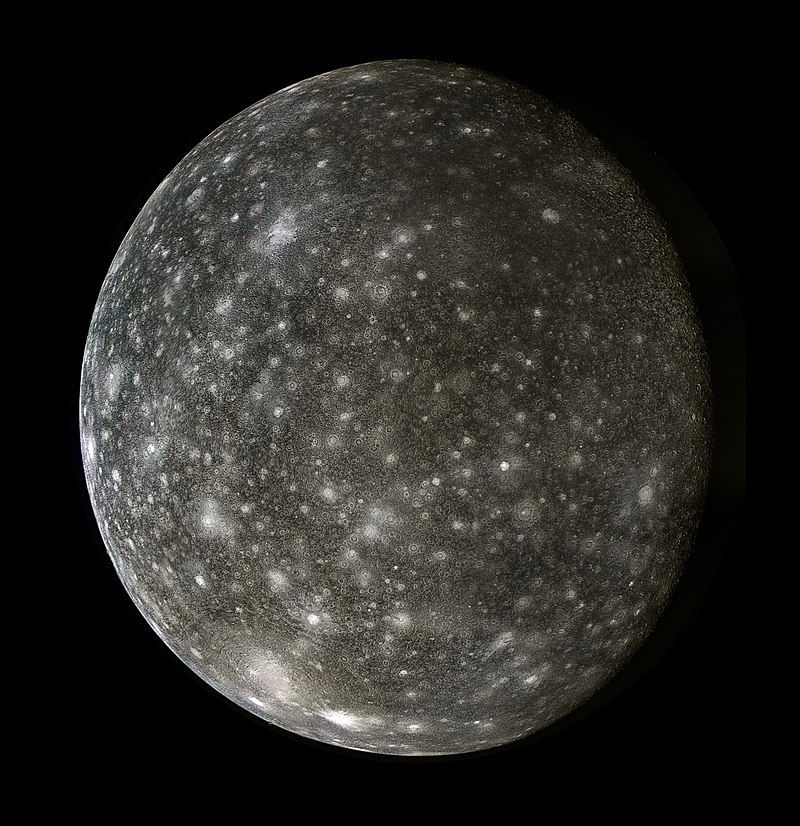
Callisto is Jupiter’s second largest moon—one of the four Galilean moons. Its average diameter measures 4806 kilometres (2985 miles). For its size, Callisto has more craters than any other planet or moon in the Solar System. Its largest crater, called Valhalla, is a series of circular ridges, one inside the other, extending outwards like frozen ripples on a pond about 1900 kilometres (1200 miles) from its centre. Callisto has a thick crust made of a mixture of water ice and rock, making it look a little like a “dirty snowball”. A salty ocean 150–200 kilometres deep, may lie beneath the crust.


Orbit
Callisto is the outermost of the four Galilean moons. It orbits Jupiter at an average distance of 1,883,000 kilometres (1,170,000 miles), which is about six times farther out than the Moon's orbit of Earth. Here, the radiation from planet's powerful magnetic field is relatively low compared to that experienced on the other Galieans. For this reason Callisto is considered to be the best bet to host possible future crewed missions.
Callisto's distance from Jupiter means it is not in an orbital resonance like the other three Galileans, Io, Europa and Ganymede, so it is not subject to the tidal heating that affects those moons. Callisto's rotation is, however, tidally locked to its orbit around Jupiter, so that it always presents the same face to it. The length of the moon's day—the same as its orbital period—is about 16.7 Earth days.
Composition
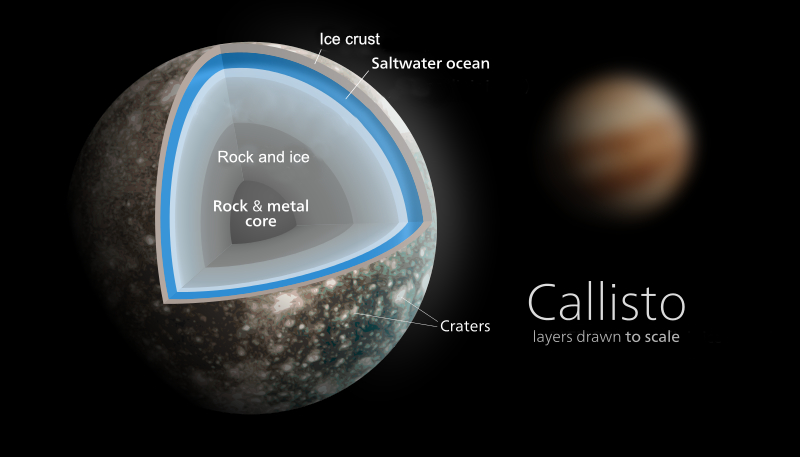
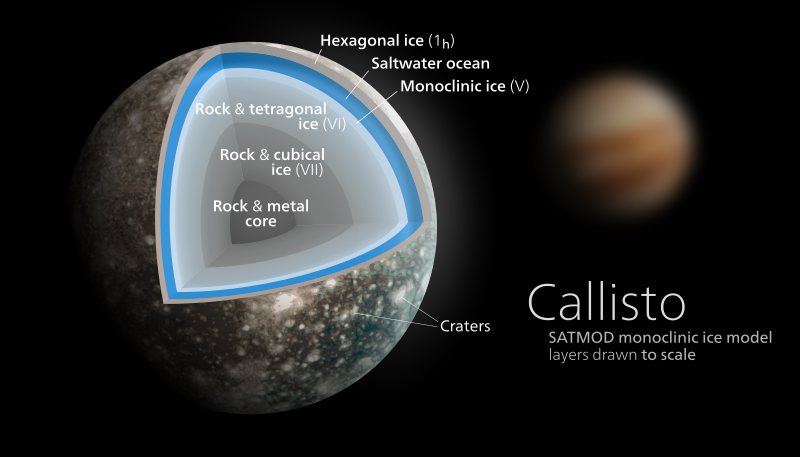
Callisto's battered crust is between 80 and 150 kilometres (50–90 miles) thick. A saltwater ocean may lie between 150 and 200 kilometres (90–125 miles) beneath the crust. It is not impossible that microbial life-forms called halophiles (organisms that thrive in salty environments) may exist in Callisto's ocean, but scientists think the conditions necessary for life appear to be less favourable here than on Europa. Callisto's ocean is heated only by radioactive decay, while that of Europa is also heated by tidal energy because its orbit lies much closer to Jupiter.
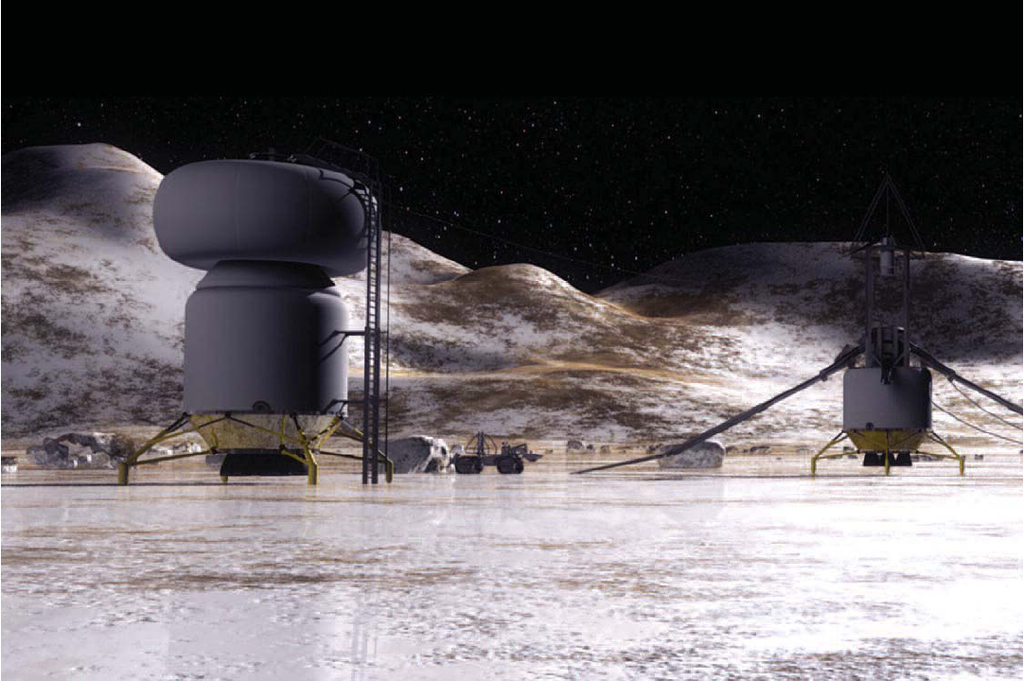
Callisto is composed of approximately equal amounts of rock and water ice. Investigation by the Galileo space probe revealed that it may have a small core made of silicate rock. There is no evidence of plate tectonics or volcanic activity on Callisto. Instead, the moon has been shaped mainly as a result of impacts from asteroids, comets and meteoroids.
pics
Without in any way limiting Q-files Ltd’s exclusive rights under copyright, any use of this publication to “train” generative artificial intelligence (AI) technologies to generate text is expressly prohibited. Q-files Ltd reserves all rights to license use of this work for generative AI training and development of machine learning language models.