
Planets and moons

CITE
We have made every effort to follow citation style rules, but there may be some minor differences. If in doubt, please refer to the appropriate citation style manual.
Io. (2026). In Q-files Encyclopedia, Space, Planets and moons. Retrieved from
https://www.q-files.com/space/planets-and-moons/io
"Io." Space, Planets and moons, Q-files Encyclopedia, 25 Mar. 2026.
https://www.q-files.com/space/planets-and-moons/io.
Accessed 21 Sep. 2026.
Io 2026. Space, Planets and moons. Retrieved 21 September 2026, from
https://www.q-files.com/space/planets-and-moons/io
Space, Planets and moons, s.v. "Io," accessed September 21, 2026.
https://www.q-files.com/space/planets-and-moons/io


Io
Io, Jupiter's third largest Galilean moon, has an average diameter of 3630 kilometres (2255 miles). With a surface coloured a vivid mix of yellows, oranges, reds and blacks, Io’s surface looks a little like a pizza. In fact, it is covered with active volcanoes and lava flows. In 1979 the space probe Voyager 1 witnessed eruptions in which plumes of sulphur dioxide gas burst through from Io’s rocky interior, jetting 300 kilometres (200 miles) above the surface. Astronomers believe that Io is being affected by the gravitational pull of nearby Jupiter which tugs at the moon, generating sufficient heat deep inside the moon to cause the eruptions.


Orbit
The innermost of the four Galilean moons, Io orbits Jupiter at a distance of 350,000 kilometres (217,000 miles) from the giant planet's cloud tops. When Jupiter's other smaller inner moons are included, Io is the fifth moon out from Jupiter. It takes about 42.5 hours (1.77 days) to complete a single orbit around Jupiter.
Io completes two orbits of Jupiter for every one orbit completed by Europa, and four for every one by Ganymede. This pattern produces what is called orbital resonance. It boosts the gravitational pull the moons have upon one another, forcing the orbits of Io and Europa to become slightly elliptical, or eccentric.
Volcanoes
When Voyager I sent back the first pictures of Io in 1979, scientists expected to see numerous impact craters. They were surprised to find there were almost none at all. Io's surface was instead covered in smooth plains dotted with tall mountains, pits of various shapes and sizes and volcanic lava flows. The lack of impact craters indicated that Io's surface was geologically young, with lava continuously erupting and smoothing over the craters.

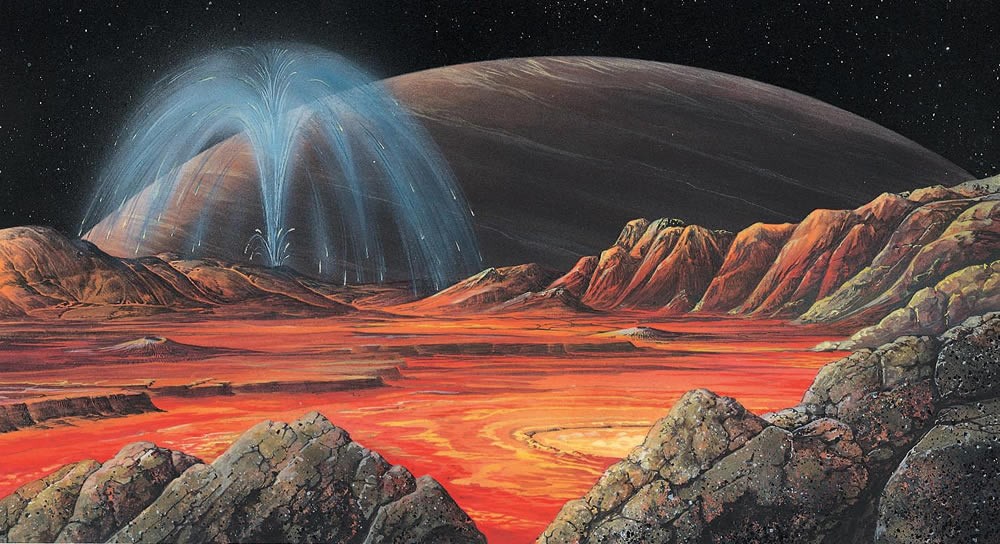

Io is, in fact, the most volcanically active world in the Solar System. It has over 400 active volcanoes, constantly spewing out lava across the ground or ejecting gas and dust into space. Several of Io's volcanoes erupt plumes of sulphur dioxide as high as 500 kilometres (300 miles) above the surface. Io's plains are coated with sulphur, producing shades of yellow, red, white, black and green.
Thanks to orbital resonances with its fellow Galilean moons, Io's orbital path is elliptical (oval-shaped) rather than circular. This means that for part of its orbit it moves closer to Jupiter before moving further away. The giant planet's powerful gravity pulls it this way and that as the moon approaches and retreats. This causes friction inside Io, the heat from which melts the rocks beneath its crust. This is known as tidal heating. As a result, Io's volcanoes erupt as magma from below the crust forces its way up under high temperature and pressure.
Io's surface is dotted with volcanic depressions known as paterae. Like volcanic calderas found on Earth, they generally have flat floors rimmed by steep walls, although most generally do not lie atop shield volcanoes. Io's paterae are also generally larger than Earth's calderas, with an average diameter of 41 kilometres (25 miles). Loki Patera, the largest, is 202 kilometres (126 miles) wide.
Lava flows are another major volcanic feature on Io; several are more than 500 kilometres (300 miles) in length. Magma erupts on to the surface from vents in the floors of paterae or through fissures on to the surrounding plains, producing flows similar to those seen at Kilauea, Hawaii.


Mountains
Io's surface is also dotted with between 100 and 150 mountains, averaging 6000 metres (20,000 feet) in height. Some of them are taller than Mount Everest, Earth's highest point. Some of io's mountains are isolated, flat-topped features. Almost none of them are volcanic in origin, but the result of compressive forces causing chunks of Io's crust to be pushed upwards through thrust faulting.
Plasma torus
Io's volcanoes release around one tonne of sulphur dioxide every second. The sulphur and oxygen atoms become ionized (electrically charged) and are swept up by Jupiter’s fast-rotating magnetic field (magnetosphere). The particles form what is known as the Io plasma torus—a doughnut-shaped ring surrounding Jupiter. As a result Jupiter's magnetic field is inflated to more than twice the size it would otherwise be. It is the combination of a strong magnetic field, Io’s source of ionized particles and the planet’s rapid spin that drives Jupiter's intense radiation.

Composition

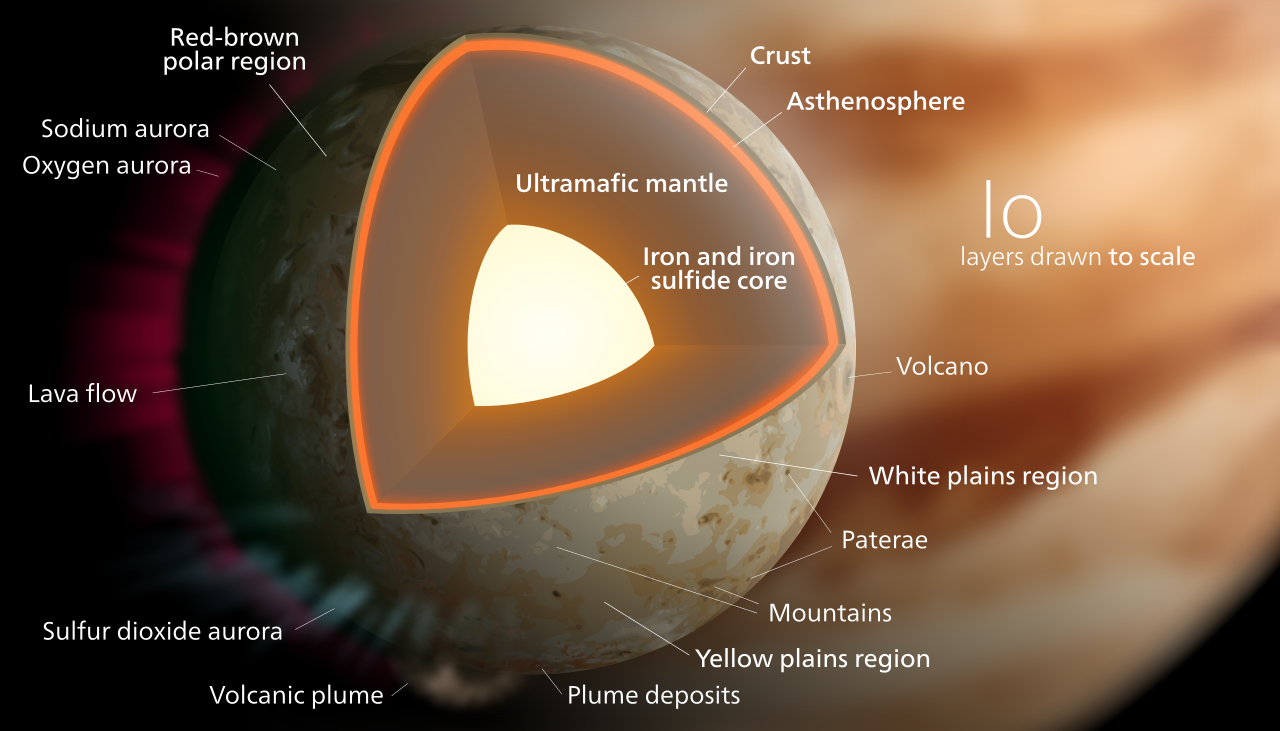
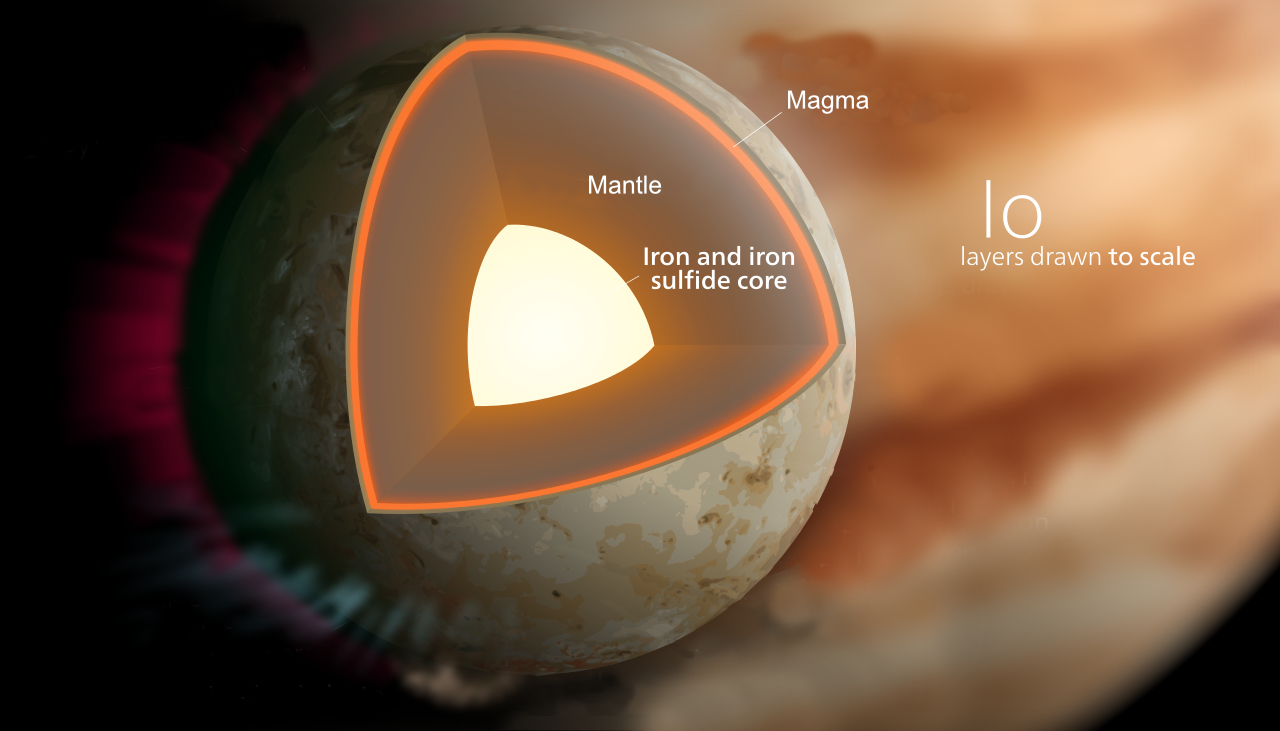
Composed mainly of silicate rock and iron, Io is more similar to the terrestrial planets than to other moons in the outer Solar System, which are mostly composed of a mix of water ice and rock. Io's rocky crust is between 12 and 40 kilometres (7.5–25 miles) thick. It overlies a magma ocean 50 kilometres (30 miles) thick. A metallic core, made of iron or iron sulphide, makes up approximately 20% of Io's mass.
pics
Without in any way limiting Q-files Ltd’s exclusive rights under copyright, any use of this publication to “train” generative artificial intelligence (AI) technologies to generate text is expressly prohibited. Q-files Ltd reserves all rights to license use of this work for generative AI training and development of machine learning language models.