
Planets and moons

CITE
We have made every effort to follow citation style rules, but there may be some minor differences. If in doubt, please refer to the appropriate citation style manual.
Europa. (2026). In Q-files Encyclopedia, Space, Planets and moons. Retrieved from
https://www.q-files.com/space/planets-and-moons/europa
"Europa." Space, Planets and moons, Q-files Encyclopedia, 25 Mar. 2026.
https://www.q-files.com/space/planets-and-moons/europa.
Accessed 21 Sep. 2026.
Europa 2026. Space, Planets and moons. Retrieved 21 September 2026, from
https://www.q-files.com/space/planets-and-moons/europa
Space, Planets and moons, s.v. "Europa," accessed September 21, 2026.
https://www.q-files.com/space/planets-and-moons/europa


Europa
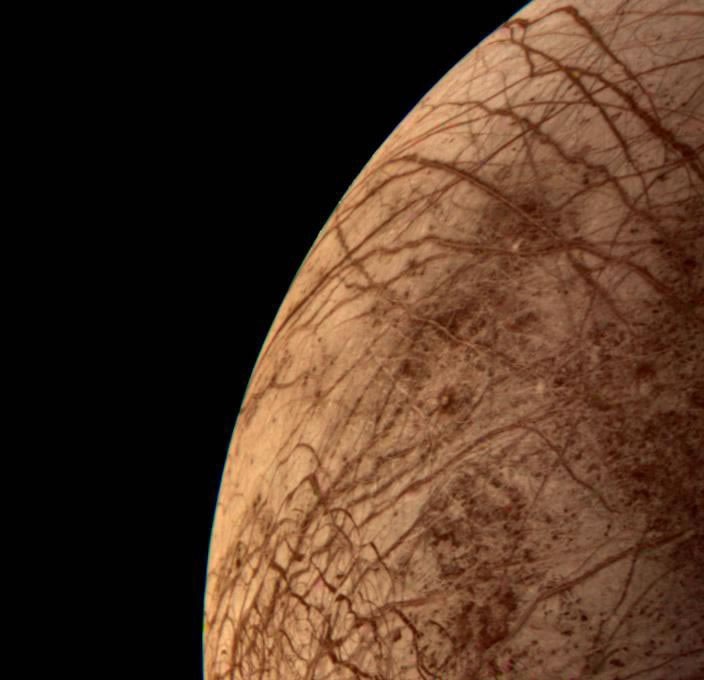
For astronomers searching for life on other worlds in the Solar System, Europa, one of Jupiter’s Galilean moons, is of special interest. Europa measures 3140 kilometres (1950 miles) across on average. It has a smooth, icy surface covered with reddish streaks called lineae, thought to be cracks in the crust. Scientists are fairly sure that below the ice there is a warm-water ocean. When Europa’s orbit takes it close to Jupiter, the planet’s gravity raises tides on this ocean, causing the icy crust above it to bulge and crack open. It is the power of these tides that warms the ocean enough to keep it in a liquid state. Just possibly, Europa's ocean could be home to living things.

Composition

Europa probably has a layer of liquid saltwater around 100 kilometres (60 miles) thick, covered by a crust of solid ice approximately 10 to 30 kilometres (6–20 miles) in depth. Beneath the water layer there is likely to be a rocky mantle and a metallic iron core.

Orbit
Of the four Galilean moons Europa is the second nearest to Jupiter. It orbits Jupiter at an average distance of about 670,900 kilometres (416,700 miles), completing a single orbit in just over three and a half days. Like its fellow Galileans, Europa is tidally locked to Jupiter, with one hemisphere constantly facing its parent planet.
Due to its orbital resonances with Io and Ganymede, Europa's orbit is slightly elliptical rather than circular. When Europa comes a little nearer to Jupiter, the giant planet's gravitational pull increases, causing Europa to bulge. As Europa moves further away, Jupiter's gravitational force decreases, causing Europa to relax back into a spherical shape. This is known as tidal flexing. The same process is at work on Io, where tidal flexing creates intense volcanic activity. On Europa, tidal flexing causes crustal movements (see below).


Evidence for an ocean
The Galileo space probe, which orbited Jupiter from 1995 to 2003, discovered that Europa has a weak magnetic field. Its existence indicates there is a layer inside the moon that conducts electricity. The most likely candidate for this is a large ocean of liquid saltwater beneath its solid icy crust.
In 2012 the Hubble Space Telescope detected water vapour plumes erupting from Europa to a height of about 200 kilometres (120 miles) above the surface. Scientists think these burst through the cracks in the moon’s thin crust.
Plate tectonics

Just as on Earth, whose outer layer is split into a number of giant tectonic plates slowly drifting around its globe, so Europa’s crust is known to be constantly on the move. Earth’s plates float like rafts on a semi-liquid underlayer of very hot, molten rock. The movement of Europa’s outer layer strongly indicates that it, too, is not solidly attached to its internal core, but floats on a liquid underlayer—not of molten rock but of a warm water.


Europa’s geology may therefore resemble that on Earth, where the tectonic plates are being eased apart at the mid-oceanic ridge by magma pushing up from beneath, powered by geothermal energy. On Europa, these crustal movements are caused by the gravitational pull of its giant parent planet, Jupiter (see above). Where Europa's crust cracks open, water from below forces its way to the surface, spreads out and freezes. These cracks are known as lineae.
Life on Europa?
There are three key ingredients that make life possible in any world: liquid water, energy and chemistry. Europa probably has liquid water in the vast ocean beneath its crust. Energy comes in the form of heat produced by tidal flexing caused by Jupiter's immense gravity. The presence of the necessary chemical elements is the least certain. Key elements forming the building blocks of life, such as carbon, hydrogen, nitrogen, oxygen, phosphorus and sulphur, may have been incorporated into Europa as the moon formed.

Later, asteroids and comets collided with the moon, leaving behind clay-like minerals often associated with organic matter on Earth. Sulphur detected on Europa's surface is thought to have orginated from the many erupting volcanoes on its sister moon Io. Drifting through space to coat the surface of Europa, the sulphur then reacted with the water in the frozen crust to form sulphur dioxide.

Europa’s internal ocean, estimated at about 100 kilometres (60 miles) deep, is thought by many scientists to be, along with Enceladus, a moon of Saturn, the most likely location of extraterrestrial life in the Solar System—if it exists anywhere at all. Other candidates include Mars, Titan, Pluto, Europa's fellow Galileans Ganymede and Callisto, all of which are suspected to have underground oceans, and the atmosphere of Venus.
On Europa, organisms might live clustered around mineral-rich hydrothermal vents in the ocean floor just like those in Earth’s oceans, or inside the rocks that form the Europan ocean bed. Alternatively, they might float or swim freely in the ocean waters, or cling to the lower surface of the icy crust, like algae and bacteria do to the Arctic ice on Earth. The level of oxygen in the oceans might even be enough to support not just microbes, but larger, more advanced life-forms.
Europa Clipper

Launched on 14th October 2024, Europa Clipper is a space probe developed by NASA specially to study Europa—to investigate its potential for harbouring life and select a possible future landing site for another probe. Europa Clipper is expected to arrive into orbit around Jupiter in April 2030, from where it will perform a series of more than 40 flybys of Europa. Under this plan it will avoid the harsh radiation fields surrounding Jupiter. The mission is equipped with nine scientific instruments, including cameras, mass spectrometers, a thermal emission imaging system, a magnetometer and a radar.
Consultant: Mike Goldsmith
pics

Without in any way limiting Q-files Ltd’s exclusive rights under copyright, any use of this publication to “train” generative artificial intelligence (AI) technologies to generate text is expressly prohibited. Q-files Ltd reserves all rights to license use of this work for generative AI training and development of machine learning language models.