
Planets and moons

CITE
We have made every effort to follow citation style rules, but there may be some minor differences. If in doubt, please refer to the appropriate citation style manual.
Neptune. (2026). In Q-files Encyclopedia, Space, Planets and moons. Retrieved from
https://www.q-files.com/space/planets-and-moons/neptune
"Neptune." Space, Planets and moons, Q-files Encyclopedia, 25 Mar. 2026.
https://www.q-files.com/space/planets-and-moons/neptune.
Accessed 6 Aug. 2026.
Neptune 2026. Space, Planets and moons. Retrieved 6 August 2026, from
https://www.q-files.com/space/planets-and-moons/neptune
Space, Planets and moons, s.v. "Neptune," accessed August 6, 2026.
https://www.q-files.com/space/planets-and-moons/neptune


Neptune
Neptune is the eighth planet from the Sun—the most distant of the true planets. Grouped with Uranus as one of the two "ice giants", it is the fourth largest planet in the Solar System. Mostly composed of gases and liquids, it has no solid surface. Little was known about Neptune until Voyager 2 paid it a visit in 1989. Like Uranus it is almost completely featureless, although clouds and storms can sometimes be seen on its surface. Both planets are a similar shade of duck-egg blue, the blueness resulting from high levels of methane, a gas that absorbs green and red light, in their atmospheres. (Neptune used to be shown as deep blue because images of it were contrast-enhanced to bring out its fainter features). Neptune has 16 known moons. Triton, the only one that is near-spherical rather than irregular in shape, is by far the largest of them.


Discovery
Neptune was first observed by German astronomer Johann Galle in September 1846, following key calculations to pinpoint its position almost exactly made by the French mathematician, Urbain Le Verrier. Noting that Uranus was being pulled slightly off course, French astronomer Alexis Bouvard had in 1821 concluded that the pull of gravity from another large planet farther away from the Sun was responsible. British astronomer John Couch Adams independently calculated where Neptune would be at roughly the same time, but Le Verrier is usually credited with the planet's discovery.
Rings
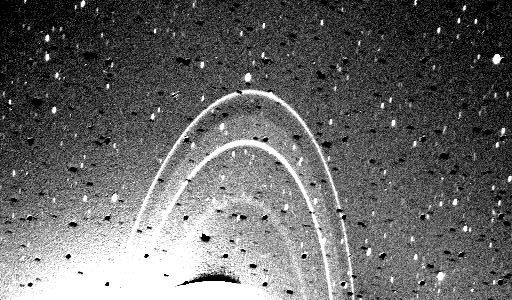
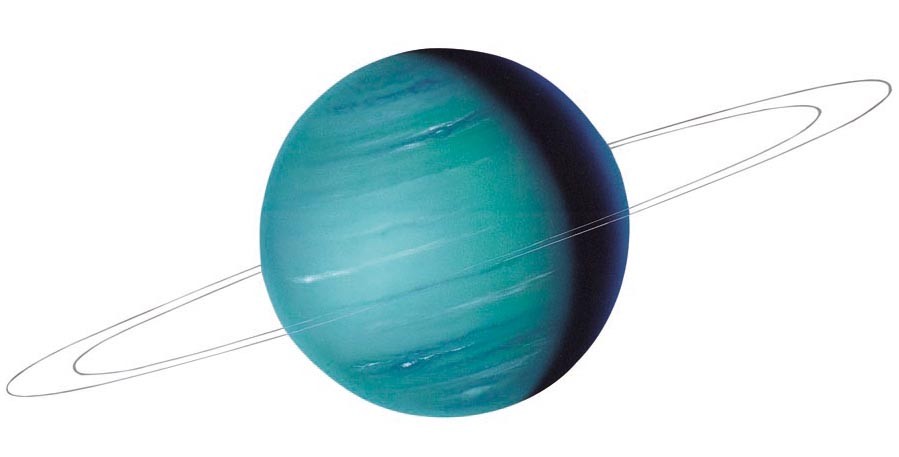
Neptune, in common with all the other gas giants, has rings. Discovered using an Earth-based telescope in 1984, there are five extremely faint rings, two broad, three narrow, all composed of dark, icy fragments ranging in size from dust to blocks the size of a small car. The outermost ring consists of material clumped together like sausages on a string.
Winds
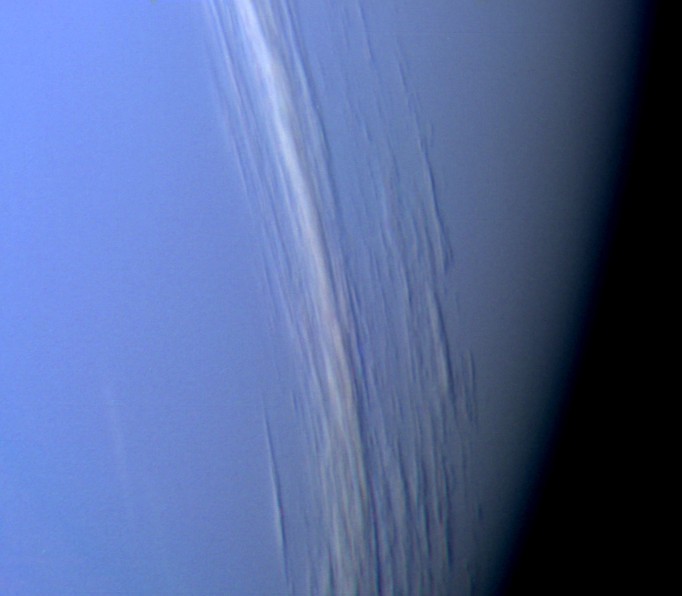
At the time it was photographed by Voyager, a storm system called the Great Dark Spot could be seen travelling in a direction opposite to Neptune’s rotation. Along with wispy high-altitude white clouds circulating overhead, it was zooming round at more than 2000 km/h (1200 mph)—the fastest winds in the Solar System. The Great Dark Spot has since disappeared, but other dark spots similar to it have been observed before also vanishing.
Neptune's storm systems are driven by a powerful source of heat from within the planet, one that is almost completely absent from its sister planet, Uranus. No one has yet been able to explain this with certainty. It might be heat left over from the planet’s formation.
Moons
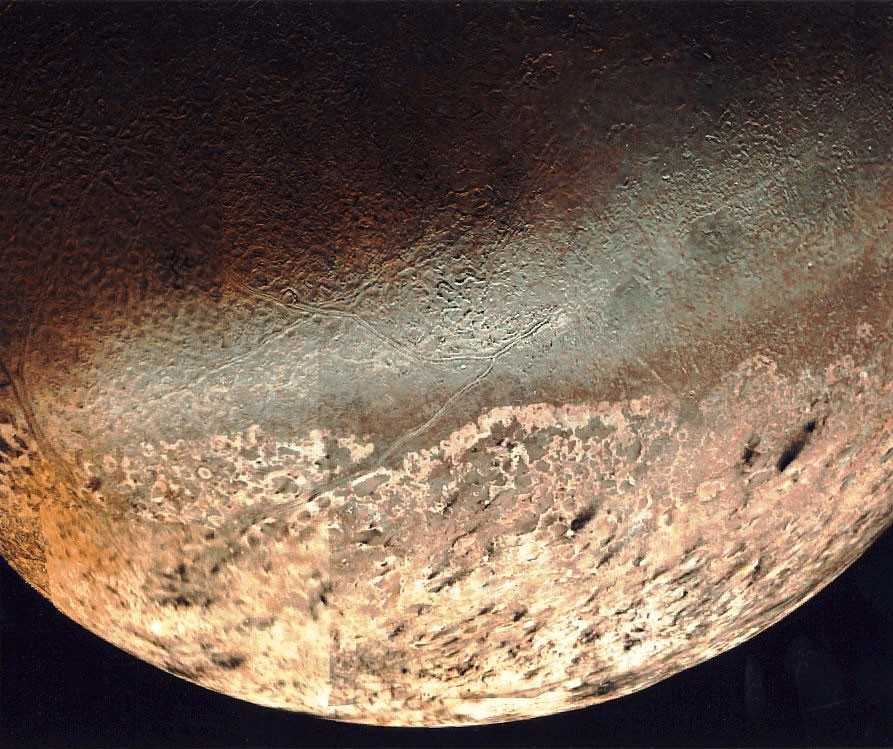
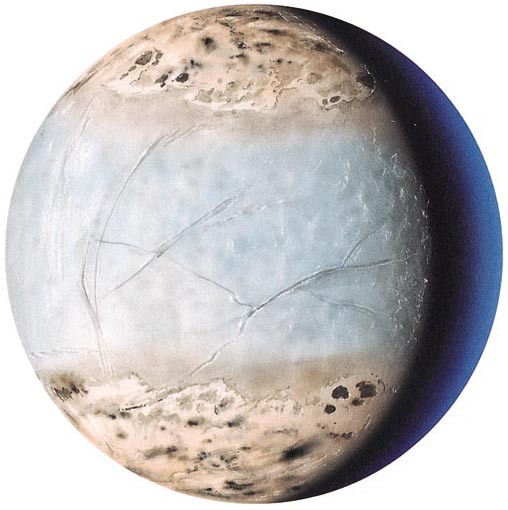
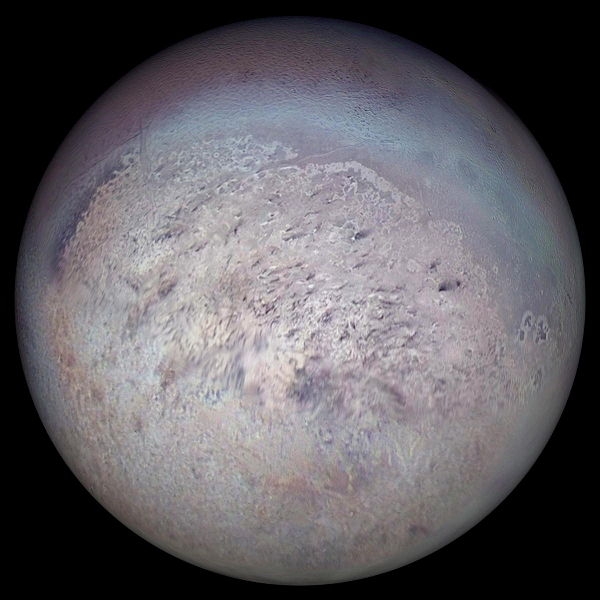
Triton, by far the largest of Neptune's moons, was discovered a few days after Neptune itself. Unlike any other major moon in the Solar System, it orbits its parent in the direction opposite to Neptune’s rotation. At -235°C, it is the one coldest known objects in the Solar System. Triton was photographed in stunning detail by Voyager 2.
Nereid was the second moon to be discovered, in 1949. It has a very unusual orbit: the point at which it passes closest to Neptune is seven times the distance it is farthest away. Neptune's innermost four moons, Naiad, Thalassa, Despina and Galatea, orbit inside Neptune's rings. Neptune was god of the sea, so its moons have been named after lesser sea gods.


Proteus, Neptune’s second largest moon, is a mis-shapen, rocky lump measuring on average just 400 kilometres (250 miles) across. It is almost completely covered by craters, with some grooves and valleys in the few areas where there are no craters. The largest crater is Pharos, which is more than 230 kilometres (140 miles) in diameter.
Although it is larger than Nereid, Proteus was not discovered by Earth-based telescopes. This is because it orbits so close to Neptune that it is lost in the glare of reflected sunlight. It was first spotted by Voyager 2 instead.
Webb image of Neptune
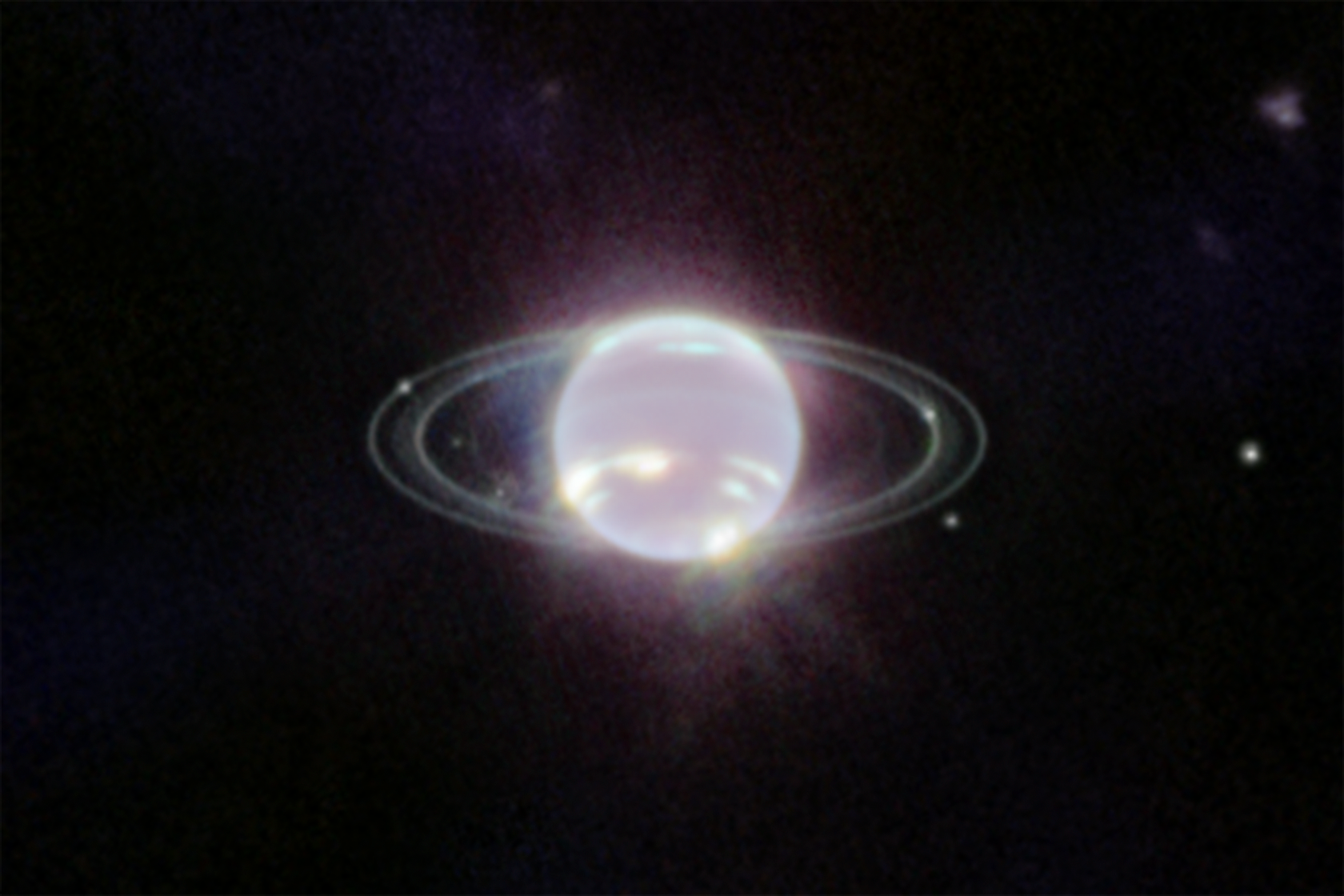
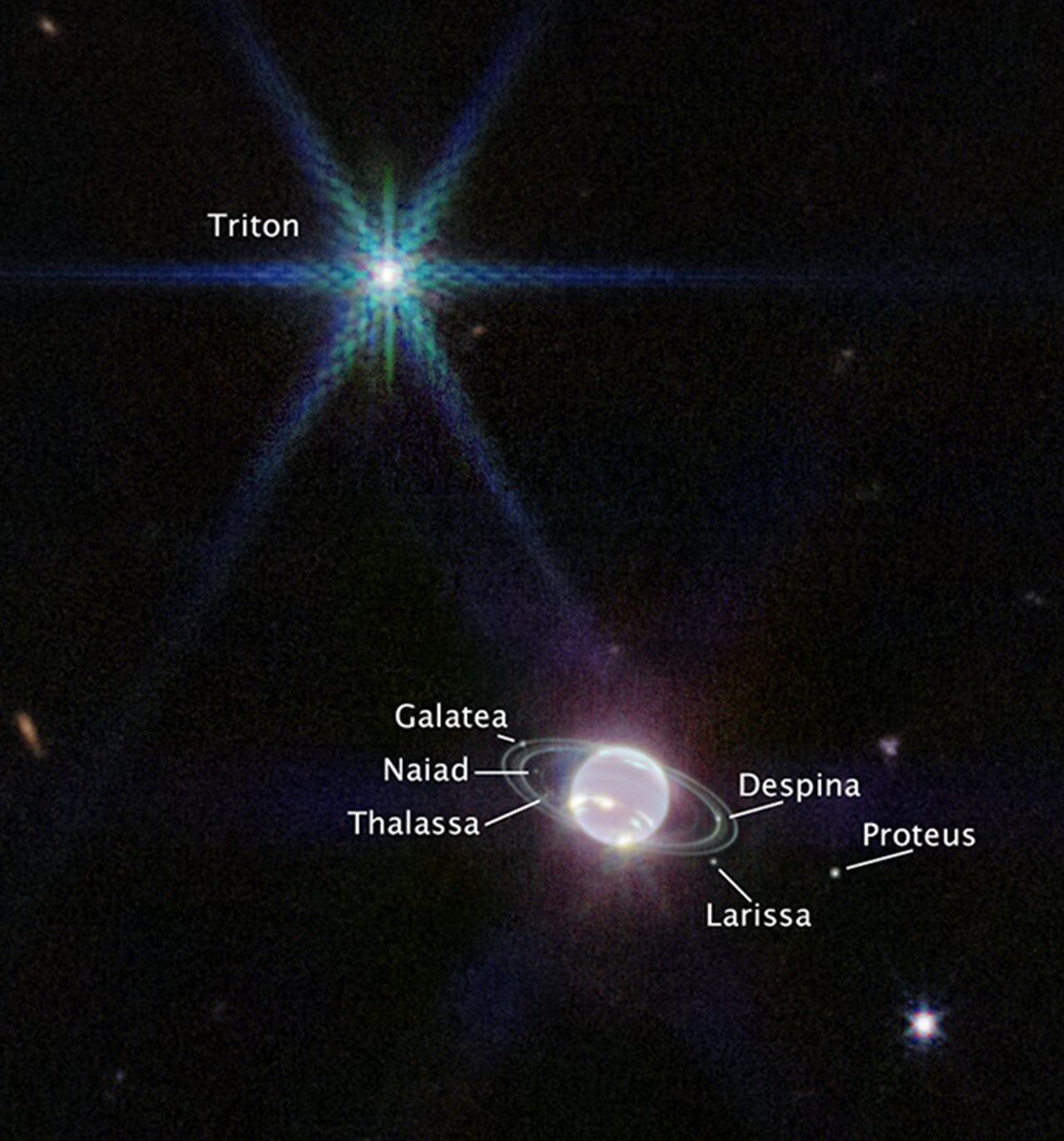
One of the first images taken by NASA’s James Webb Space Telescope was of Neptune. Published in September 2022, the image, taken with Webb's Near-Infrared Camera (NIRCam) in the near-infrared range, reveals the planet's narrow rings together with fainter dust bands. The lighter streaks and spots on the planet's globe are methane-ice clouds in its upper atmosphere reflecting sunlight.
Webb also captured seven of Neptune’s 16 known moons: Galatea, Naiad, Thalassa, Despina, Proteus, Larissa and Triton. Triton dominates the image as a very bright point of light with lines radiating out from it (called diffraction spikes). Triton is much brighter than Neptune because it reflects around 70% of the sunlight that strikes its icy surface, while the methane in Neptune's atmosphere strongly absorbs infrared so the planet appears quite dark.
Composition
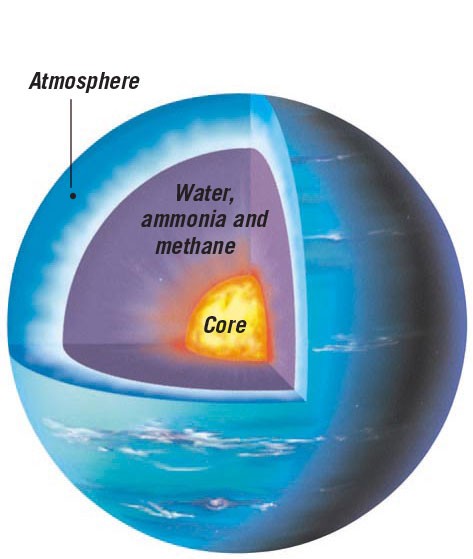
Surrounding Neptune’s small, rocky core is a hot ocean of water mixed with methane and ammonia and methane. Scientists describe these compounds as "ices", even when they are liquid. For this reason, both Neptune and Uranus, which has a similar composition—and quite different to the gas giants Jupiter and Saturn—are known as ice giants.
Neptune's thick atmosphere is composed mainly of hydrogen, with some helium and methane. It is the presence of methane that gives it its blue colour. Although Neptune has less methane in its atmosphere than Uranus, it is slightly darker because it has a thinner surrounding layer of haze.
Factfile
Average diameter: 49,557 km (30,781 miles)
Mass: 17.14 (Earth = 1)
Average density: 1.6 (water = 1)
Surface gravity: 1.2 (Earth = 1)
Day: 16.1 hours
Year: 164.8 years
Average speed in orbit: 5.4 km/sec (3.4 miles/sec)
Average distance from the Sun: 4496 million km (2793 million miles)
Average temperature: -201°C (-330°F), the temperature at a depth in the atmosphere where the pressure is similar to that at the surface of the Earth
Atmosphere: hydrogen, helium, methane
Moons: 16
Name: the Roman god of the sea

Consultant: Mike Goldsmith
pics

Without in any way limiting Q-files Ltd’s exclusive rights under copyright, any use of this publication to “train” generative artificial intelligence (AI) technologies to generate text is expressly prohibited. Q-files Ltd reserves all rights to license use of this work for generative AI training and development of machine learning language models.