
Chemistry

CITE
We have made every effort to follow citation style rules, but there may be some minor differences. If in doubt, please refer to the appropriate citation style manual.
Methane. (2026). In Q-files Encyclopedia, Science, Chemistry. Retrieved from
https://www.q-files.com/science/chemistry/methane
"Methane." Science, Chemistry, Q-files Encyclopedia, 1 Sep. 2026.
https://www.q-files.com/science/chemistry/methane.
Accessed 21 Sep. 2026.
Methane 2026. Science, Chemistry. Retrieved 21 September 2026, from
https://www.q-files.com/science/chemistry/methane
Science, Chemistry, s.v. "Methane," accessed September 21, 2026.
https://www.q-files.com/science/chemistry/methane


Methane
Methane is a colourless, odourless, flammable gas. It is a compound with the chemical formula CH4 (one atom of carbon and four atoms of hydrogen). It is the main ingredient of natural gas, making up about about 87% by volume. Naturally-occurring methane is found both below ground and under the ocean floor, where the largest reservoir of methane is found. Both natural and human sources release methane into the Earth's atmosphere, where concentration levels, although tiny, are increasing.


Greenhouse gas
Methane is a greenhouse gas: it traps part of the Sun's heat that is radiated back into space, warming the Earth's surface. Although the presence of methane in the atmosphere is minuscule (around 1.8 parts per million), it is a very effective absorber of heat, estimated to be more than 80 times as powerful as carbon dioxide (CO2), 20 years after its release into the atmosphere.
Methane accounts for about 25% of the heating effects of all of the greenhouse gases combined. The concentration of methane in our atmosphere has risen by about 150% since 1750, before the Industrial Revolution began. Methane emissions have sharply increased—by between 8 to 10%—in the 2000s.
Natural sources
In nature, methane is produced by the decomposition of organic matter by micro-organisms known as archaea. Bogs, marshes and shallow-water sediments are the major natural source of methane produced in this way. Archaea also play a role in the digestive process of animals that eat cellulose, the substance that forms the walls of plant cells. These include both termites and ruminants (cattle, deer, sheep etc.), which are both important sources of methane.


As a major component of natural gas, a fossil fuel, methane is found in underground rocks, often close to crude oil seams and coal beds. The gas was formed when layers of decomposing plant and animal matter became exposed to intense heat and pressure (known as thermogenic processes) under the surface of the Earth over millions of years. Methane may leak into the atmosphere from these natural gas reservoirs.
Permafrost
Significant reservoirs of methane—in the form of methane molecules trapped inside "cages" of water molecules—are found in what are called methane hydrate (also known as clathrate) deposits. These are found along tectonic plate margins, under sediments on ocean floors and in the Arctic permafrost, the permanently frozen soils found in tundra regions bordering the Arctic Ocean. These reservoirs of methane are a potential contributor to global warming. It is not known exactly how much methane is stored in Arctic permafrost, but as global warming takes hold and the permafrost begin to thaw, methane is released into the atmosphere, where it adds to greenhouse gases contributing to further global warming. Some scientists fear a "tipping point" may be reached, leading to runaway climate change.


Human sources
Because cattle and sheep are major producers of methane (through their burping and breaking wind), livestock farming, in which millions of animals are raised, is responsible for an increase in methane in the atmosphere and a major contributor to global warming.
Agricultural waste materials, such as sewage sludge and manure, and flooded rice fields, where archaea accumulate on decaying plants in the waterlogged soil, are also sources of methane.
Landfill gas, around 50% of which is made up of methane is created by the decomposition of waste in landfill sites. Some methane from this waste can be used as fuel in power stations, reducing the need for extra fossil fuels.

Uses
Natural gas, consisting mostly of methane, is transported as a refrigerated liquid (liquefied natural gas, or LNG). Gas pipelines distribute the gas to homes where it is used for domestic heating and cooking. (The familiar smell of natural gas as used in homes is achieved by the addition of an odourant as a safety measure.) Natural gas is important for electricity generation by burning it as a fuel in a gas turbine or steam generator.


Burning methane in the presence of oxygen, either for domestic use or in power stations, releases carbon dioxide and water vapour, as shown in this oxidation reaction: CH4 + 2 O2 → CO2 + 2 H2O. The CO2 released during this process contributes to the greenhouse gases in the atmosphere.
Methane is also used to produce hydrogen gas on an industrial scale. Liquid methane is used as a rocket fuel when combined with liquid oxygen.

Methane on Mars
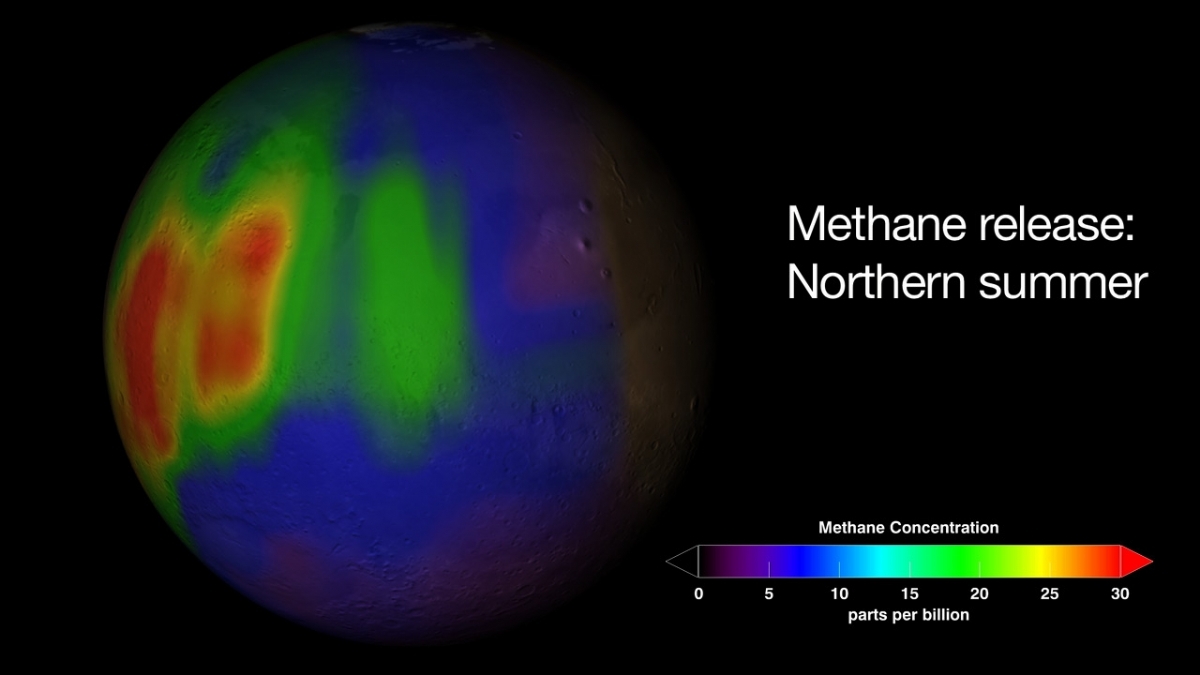
The Curiosity rover, a robotic vehicle currently (as of May 2023) carrying out experiments on the surface of Mars, has detected seasonal changes in the levels of methane in the planet's atmosphere. Levels peaked at the end of the Martian summer, which is what would be expected if the methane had a biological origin. This has led some scientists to think that there could be micro-organisms living in the rocks deep beneath the surface of Mars, just as extremophiles do on Earth. Methane can also, however, be produced by a non-biological (or abiotic) process called ’'serpentinization". This involves a chemical reaction betweeen water, carbon dioxide and the mineral olivine. Read more about Curiosity's discoveries here.
Consultant: Mike Goldsmith
pics
Without in any way limiting Q-files Ltd’s exclusive rights under copyright, any use of this publication to “train” generative artificial intelligence (AI) technologies to generate text is expressly prohibited. Q-files Ltd reserves all rights to license use of this work for generative AI training and development of machine learning language models.