
Chemistry

CITE
We have made every effort to follow citation style rules, but there may be some minor differences. If in doubt, please refer to the appropriate citation style manual.
Periodic Table. (2026). In Q-files Encyclopedia, Science, Chemistry. Retrieved from
https://www.q-files.com/science/chemistry/periodic-table
"Periodic Table." Science, Chemistry, Q-files Encyclopedia, 10 Mar. 2026.
https://www.q-files.com/science/chemistry/periodic-table.
Accessed 7 Nov. 2026.
Periodic Table 2026. Science, Chemistry. Retrieved 7 November 2026, from
https://www.q-files.com/science/chemistry/periodic-table
Science, Chemistry, s.v. "Periodic Table," accessed November 7, 2026.
https://www.q-files.com/science/chemistry/periodic-table


Periodic Table
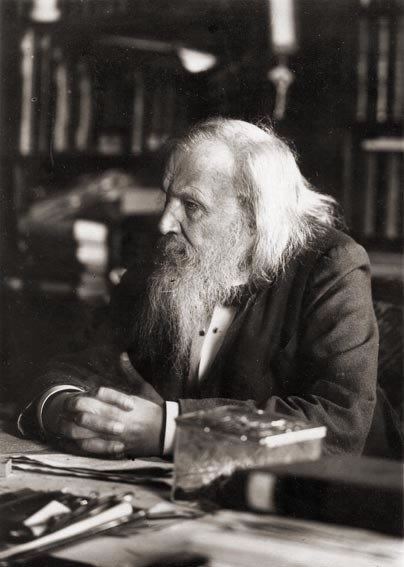
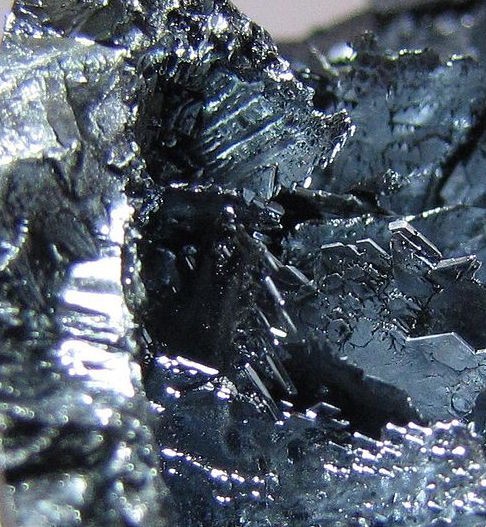
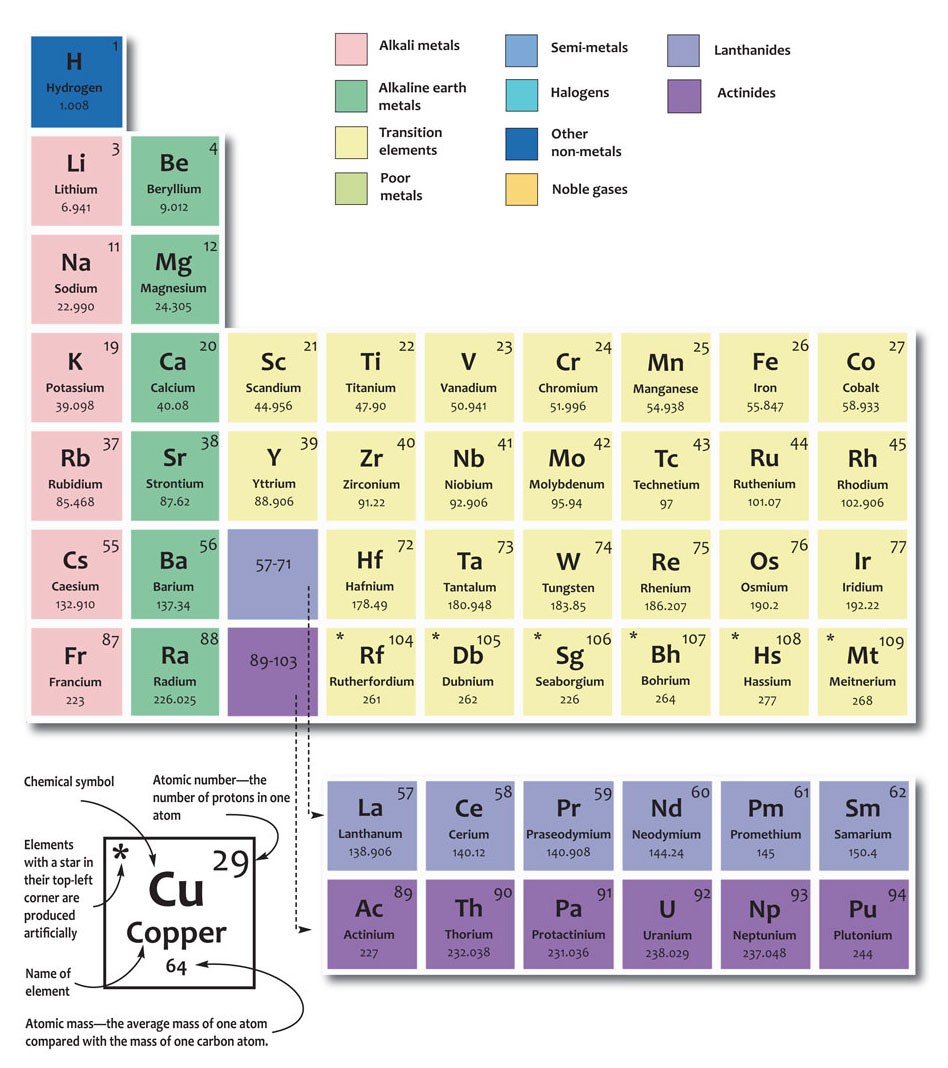
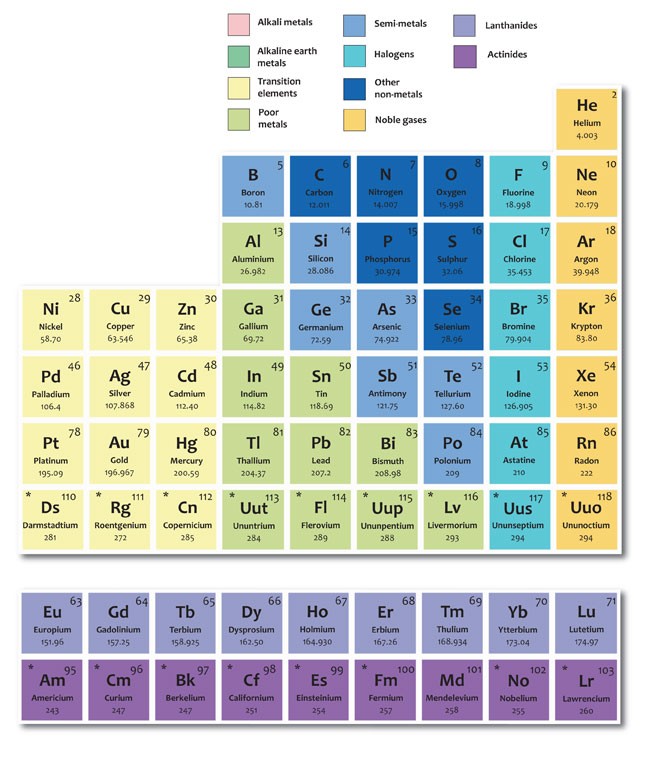
The Periodic Table of elements is a list of all known elements arranged in order of their atomic numbers (the number of protons in each atom). It was designed by Russian scientist Dmitri Mendeleev (1834–1907). He originally arranged the known elements in order of their atomic mass. Those with similar chemical properties were arranged into vertical columns. This resulted in some gaps in his horizontal rows (“periods”), but Mendeleev decided that these would be filled by elements still to be discovered. He predicted the existence of germanium, gallium and scandium, which were all discovered in his lifetime. Of the 118 elements known so far, 94 occur naturally on Earth; the rest are artificially created.
Ordering the elements
Ordering elements according to their atomic mass has some problems. In order to place iodine in the same group as other elements with similar properties (e.g. fluorine, chlorine and bromine), Mendeleev had to put it after tellurium, even though tellurium has a higher atomic mass than iodine. Using the atomic number instead of atomic mass as the organizing principle (first proposed by the British chemist Henry Moseley in 1913) solved the problem—iodine has a higher atomic number than tellurium. In fact in most cases atomic mass and atomic number give the same order.
A list of elements
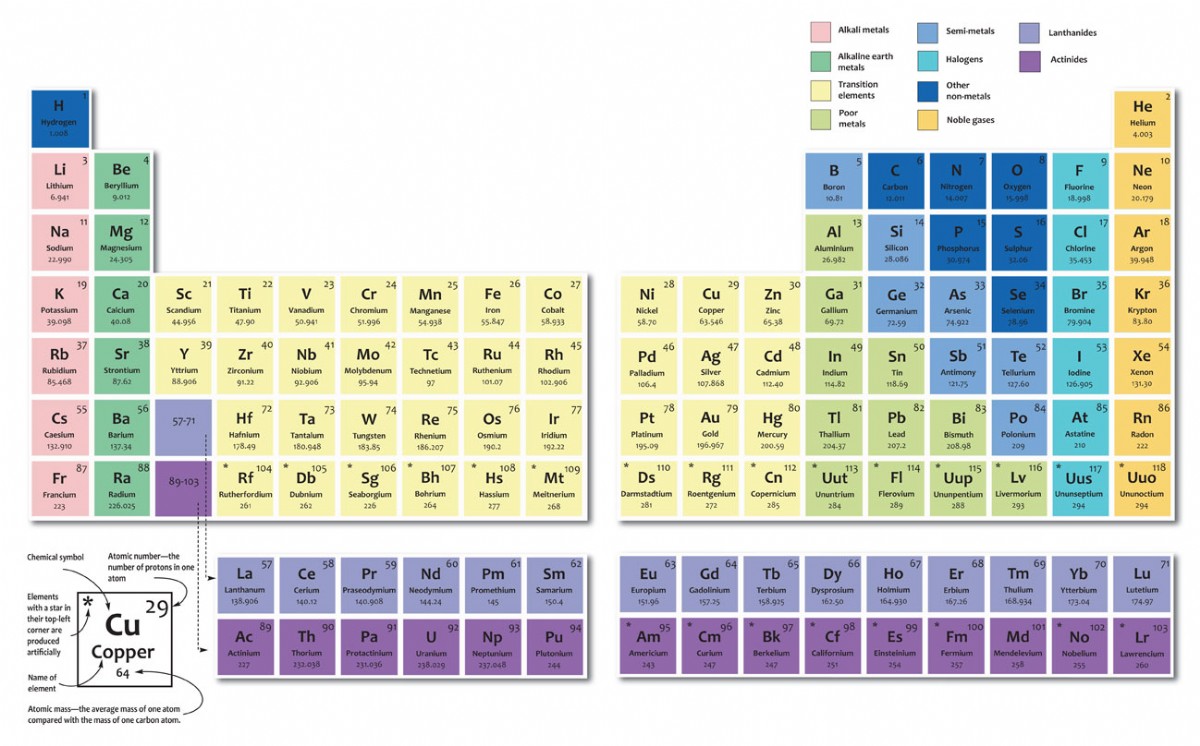
The horizontal rows are called periods and the vertical columns are called groups. Each group contains elements that have the same number of electrons in their outer shells. For this reason, they have similar chemical properties. Each element has a higher atomic number than the element to its left.
The lanthanide and actinide series (purple) are normally displayed below the rest of the Periodic Table, for reasons of clarity. The arrows show where these elements fit into the table.
Metals, non-metals and semi-metals
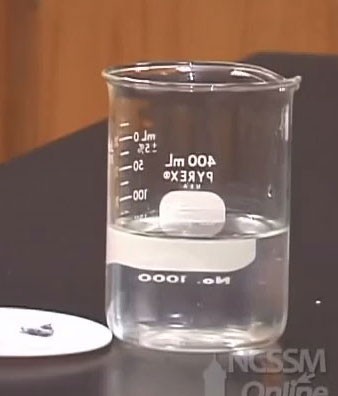
Most of the elements are metals. Only 17 are non-metals. There are important differences between metals and non-metals. All metals, apart from mercury, are solids. They are good conductors of heat and electricity and usually have high melting points. They normally form positive ions, called cations, when they form an ionic bond with other elements. Many non-metals are gases. Of the non-metals, only carbon is a good conductor of heat and electricity. The non-metals that are solids have low melting points. They normally form negative ions, called anions, when they form an ionic bond with other elements.
Between the metals and non-metals are the semi-metals. These have some properties of metals and some of the non-metals. For example, arsenic looks metallic, but it is a poor conductor of heat and electricity.
Predicting reactivity
Elements in the same group on the table have similar physical and chemical properties. They also form ions with the same number of positive or negative charges. On the left of the table, for example, is a group of elements called the alkali metals. These metals—lithium, sodium, potassium, rubidium, caesium and francium—are highly reactive: their atoms each have just one electron in their outer shells, which is easily lost, giving rise to a positively charged ion.
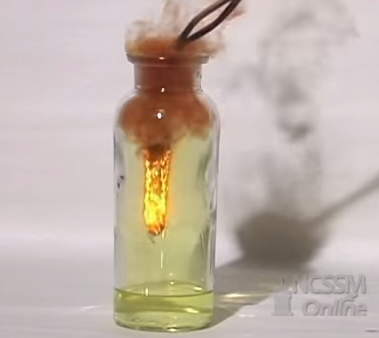
On the right of the table is a non-metal group called the halogens: fluorine, chlorine, bromine, iodine and astatine. Their atoms each have nearly a full set of electrons in their outer shells and thus can easily gain an electron to form negatively charged ions. So these elements, too, are highly reactive: they easily form bonds with other elements.
Glossary of terms
Actinides A group of radioactive metals. They are transition metals.
Alkali metals A group of metals that react with water to form alkaline solutions. All alkali metals have just one electron in their outer shell. They are generally soft, shiny and a pale silvery colour.
Alkaline earth metals A group of metals that have two electrons in their outer shell.
Atomic mass The average mass of one atom compared with the mass of one carbon atom.
Atomic number The number of protons found in the nucleus of an atom.
Chemical symbols Letters that are used to represent a chemical element. For example, C represents carbon and Cu stands for copper.
Element An element is a substance made up of atoms of the same type. It cannot be broken down into simpler substances. Different elements have different characteristics, which are determined by the number of subatomic particles they have. There are approximately 100 natural elements known to us. These are divided into metals, non-metals and semi-metals.
Halogens A group of non-metallic elements with similar characteristics. They easily form bonds with other elements.
Lanthanides A group of silvery metals with very high melting points. They are sometimes called the “rare earth metals”. They belong to the transition metals.
Noble gases A group of gases that have similar characteristics. They are sometimes known as the inert gases because they do not easily form compounds with other elements. One common noble gas is neon, which is used to make lights and street signs. Because it does not react with other elements, it will not ignite or explode.
Poor metals The name sometimes given to a group of soft, weak metals that melt at low temperatures.
Semi-metals Otherwise known as the metalloids, the semi-metals are a group of elements that are neither metals nor non-metals. Typically they have the hard, shiny appearance of a metal, but make poor electrical conductors.
Transition metals A group of metals that are mostly hard, dense and shiny and make good electrical conductors.
Consultant: Nina Notman
pics
Without in any way limiting Q-files Ltd’s exclusive rights under copyright, any use of this publication to “train” generative artificial intelligence (AI) technologies to generate text is expressly prohibited. Q-files Ltd reserves all rights to license use of this work for generative AI training and development of machine learning language models.