
Chemistry

CITE
We have made every effort to follow citation style rules, but there may be some minor differences. If in doubt, please refer to the appropriate citation style manual.
Electrolysis. (2026). In Q-files Encyclopedia, Science, Chemistry. Retrieved from
https://www.q-files.com/science/chemistry/electrolysis
"Electrolysis." Science, Chemistry, Q-files Encyclopedia, 10 Mar. 2026.
https://www.q-files.com/science/chemistry/electrolysis.
Accessed 5 Nov. 2026.
Electrolysis 2026. Science, Chemistry. Retrieved 5 November 2026, from
https://www.q-files.com/science/chemistry/electrolysis
Science, Chemistry, s.v. "Electrolysis," accessed November 5, 2026.
https://www.q-files.com/science/chemistry/electrolysis


Electrolysis
Electricity can be used to separate a chemical compound into the molecules that make it up. This process is called electrolysis. For it to work, the compound has to conduct electricity, it must be in liquid form (molten or in solution) and it must contain ions (electrically charged atoms), that are free to move about. Two rods, made of conducting material such as carbon or a metal—the electrodes—are placed in the liquid compound, called the electrolyte. An electrical current is then passed through the liquid. The negative ions in the compound are attracted to the positively charged electrode, called the anode, while the positive ions move to the negatively charged electrode, the cathode.
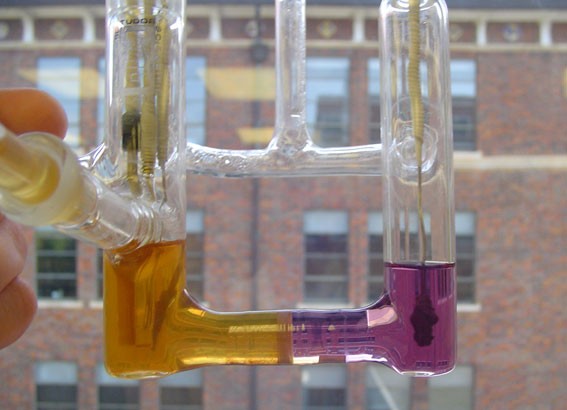

Electrolysis of water
Water, a compound (H2O), can be broken down by electrolysis into molecules of oxygen (O2) and hydrogen (H2). When an electric current is passed through the water, the molecules are broken down into positive hydrogen ions (H+) and negative hydroxide ions (OH-). The positive ions are attracted to the cathode, the negatively charged electrode. Here, electrons from the cathode are given to the hydrogen ions to make neutral hydrogen gas (this is a reduction reaction).
Meanwhile, the negative hydroxide ions are attracted to the anode, the positively charged electrode. Here, they give up their electrons to form neutral oxygen gas (this is an oxidation reaction).
Because water contains two hydrogen atoms for every oxygen atom, twice as much hydrogen gas as oxygen gas is produced. In a voltameter, the gases bubble up through the water to collect in tubes above both the cathode and anode.
Chemical reactions
Electrolysis can bring about certain chemical reactions. In the electrolysis of a solution of sodium chloride in water, for example, the negative chloride ions are attracted to the anode. Here, they give up enough electrons to form neutral chlorine atoms, which bubble up as gas. Meanwhile at the cathode, water is separated into hydroxide ions and hydrogen ions. These hydrogen ions are reduced by the cathode to form hydrogen gas. The sodium ions, also attracted to the cathode, and the hydroxide ions combine to form a sodium hydroxide solution. Both sodium hydroxide and chlorine are useful products; producing them on an industrial scale is called the chloralkali process.
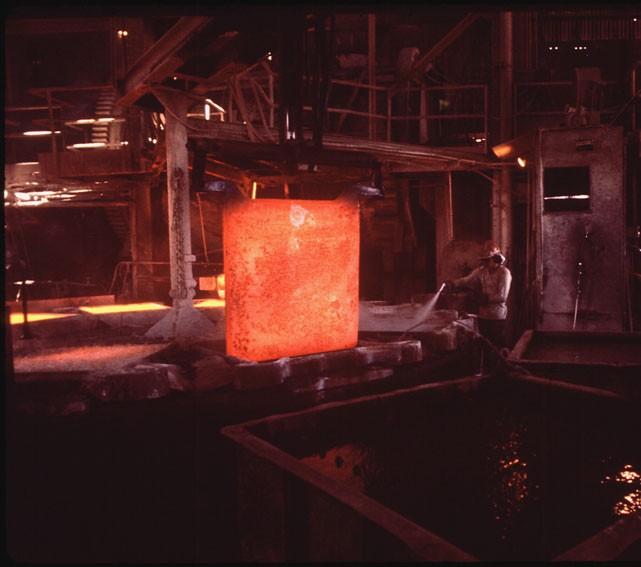
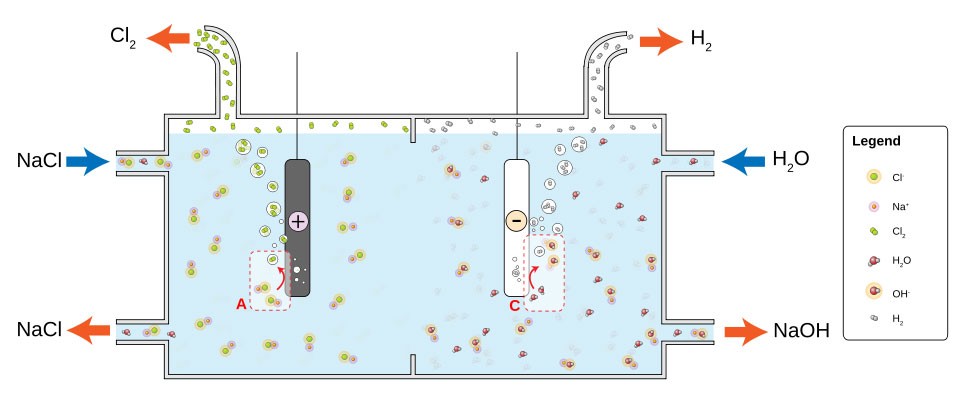
This diagram shows the electrolysis of a solution of sodium chloride (NaCl). At the anode (labelled A), chloride ions (Cl-) give up their electrons and form chlorine atoms (Cl2). At the cathode (labelled C), water (H2O) is separated into hydroxide ions (OH-) and hydrogen (H2) gas. The sodium (Na+) and hydroxide ions combine to form a sodium hydroxide (NaOH) solution.
Electroplating
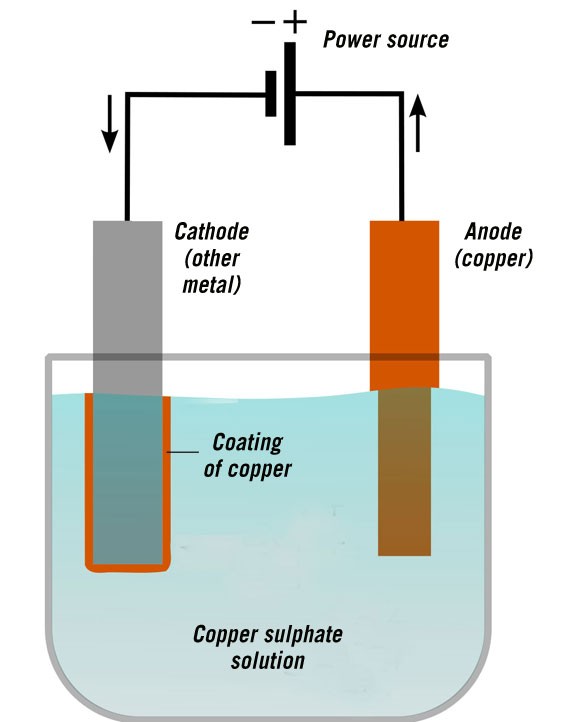
Electrolysis is used in industry to coat one material with a thin layer of another. This process is called electroplating. To coat an item with copper, an anode is a copper plate, the cathode is the item to be coated and the electrolyte is a copper sulphate solution. When electricity is passed through the solution, copper ions from the solution are attracted to coat the cathode, while copper is drawn from the anode into the solution. In a similar way, gold and silver can be electroplated on to items of jewellery, or chromium electroplated on to steel to provide resistance to corrosion. Tin cans are made by electroplating steel with tin.
Consultant: Nina Notman
pics
Without in any way limiting Q-files Ltd’s exclusive rights under copyright, any use of this publication to “train” generative artificial intelligence (AI) technologies to generate text is expressly prohibited. Q-files Ltd reserves all rights to license use of this work for generative AI training and development of machine learning language models.