
Chemistry

CITE
We have made every effort to follow citation style rules, but there may be some minor differences. If in doubt, please refer to the appropriate citation style manual.
Atoms. (2026). In Q-files Encyclopedia, Science, Chemistry. Retrieved from
https://www.q-files.com/science/chemistry/atoms
"Atoms." Science, Chemistry, Q-files Encyclopedia, 10 Mar. 2026.
https://www.q-files.com/science/chemistry/atoms.
Accessed 21 Sep. 2026.
Atoms 2026. Science, Chemistry. Retrieved 21 September 2026, from
https://www.q-files.com/science/chemistry/atoms
Science, Chemistry, s.v. "Atoms," accessed September 21, 2026.
https://www.q-files.com/science/chemistry/atoms


Atoms
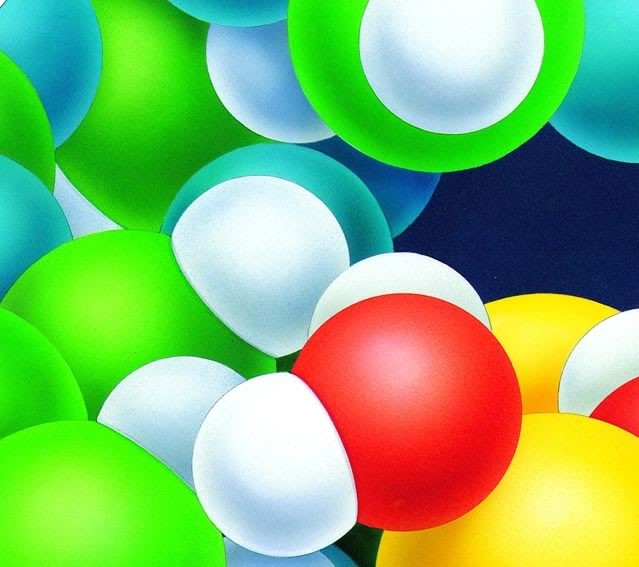
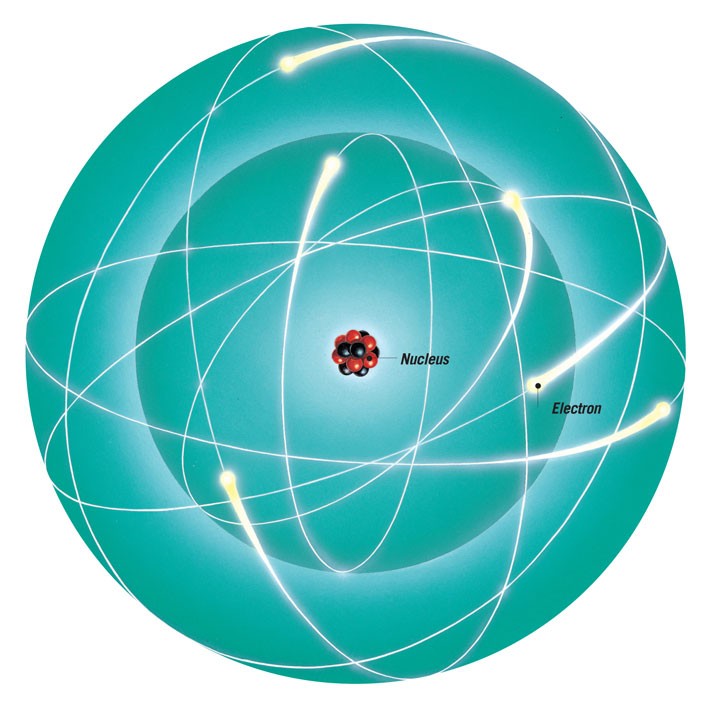
All matter is made of atoms. An individual atom is far too small to see even with the most powerful microscopes. But atoms joined together make up every solid object, substance, chemical and material in the Universe. A pinhead, for example, contains about one billion billion atoms. Atoms themselves are not solid, like marbles, but mostly empty space. But this space contains even smaller pieces of matter known as subatomic particles. There are three main kinds: protons, neutrons and electrons. The protons and neutrons are gathered together in the middle of the atom, forming its central part or nucleus.
Electrons
Electrons are much smaller than protons and neutrons. Minuscule bundles of energy, they do not behave like the particles we are familiar with, but more like waves of energy surrounding the nucleus. Small groups of these wave-like electrons form layers around the nucleus known as shells. The number of shells an atom has depends on the number of electrons it contains. A carbon atom, for example, has six electrons grouped in two shells. It is these shells of electrons that give an atom almost all its volume.
Inside an atom, there are the same number of electrons as there are protons. Both have electrical charges: electrons negative, protons positive (neutrons have no charge at all). Unlike charges attract, so the atom is held together. The two sets of opposite charges balance each other out so the whole atom has no charge. This makes it stable or unlikely to break up.
Elements
Not all atoms are the same. There are 94 different kinds of atoms that occur naturally. Scientists have made another 17 or so artificial kinds in laboratories. A substance made from just one kind of atom is known as a chemical element. An atom is the smallest part of an element that can exist.
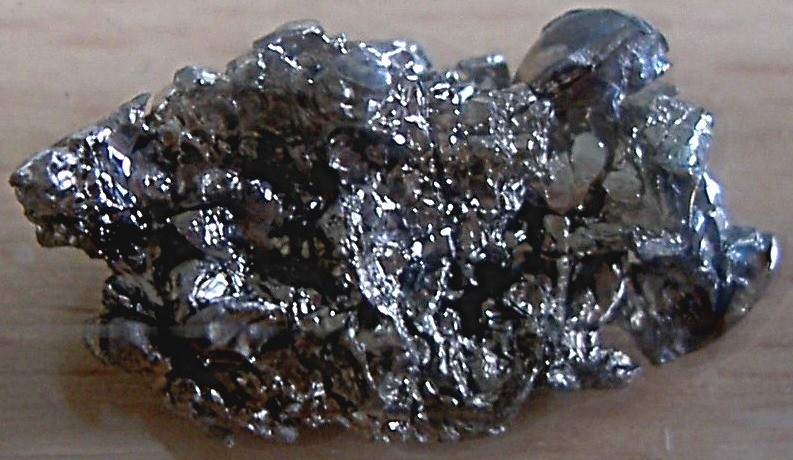
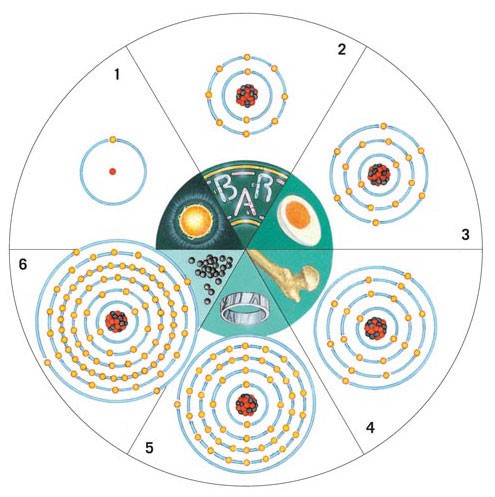
Each element has a different number of electrons and protons in its atoms. It is this unique structure that gives each element its individual properties. Hydrogen (1) is the simplest because its atom has just two subatomic particles: one proton and one electron. It is a very light gas that makes up most of the Sun. Neon (2) is a gas used in coloured strip-lights. Egg yolks are rich in sulphur (3). Calcium (4) is needed for healthy bones. Silver (5) is a shiny valuable metal. Lead (6) has many subatomic particles and so is very heavy. It is used to make small weights or shot.
Consultant: Mike Goldsmith
pics
Without in any way limiting Q-files Ltd’s exclusive rights under copyright, any use of this publication to “train” generative artificial intelligence (AI) technologies to generate text is expressly prohibited. Q-files Ltd reserves all rights to license use of this work for generative AI training and development of machine learning language models.