
Resources and industry

CITE
We have made every effort to follow citation style rules, but there may be some minor differences. If in doubt, please refer to the appropriate citation style manual.
Oil and gas. (2026). In Q-files Encyclopedia, Geography, Resources and industry. Retrieved from
https://www.q-files.com/geography/resources-and-industry/oil-and-gas
"Oil and gas." Geography, Resources and industry, Q-files Encyclopedia, 1 Apr. 2026.
https://www.q-files.com/geography/resources-and-industry/oil-and-gas.
Accessed 13 Sep. 2026.
Oil and gas 2026. Geography, Resources and industry. Retrieved 13 September 2026, from
https://www.q-files.com/geography/resources-and-industry/oil-and-gas
Geography, Resources and industry, s.v. "Oil and gas," accessed September 13, 2026.
https://www.q-files.com/geography/resources-and-industry/oil-and-gas


Oil and gas
Oil is used as a fuel in power stations, cars, ships and aircraft. It is also essential for many chemical industries. Natural gas is used for domestic heating and cooking, generating electricity and fuel for vehicles. Like coal, oil and gas are fossil fuels: they come from the remains of tiny plants and creatures that lived in the oceans millions of years ago. Their remains accumulated on the seabed and slowly turned into oil and gas. About one fifth of the world’s oil supply is still found under the sea. It is extracted using oil platforms.

Formation of oil
Oil and gas were formed in the seas millions of years ago. When the tiny plants and animals that lived in the sea died, they sank to the bottom (1) and were buried under layers of sand and silt. These were gradually compressed into layers of sedimentary rock (2). The heat action of bacteria changed the remains into crude oil, also known as petroleum, and natural gases.

Pressures in the Earth forced the oil up through the sedimentary rock, which has tiny holes in it like a sponge. The oil rose until it came to a layer of hard rock. If the hard rock formed a dome over the soft rock, the oil became trapped under it (3). Geologists looking for oil study the local rock formations and make test drillings. If oil is found, wells are drilled into the ground. When the drill reaches oil, the pressure may be enough to send it gushing up to the surface (4). If not, it is pumped. The crude oil from the well is sent by pipeline or tanker to a refinery.

Oil platform
Oil under the seabed is mined using drills mounted on an oil platform (commonly known as an oil rig). The structure may be fixed to the seabed, or it may float. Drilling equipment is fixed inside a derrick, a steel framework tower. The drill is made of lengths of pipe, each around 10 metres (33 feet) long, with a drill bit, a rotating head fitted with sharp teeth, at the end. The oil platform also has a helicopter landing pad and accommodation for the workforce.

Oil tankers
Oil tankers, giant ships measuring up to 450 metres (1500 feet) long, transport up to 500,000 tonnes of crude oil at a time. They are made of thin metal which is designed to bend easily in heavy seas. They take the oil to refineries, where it is turned into petrol, lubricants and other substances.

Pumpjack

A pumpjack (also called a nodding donkey) is a machine that operates a piston pump in an oil well on land. It is used to lift oil out of the well where there is not enough pressure for the liquid to rise to the surface of its own accord. A pumpjack converts the rotary motion of an electric motor to a vertical motion—a beam rocks up and down—to drive the pump shaft, in a similar way to steam engines of the 18th and 19th centuries.
Tar sands
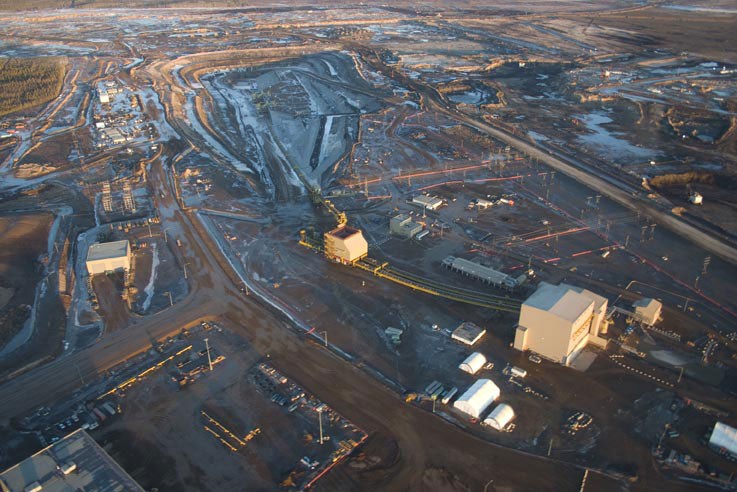
Tar sands, also known as bituminous sands, are a kind of crude oil deposit. The sands consist of loose sand mixed with clay, water and a thick, sticky form of oil called bitumen or tar. Tar sands are found in vast quantities in Canada, and also in Kazakhstan and Russia. They are now an alternative source of oil to ordinary crude oil.
Because bitumen is too thick to flow like crude oil, it must be mined out of the ground, or made to flow into wells by injecting steam or other liquids into the sands. It is also more difficult to transport and convert into gasoline, diesel and other products, so it has to be mixed with ordinary crude oil first. This special refining process produces much more greenhouse gases than in the production of ordinary oil.
Distillation
In a refinery, oil is separated into different substances by a process called distillation. The oil is boiled at the bottom of a huge tank called a fractionating tower. The gases, or vapours, that are formed float upwards, cool and condense into liquids at different temperatures. Trays at different heights in the tower collect the liquids as they form. These separate parts, or fractions, are formed into different oil products, such as petrol, kerosene and diesel oil. At the top of the tower, gas comes off. The thickest, heaviest products, such as bitumen (asphalt), used for making roads, sink to the bottom. They can be refined again to make lubricating oils.


Natural gas
Natural gas is a naturally occurring gas mixture, consisting mostly of methane. It is found in underground rock formations, often close to crude oil seams and coal beds. It is created by micro-organisms called archaea living in bogs, marshes and shallow-water sediments, or from organic matter buried deep inside the Earth's crust.
Natural gas is widely used for domestic heating and cooking, generating electricity and fuel for vehicles, as well as in the manufacture of cattle feed, plastics and other chemicals.
Fracking
Vast quantities of natural gas can be extracted from under the ground through a process known as hydraulic fracturing, or fracking. This is a technique designed to recover gas from shale, a type of sedimentary rock. It involves drilling down into the Earth, then blasting a high-pressure mixture of water, sand and chemicals into a seam of rock. The rock is fractured apart by the blast, releasing the gas trapped inside. The gas then flows out of the shale and rises to the well head. Widely practised in the US for several decades, drilling for shale gas is only at the exploratory phase in Europe.


Fracking is extremely controversial. It is likely that minor earthquakes may be triggered by the drilling. There are other serious environmental concerns. The process uses huge amounts of water, which must be transported to the drilling sites. Chemicals used in the fracking process may contaminate the groundwater around the sites. The drilling causes air and noise pollution. Opponents of fracking are urging energy companies and governments to invest instead in renewable sources of energy such as wind and solar power, and not fossil fuels.
But supporters of fracking claim it allows drilling companies to access difficult-to-reach resources of gas, boosting production and creating thousands of jobs. Prices of gas will be reduced. Emissions of carbon dioxide from generating electricity through burning gas are about half those of burning coal.

Consultant: Lloyd Jenkins
pics


Without in any way limiting Q-files Ltd’s exclusive rights under copyright, any use of this publication to “train” generative artificial intelligence (AI) technologies to generate text is expressly prohibited. Q-files Ltd reserves all rights to license use of this work for generative AI training and development of machine learning language models.