
Resources and industry

CITE
We have made every effort to follow citation style rules, but there may be some minor differences. If in doubt, please refer to the appropriate citation style manual.
Mining. (2026). In Q-files Encyclopedia, Geography, Resources and industry. Retrieved from
https://www.q-files.com/geography/resources-and-industry/mining
"Mining." Geography, Resources and industry, Q-files Encyclopedia, 14 Apr. 2026.
https://www.q-files.com/geography/resources-and-industry/mining.
Accessed 21 Sep. 2026.
Mining 2026. Geography, Resources and industry. Retrieved 21 September 2026, from
https://www.q-files.com/geography/resources-and-industry/mining
Geography, Resources and industry, s.v. "Mining," accessed September 21, 2026.
https://www.q-files.com/geography/resources-and-industry/mining


Mining
Mining is the extraction of useful minerals, including metals, from the surface of the Earth. Rock that contains enough metal to make it profitable to be extracted is known as ore. Often more waste rock than ore is mined, so the mining process includes both the extraction of ore and removal of waste. Besides metals, materials extracted by mining include: oil and gas, coal, oil shale, gemstones, limestone, dimension stone (fine building stone), rock salt, phosphates, potash, gravel, sand and clay. Oil and gas extraction is one of the largest types of mining measured by its global economic importance. Coal mining is widespread in many countries because burning coal is a way to generate electricity. Mining brings many benefits but sometimes—especially in the case of underground mining—at the cost of human lives. Waste from mines may pollute local environments, which harms communities and wildlife. Indigenous peoples are often affected by mining operations, with disputes over land where they have lived for generations.


Minerals
Rocks are stony masses made up from minerals. Minerals, in turn, consist of chemical elements, such as silicon, oxygen or magnesium, and have a crystalline structure. Many elements that make up minerals, especially metals, are valuable in their pure form, but in nature they are usually mixed with unwanted rock. In a mining operation, the ore, the rock containing the "target" minerals, is taken out of the the ground along with waste rock. The ore is then carried away to be processed and refined in order to separate out the desired elements.
Minerals may exist in two forms: as placer deposits, which consist of valuable minerals contained within loose materials such as river gravels or beach sands, or as lode deposits, where valuable minerals are found inside a mass of solid rock—either as veins (sheet-like layers) or as grains distributed among other minerals making up the rock.


Critical minerals
Critical minerals, also called "transition-critical materials" (TCMs), such as copper, lithium, nickel, cobalt, graphite and rare earth metals (also called lanthanides), are essential to many zero-carbon energy technologies. They are used, for example, in making components for wind turbines or batteries for electric vehicles (EVs). Demand for these minerals is growing quickly as the move to reach net zero emissions in line with the Paris Agreement ("clean energy transition") gathers pace. Lithium, nickel, cobalt, manganese and graphite are crucial to battery performance. Rare earth metals are essential for electronic components and for permanent magnets in EV motors. Electricity networks need a huge amount of copper for making wires and cables.

Some nations are increasingly concerned about whether they will have access to the supply of critical minerals in future. China dominates the production of rare earth metals—in 2021 it controlled 60% of global production—putting other countries at a disadvantage.


Mineral exploration
Mineral exploration is the process of locating minerals in the ground and finding out what their concentrations (grade) and quantities (tonnage) are. This helps mining companies to decide whether it is worthwhile to mine the ores. Geologists carry out surveys of the rock layers beneath the surface, and also measure the magnetism of the rocks and minerals. This is because the magnetic field is stronger in rocks that contain metals such as iron, nickel and cobalt.
Mining operations

Most mining operations are carried out either by surface mining and sub-surface (underground) mining. Surface mining is much more common: in the United States, for example, nearly all metal ores are mined in this way.
In-situ mining (or in-situ leaching) is another method of extracting minerals from the Earth. It does so without any excavation (digging), but it does need the minerals to be soluble in either water, acid or carbonate solutions. A solution injected into the ground dissolves the mineral in its location. The liquid containing the dissolved mineral is then pumped back to the surface. The most common mineral extracted in this way is uranium, but most rare earth metals can be mined in this way, too.


Brine mining is the extraction of useful minerals that are already naturally dissolved in brine, water containing a high concentration of salt. Brines are important sources of calcium, iodine, lithium, magnesium, potassium and bromine as well as common salt. Sub-surface brines, such as those beneath the Salar de Atacama salt flat, a dry lake bed in Chile, have yielded about half of the world's production of lithium, a metal greatly in demand for use in lithium-ion batteries for EVs.
Beneath the salt flat, there is a large reserve of lithium-rich brine. This is pumped to the surface and, via a network of canals, into shallow evaporation ponds. The dry, hot weather evaporates the brine, leaving behind deposits of lithium salts. Each tonne of lithium requires the evaporation of about 2 million litres of water.
The potential loss of water from evaporation mining at another Chilean salt flat, Salar de Maricunga, threatens the livelihood of local communities, who depend on water for their crops and livestock. Direct lithium extraction, an alternative mining method, in which lithium is extracted from the brine more quickly so that the brine can be pumped back into the salt flat, may be used instead, but it, too, has its drawbacks. The treated water, which contains traces of certain chemicals, could destroy the fragile salt flat ecosystem, home to flamingos, rheas, guanacos and many other species.

Methods of surface mining


Surface mining is done by stripping vegetation, soil and layers of bedrock, together known as the overburden, in order to reach ore deposits below. Methods include: open-pit mining (or open-cast mining), in which an open pit is dug in the ground; strip mining, in which surface layers are stripped off to reach ore deposits underneath without digging deeper (commonly used to mine coal and lignite or brown coal); mountaintop removal, which involves removing the top of a mountain to reach ore deposits at depth; landfill mining in which landfills are excavated for metals (such as aluminum, used in cans, and a wide variety of other metals found in discarded electronics) that can be recycled; placer mining in which valuable minerals such as gold, platinum, tin or diamonds are sifted from sediments in riverbeds or sands.
Open-pit mining

Open-pit mining is best suited for mineral deposits that are close to the surface of the Earth but are not accumulated in horizontal layers. Materials typically extracted from open-pit mines include coal, copper, diamonds, gypsum, limestone, marble, metal ores, uranium and phosphates. It is also used for loose materials such as sand, gravel and crushed rock (together known as aggregate), which are too unstable to be reached by tunnelling.
Open-pit mines that produce aggregate or dimension stone (large, precisely cut stones used for constructing buildings, monuments or headstones) are normally called quarries. Aggregate mixed with an oily substance called asphalt (also called bitumen) is used in road construction. Aggregate mixed with cement makes concrete, a building material that is extremely widely used.


The walls of an open-pit mine are stepped. The vertical face of the step is known as the batter, while the flat part is called the bench or berm. The steps help prevent rock falling down the entire face of the wall. A haul road is usually built into the side of the pit, forming a ramp. Trucks use it to carry away the mined rock.
Underground mining
Sub-surface mining involves digging tunnels or shafts into the ground to reach ore deposits buried at depth. Ore, for processing, and waste rock, for disposal, is brought to the surface through the tunnels and shafts. In shaft mining, vertical access shafts are created, while in drift mining, horizontal access tunnels are made.


Long wall mining, in which a long surface is grinded to remove the ore, is a common technique used in underground mining. Another is room and pillar mining, in which ore is removed from underground "rooms" while leaving pillars in place to support the roof of the room. After all the ore is worked out from one room, the miners retreat and the supporting pillars are removed. This allows the room to cave in, and so loosening more ore to be mined. There are dangers in this method: accidental caving in of rooms or access tunnels can lead to miners being trapped underground.
Mining machinery

Heavy machinery is used in mining to explore and develop sites, remove overburden, break and remove rocks and process the ore. Bulldozers, drills and trucks are all necessary for excavating the land. Large drills are used to sink shafts and to excavate slopes.
Trams are used to transport miners, minerals and waste. Lifts (elevators) carry miners, rock and machinery into and out of underground mines. Huge trucks, shovels and cranes are employed in surface mining to shift large quantities of overburden and carry away ore. Processing plants—often located close to mines—use large crushers, mills and other equipment to extract the valuable minerals from the ore.


Explosives
Explosives are used to blast out ore from the surrounding rocks. A very common explosive used in mining is called ANFO, a substance consisting of 94% ammonium nitrate and 6% fuel oil. A blasting operation involves drilling holes, placing a charge and detonator in each hole then detonating the charge. Upon detonation, the explosive is instantly transformed into a hot gas with enormous pressure. This shatters the area adjacent to the drill hole, causing the surrounding rock to crack open.

Explosives in each drill hole are set off in a sequence so that there are delays of a few milliseconds between each one. This breaks up the rock is the most efficient (and least noisy) way. The shattered rock is then crushed into smaller pieces and taken to be processed.


Environmental issues
Sinkholes, large holes in the ground made by the collapse of the surface layer, at or near mine sites are typically caused from the failure of a mine roof from the extraction of ore. The overburden at the mine site may develop cavities, causing it eventually to cave in. The sudden opening up of a large crater at the surface without warning is a serious danger to life and property.
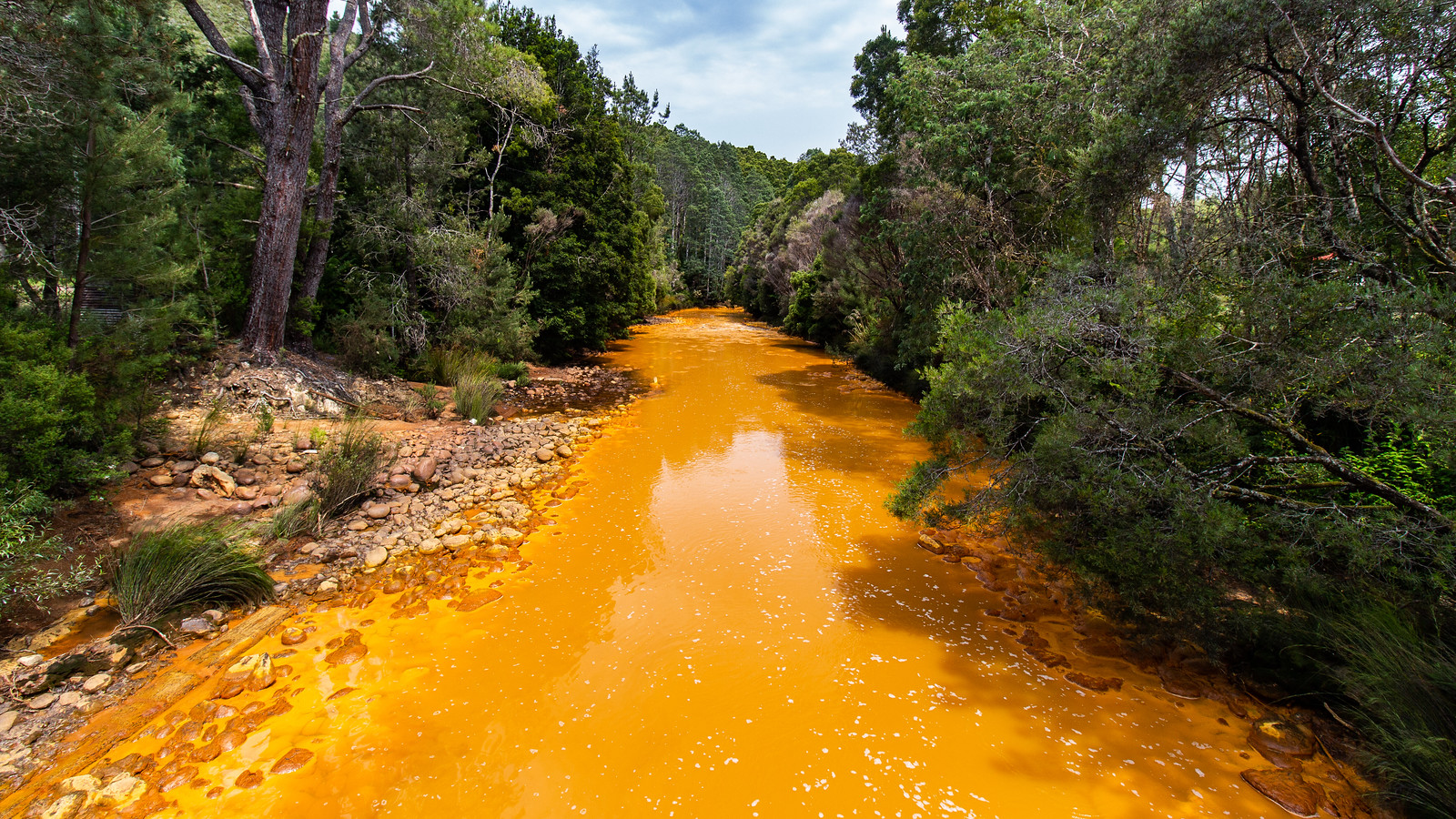
Mining can cause the pollution of soil, groundwater and surface water by toxic metals such as arsenic and mercury commonly found in mine waste. The large amounts of water used in various mining processes increase the potential for these chemicals to seep into the ground and into streams and rivers. This can lead to the devastation of the surrounding ecosystems—the plants, animals and micro-organisms that co-exist in a natural habitat. It may also endanger the health of the local population dependent on local water sources and crops grown in contaminated soils.
Mining may create a type of water pollution known as acid mine drainage (also called acid rock drainage). Sub-surface mining often takes place below the water table, so water must be constantly pumped out of the mine in order to prevent flooding. When a mine is abandoned, the pumping stops, so water floods the mine. This may lead to the oxidation of metal sulphides within the surrounding rock and overburden, producing, through a chemical reaction, sulphuric acid. Acid mine drainage is most commonly found in abandoned copper mines. When mixed with groundwater, surface water and soil, the acid has harmful effects on humans, animals and plants.

Tailings dams

The materials left over after the process of separating metal from the waste or the unwanted part of the ore (called the gangue) are known as tailings. Ore mills generate huge amounts of waste. For example, 99 tonnes of waste is generated per tonne of copper extracted; only 5.3 grams of gold is extracted per tonne of ore. The tailings form a slurry, a mixture of solids suspended in a liquid. This is pumped to a tailings dam or settling pond, where the water is left to evaporate. The ponds are secured by impoundments (dams or embankment dams). These huge structures are designed to contain the waste forever.

Tailings dams can often be toxic due to the presence of sulphides or toxic chemicals in the gangue. Cyanide, used to treat gold ore via the extraction process, is an extremely poisonous substance found in the tailings at gold mines. Bauxite residue, or red mud, is a highly alkaline waste generated during the processing of bauxite into alumina.
Tailings dams are vulnerable to leakages. Contamination by toxic metals or acid mine drainage can harm the surrounding environment (see above). Impoundment failures—a collapse of the dam, causing the slurry to flood the surroundings—could potentially cause major loss of life in communities downstream as well as catastrophic contamination of the flooded land.

Artisanal mining


In artisanal (small-scale) mining, workers use basic tools such as picks and shovels to mine rocks both at the surface and underground, They dig out a wide range of minerals, including gold, gemstones and metals such as cobalt, tin, tungsten and tantalum. A significant portion of the world's critical minerals (see above) are mined in this way, often under dangerous, exploitative conditions that include child labour and other human rights abuses. However, artisanal mining is also a vital livelihood for around 45 million people around the world, especially in Africa and Asia.
Revenue from mineral exports such as copper, cobalt and diamonds is vital to the economy of the Democratic Republic of Congo. As of 2023, the country is estimated to produce around 70% of the world's cobalt, a mineral used in the manufacture of electronic devices and EVs. Much of the country's cobalt is dug up by artisanal miners, and has been linked with human rights abuses, including unsafe working conditions and forced labour. There have been reports of children carrying heavy sacks from mines to local traders and being paid for their work only in food and accommodation.

pics


Without in any way limiting Q-files Ltd’s exclusive rights under copyright, any use of this publication to “train” generative artificial intelligence (AI) technologies to generate text is expressly prohibited. Q-files Ltd reserves all rights to license use of this work for generative AI training and development of machine learning language models.