
Mammals

CITE
We have made every effort to follow citation style rules, but there may be some minor differences. If in doubt, please refer to the appropriate citation style manual.
Llamas. (2026). In Q-files Encyclopedia, Life, Mammals. Retrieved from
https://www.q-files.com/life/mammals/llamas
"Llamas." Life, Mammals, Q-files Encyclopedia, 24 Mar. 2026.
https://www.q-files.com/life/mammals/llamas.
Accessed 22 Sep. 2026.
Llamas 2026. Life, Mammals. Retrieved 22 September 2026, from
https://www.q-files.com/life/mammals/llamas
Life, Mammals, s.v. "Llamas," accessed September 22, 2026.
https://www.q-files.com/life/mammals/llamas


Llamas
The llama family is made up of those smaller members of the camel family that live in the Andes mountains of South America. They are agile, long-legged animals that feed on grass or browse on plants. There are four species: llama, alpaca, guanaco and vicuña. The llama and alpaca are domesticated animals—used as beats of burden by the Incas and other Andean civilizations long before Europeans arrived. Llamas can carry heavy loads for miles across rough terrain, while alpacas are bred for their fine wool. The guanaco and vicuña still live in the wild. They are also prized for their wool, which means that they are vulnerable to hunters. Llamas graze on grass and, like cows, bring up their food and chew it again as cud. They can survive by eating many different kinds of plants, from which they obtain all the water they need. Llamas are social animals and live with other llamas as a herd. They are intelligent and are able to learn simple tasks.

Guanacos and vicuñas
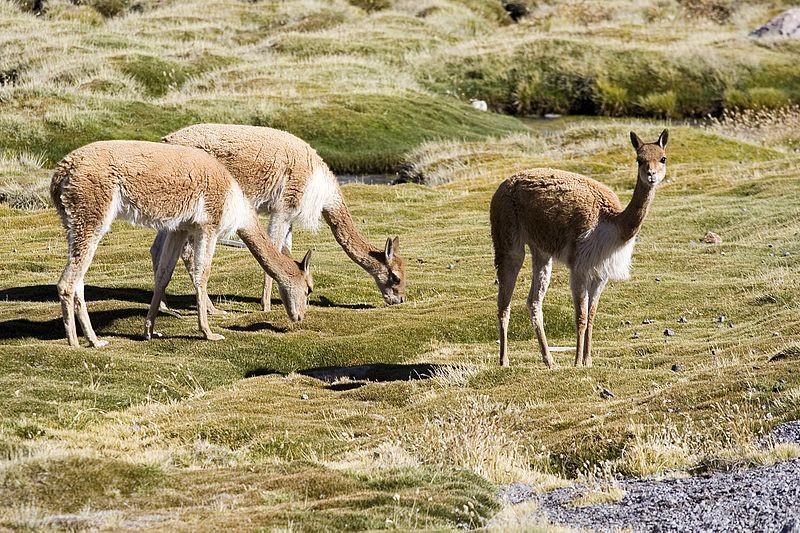
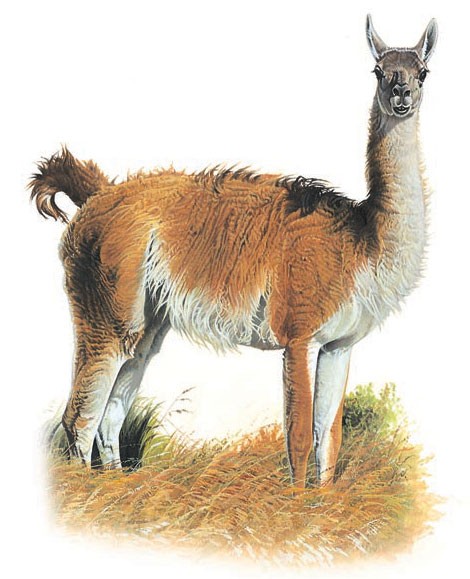
Guanacos graze the slopes of the Andes mountains, or browse on the low slopes of the Patagonian desert. They get moisture from the plants they feed on so they never need to drink. Guanacos were domesticated to become llamas. Millions of guanacos once roamed the pampas grasslands, but their numbers have been greatly reduced by hunting for their wool and skins. They are also shot by sheep farmers who see them as competition for grazing and blame them for transmitting diseases to their flocks.
The vicuña is smaller and more slender than the guanaco. It lives in herds amid the Andean rocks and precipices of Peru, southern Ecuador and northern Bolivia. The domesticated alpaca is descended from the vicuña.
Camels and llamas
The first camels lived on North American plains about 40 million years ago. Some camels crossed over into Asia when sea levels were low between the two continents, by what is known as the Bering Land Bridge. There they evolved into the dromedary and Bactrian camels. About three million years ago, some other camels managed to spread into South America, where they evolved to become the llama family. The remaining North American camels died out about 10,000 years ago.

Consultant: Chris Jarvis
pics

Without in any way limiting Q-files Ltd’s exclusive rights under copyright, any use of this publication to “train” generative artificial intelligence (AI) technologies to generate text is expressly prohibited. Q-files Ltd reserves all rights to license use of this work for generative AI training and development of machine learning language models.