
Mammals

CITE
We have made every effort to follow citation style rules, but there may be some minor differences. If in doubt, please refer to the appropriate citation style manual.
Walrus. (2026). In Q-files Encyclopedia, Life, Mammals. Retrieved from
https://www.q-files.com/life/mammals/walrus
"Walrus." Life, Mammals, Q-files Encyclopedia, 24 Mar. 2026.
https://www.q-files.com/life/mammals/walrus.
Accessed 22 Sep. 2026.
Walrus 2026. Life, Mammals. Retrieved 22 September 2026, from
https://www.q-files.com/life/mammals/walrus
Life, Mammals, s.v. "Walrus," accessed September 22, 2026.
https://www.q-files.com/life/mammals/walrus


Walrus
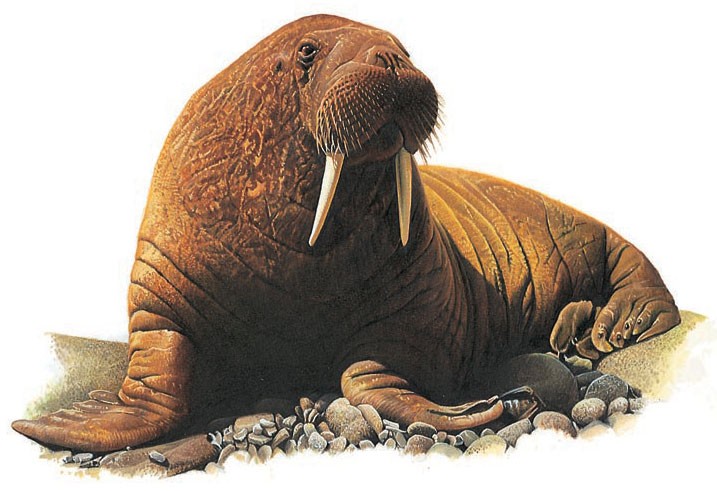
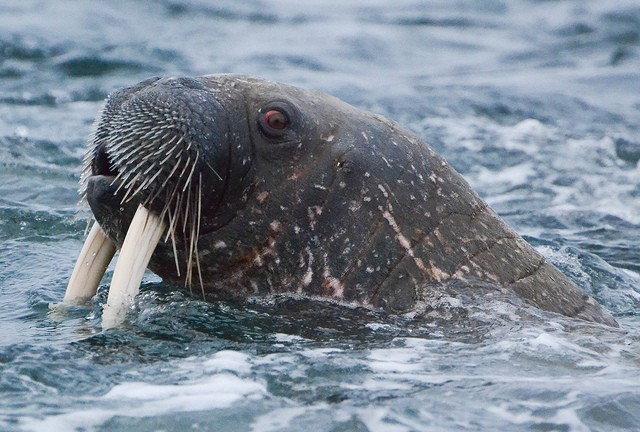
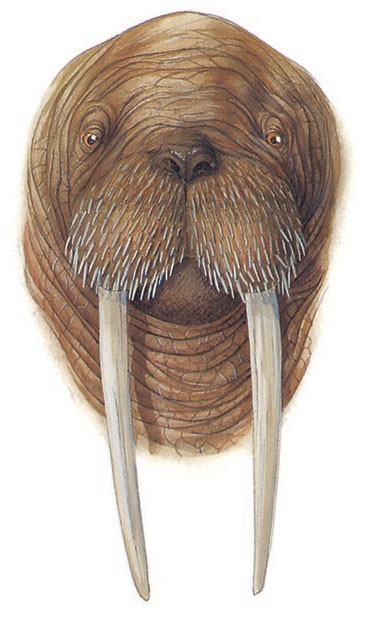
The walrus is a large, slow-swimming Arctic mammal with huge tusks. Along with seals, sea lions and fur seals, it is a member of the pinniped group. Its massive body is covered with thick, tough skin. Underneath, there is a layer of fat, called blubber, that protects the animal from the cold. The walrus eats clams (bivalve molluscs), using its tusks to prise them off rocks and sucking the the meat out of the shells. It will also eat shrimp, crabs and other molluscs.
Getting around
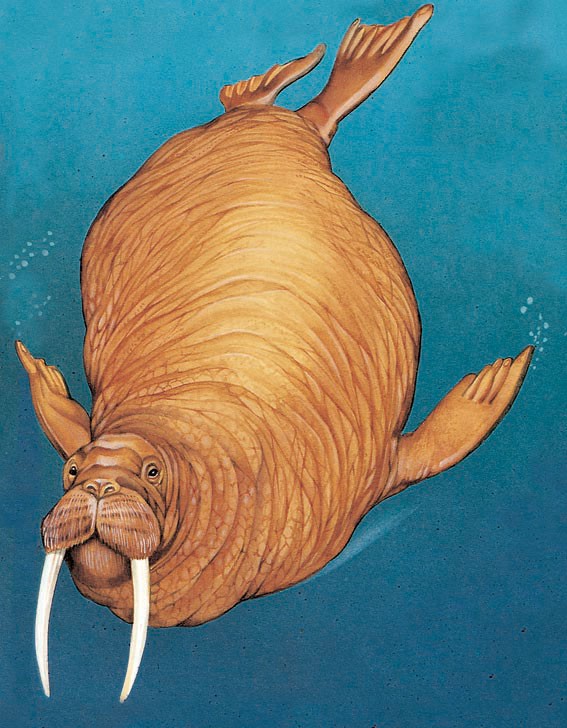
Like a sea lion, the walrus can turn its rear flippers forwards and walk on all fours. It swims more like a seal, using body movements rather than its flippers to push itself through the water. Also, like seals, it does not have external ears.
To find food, the walrus drifts along the seabed using its sensitive, bristly whiskers to feel its way. Its tusks are used to prise shellfish off rocks, to haul the animal's huge body out of the water and to knock breathing holes into the sea ice from below.
Summer gathering
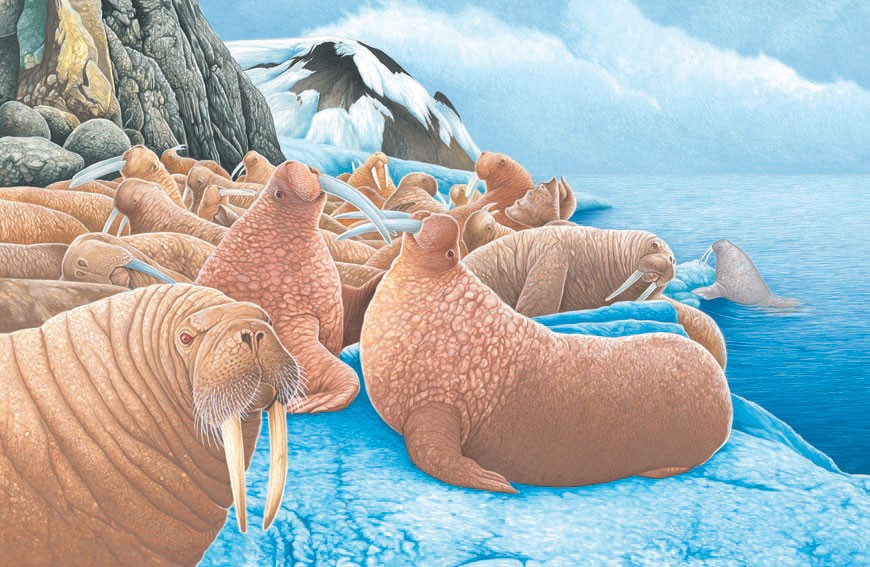
Every winter, walrus males, or bulls, fight for dominance. They stab at one another with their long tusks in order to win the right to mate with females, known as cows. But on summer days, large groups of males gather on Arctic coasts while the females raise their pups on ice floes out to sea. If there is no room on the ground, they will happily lie on top of one another. The walruses are pale grey when they leave the cold sea, but, after half an hour in the sun, their skin turns almost pink. This is because blood rushes to their skin to help carry the heat away from their bodies.
Consultant: Chris Jarvis
pics
Without in any way limiting Q-files Ltd’s exclusive rights under copyright, any use of this publication to “train” generative artificial intelligence (AI) technologies to generate text is expressly prohibited. Q-files Ltd reserves all rights to license use of this work for generative AI training and development of machine learning language models.