
Mammals

CITE
We have made every effort to follow citation style rules, but there may be some minor differences. If in doubt, please refer to the appropriate citation style manual.
Sperm whale. (2026). In Q-files Encyclopedia, Life, Mammals. Retrieved from
https://www.q-files.com/life/mammals/sperm-whale
"Sperm whale." Life, Mammals, Q-files Encyclopedia, 17 Apr. 2026.
https://www.q-files.com/life/mammals/sperm-whale.
Accessed 21 Sep. 2026.
Sperm whale 2026. Life, Mammals. Retrieved 21 September 2026, from
https://www.q-files.com/life/mammals/sperm-whale
Life, Mammals, s.v. "Sperm whale," accessed September 21, 2026.
https://www.q-files.com/life/mammals/sperm-whale


Sperm whale
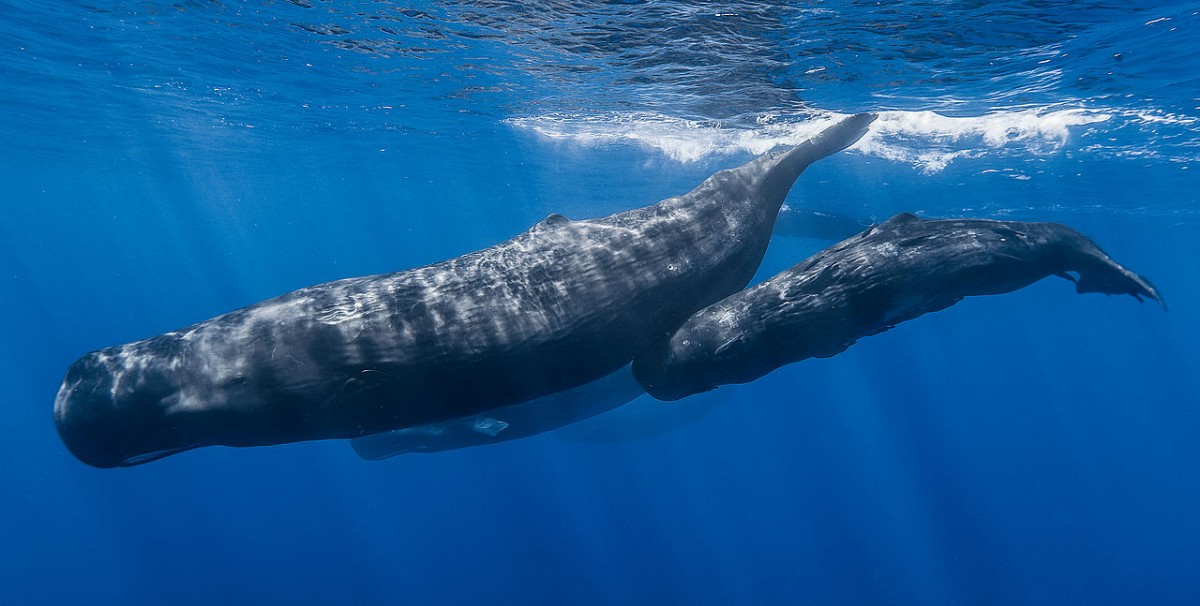
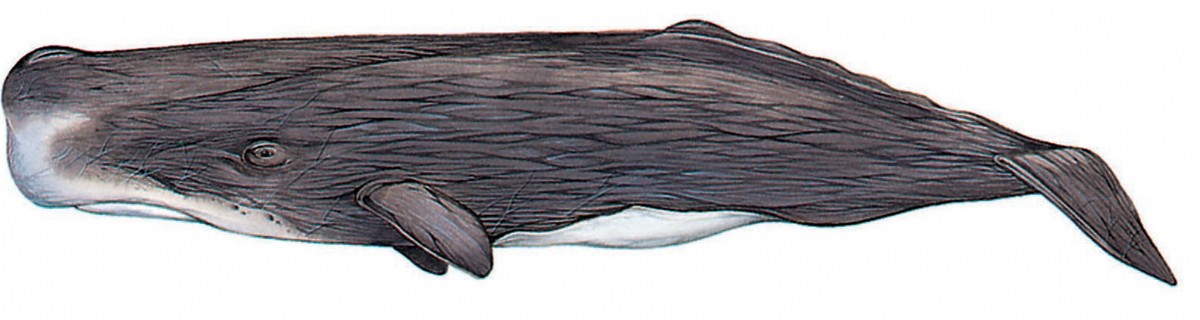
At up to 15 metres (roughly 50 ft) long and 45 tonnes in weight, the sperm whale is the largest of the toothed whales. It has the largest brain of any animal. It can can dive to depths of at least 1000 metres (3300 feet), and very likely up to three times that depth. Sperm whales live together in groups, called pods, of 15 to 20 animals. Pods include females and their young; males roam solo or move from pod to pod. Sperm whales may live for up to 70 years.


Champion diver
Usually, the sperm whale dives down into the water around 400 metres (1300 feet) for around 35 minutes in search of deep-sea squid, its main food. However, it is thought to be capable, scientists believe, of descending to 3000 metres (10,000 feet) for 90 minutes or longer in its hunt for prey.
The sperm whale's huge, square head contains a special organ which helps it to descend and ascend long distances. This organ, called the spermaceti, is filled with a waxy substance. When the whale dives, the cold water cools the wax, causing it to solidify and make the head heavier. On ascent, blood flow to the head warms and melts the wax, making the head lighter.
Defence
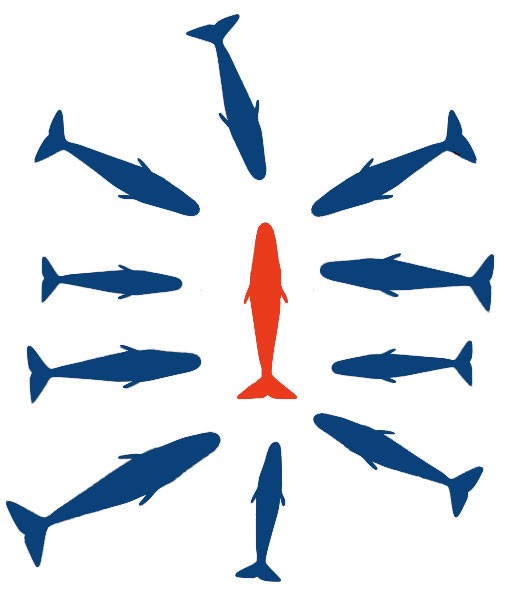
Individual large sperm whales have no predators other than humans. But killer whales prey on groups of females with young, usually intent on seizing the calves. The adult females protect their calves, or another injured adult, by encircling them. This is called the Marguerite formation (the positions the whales take up look, from above, like the Marguerite daisy flower). A blow from their powerful flukes can fatally wound an attacking killer whale. Years ago, whalers would take advantage of this defensive behaviour by injuring one of the family members, and so attracting the rest of the group. Sometimes, the tables are turned when male sperm whales attack killer whales.

Underwater battles
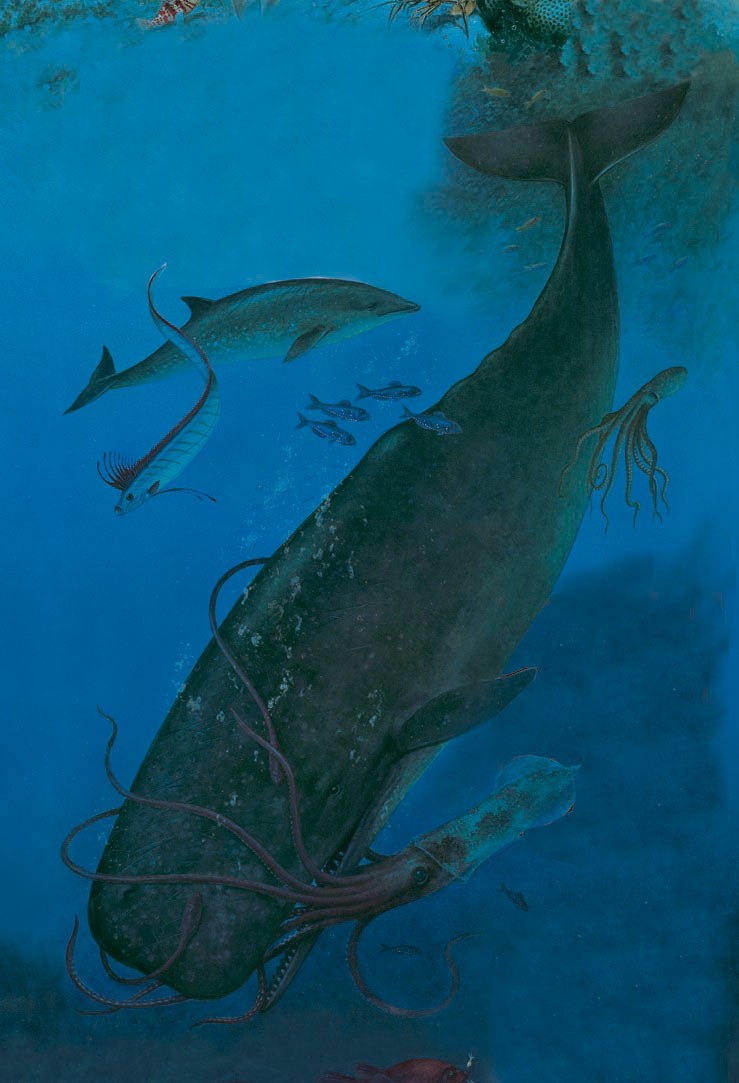
The sperm whale dives to great depths in search of its favourite prey, giant squid and colossal squid. No one has ever seen a sperm whale attack either of these species, but it is probably a violent struggle. The squid's tentacles can leave sucker-shaped wounds on the whale's back.

Ambergris
Ambergris is a waxy, grey substance produced in the digestive system of sperm whales. The whales eat vast quantities of squid, most of which cannot be digested, so is vomited out. But some indigestible matter may remain, and over the years it binds together in the whale’s intestines to form ambergris. This is sometimes excreted and is most commonly found floating in the sea. But sometimes it ruptures the intestine and kills the whale.
Produced by only about one in a hundred sperm whales, ambergris is a rare substance. It is highly valued by perfumers (who call it called "floating gold") for its sweet, woody scent. It contains ambrein, an odourless alcohol, that can extend the life of other scents.
Consultant: Chris Jarvis
pics

Without in any way limiting Q-files Ltd’s exclusive rights under copyright, any use of this publication to “train” generative artificial intelligence (AI) technologies to generate text is expressly prohibited. Q-files Ltd reserves all rights to license use of this work for generative AI training and development of machine learning language models.