
Mammals

CITE
We have made every effort to follow citation style rules, but there may be some minor differences. If in doubt, please refer to the appropriate citation style manual.
Hippopotamus. (2026). In Q-files Encyclopedia, Life, Mammals. Retrieved from
https://www.q-files.com/life/mammals/hippopotamus
"Hippopotamus." Life, Mammals, Q-files Encyclopedia, 24 Mar. 2026.
https://www.q-files.com/life/mammals/hippopotamus.
Accessed 6 Aug. 2026.
Hippopotamus 2026. Life, Mammals. Retrieved 6 August 2026, from
https://www.q-files.com/life/mammals/hippopotamus
Life, Mammals, s.v. "Hippopotamus," accessed August 6, 2026.
https://www.q-files.com/life/mammals/hippopotamus


Hippopotamus
Hippopotamuses are large African semi-aquatic mammals: they live both in the water and on land. They are ungulates, mammals that have hooves instead of claws. The hippo is classified as an even-toed ungulate, along with pigs, deer, camels and others, although their closest living relatives are now thought to be whales and dolphins. Hippos live in groups of up to 30 individuals in grassland rivers and lakes. They feed on grasses on land at night. The hippo's smaller, more solitary, relative, the pygmy hippopotamus, lives in forests and swamps.
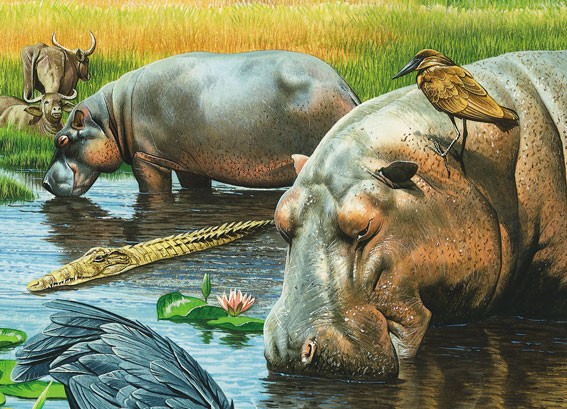
Wallowing


The skin of a hippopotamus dries out quickly in the hot African sunshine, so hippos spend around 16 hours a day lazing in cool water or mud. Their eyes, ears and nostrils are high on their heads, so that they can submerge almost their entire bodies. Hippos stir up the bottom mud, providing nutrients for other swamp life. They even mate and give birth in the water.
At night, as the air cools down, hippos come out on to land and graze on short grasses for a few hours. Because they spend little time moving about, they do not need to eat for long periods every day as other large ungulates do. They still manage to eat 25–40 kilograms (55–88 pounds) of food a day, however.
Fights
Despite their lazy appearance, hippos are powerful, aggressive animals who will fight fiercely for territory or to defend their young. They are rarely attacked themselves and will chase off, or even kill, crocodiles.
During the dry season, waterholes rapidly shrink and hippos find themselves crowded into large groups of more than 100 individuals. Bull hippos, used to ruling their own territory, engage in fierce battles for dominance with other bulls. Males use their upper canine teeth to push rivals away, slashing out at them with their long lower canines.

Fights usually end when one male gives in to a stronger rival, but some end in serious injury or even death. Most males bear scars from previous fights.
Skin

Hippopotamus skin is up to 15 centimetres (6 inches) thick. This provides protection from predators. Hippos do not have sweat glands like other mammals. Instead their pores produce a pink, sticky fluid that dries to form a coat over their bodies. This stops them being burnt by the sun, and may also prevent any wounds from becoming infected in dirty water or mud wallows.
Consultant: Chris Jarvis
pics
Without in any way limiting Q-files Ltd’s exclusive rights under copyright, any use of this publication to “train” generative artificial intelligence (AI) technologies to generate text is expressly prohibited. Q-files Ltd reserves all rights to license use of this work for generative AI training and development of machine learning language models.