
Human body

CITE
We have made every effort to follow citation style rules, but there may be some minor differences. If in doubt, please refer to the appropriate citation style manual.
Teeth. (2026). In Q-files Encyclopedia, Life, Human body. Retrieved from
https://www.q-files.com/life/human-body/teeth
"Teeth." Life, Human body, Q-files Encyclopedia, 23 Mar. 2026.
https://www.q-files.com/life/human-body/teeth.
Accessed 21 Sep. 2026.
Teeth 2026. Life, Human body. Retrieved 21 September 2026, from
https://www.q-files.com/life/human-body/teeth
Life, Human body, s.v. "Teeth," accessed September 21, 2026.
https://www.q-files.com/life/human-body/teeth


Teeth
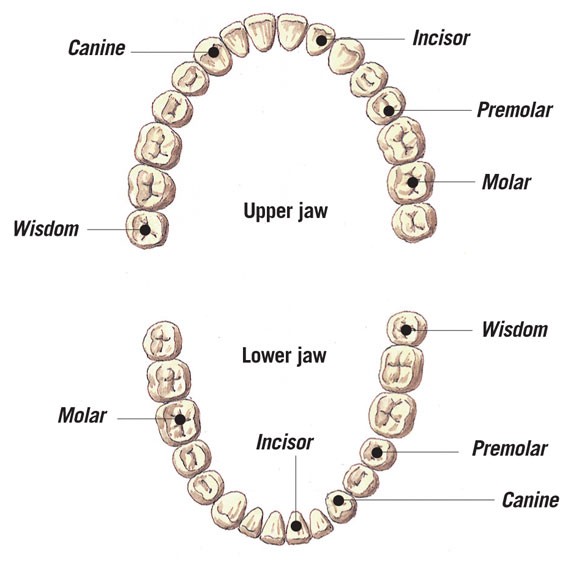
There are four main kinds of teeth. The sharp-edged, chisel-like incisors at the front of the mouth slice and cut pieces from large food items. The taller, pointed canines tear and grip tough food. The premolars and molars at the back of the mouth squeeze and crush the food. By the age of three, children have 20 milk (or deciduous) teeth: four incisors, two canines and four molars in each jaw. Between 6 and 12 years, these teeth are shed and replaced by adult teeth. An adult person has 32 teeth. There are four incisors, two canines, four premolars and six molars in each jaw. The rearmost molars are called wisdom teeth.
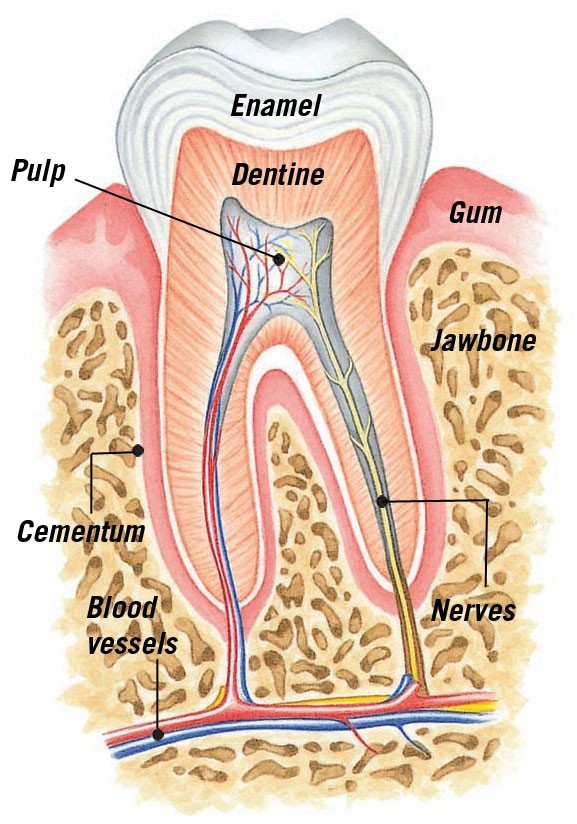
Structure of a tooth
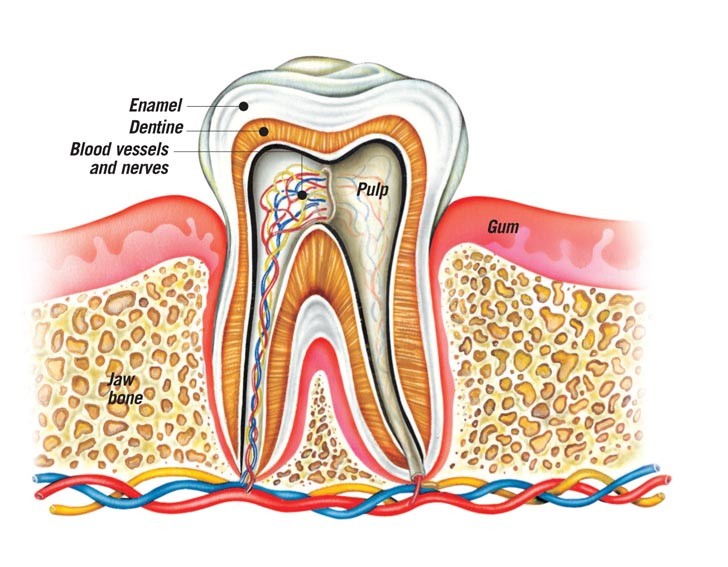
Each tooth has a long root that, with a coating of cementum "glue", anchors it firmly in the jawbone, and a crown that sticks up above the soft, pink gum. The bulk of the tooth is made of dentine, a hard, bone-like material. The tooth's hollow interior, the pulp cavity, contains blood vessels and nerves.
Above the gum, the tooth is coated with enamel. The hardest substance in the body, it protects the tooth from many years of crushing and grinding, chemical attack by mouth bacteria, and from the extremes of heat and cold. But even enamel can be eaten away by acids released by mouth bacteria that feed on food remains left on or between the teeth.
Consultant: Richard Walker
pics
Without in any way limiting Q-files Ltd’s exclusive rights under copyright, any use of this publication to “train” generative artificial intelligence (AI) technologies to generate text is expressly prohibited. Q-files Ltd reserves all rights to license use of this work for generative AI training and development of machine learning language models.