
Human body

CITE
We have made every effort to follow citation style rules, but there may be some minor differences. If in doubt, please refer to the appropriate citation style manual.
Skeleton. (2026). In Q-files Encyclopedia, Life, Human body. Retrieved from
https://www.q-files.com/life/human-body/skeleton
"Skeleton." Life, Human body, Q-files Encyclopedia, 23 Mar. 2026.
https://www.q-files.com/life/human-body/skeleton.
Accessed 21 Sep. 2026.
Skeleton 2026. Life, Human body. Retrieved 21 September 2026, from
https://www.q-files.com/life/human-body/skeleton
Life, Human body, s.v. "Skeleton," accessed September 21, 2026.
https://www.q-files.com/life/human-body/skeleton


Skeleton
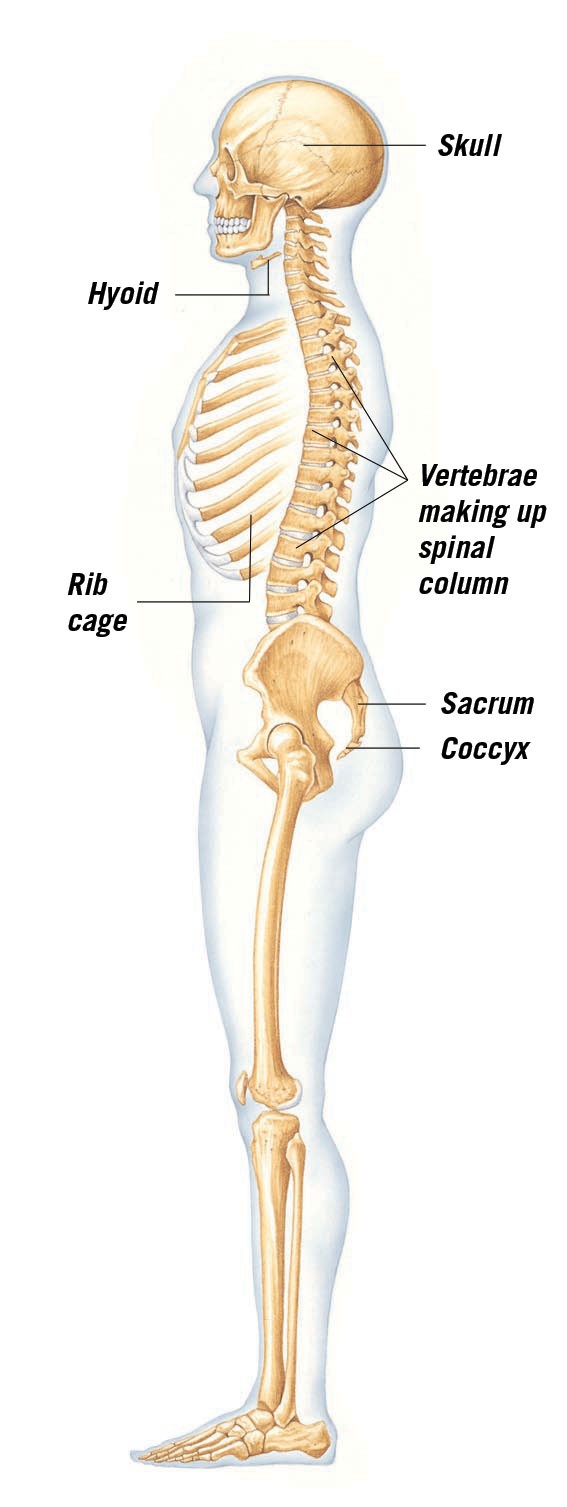
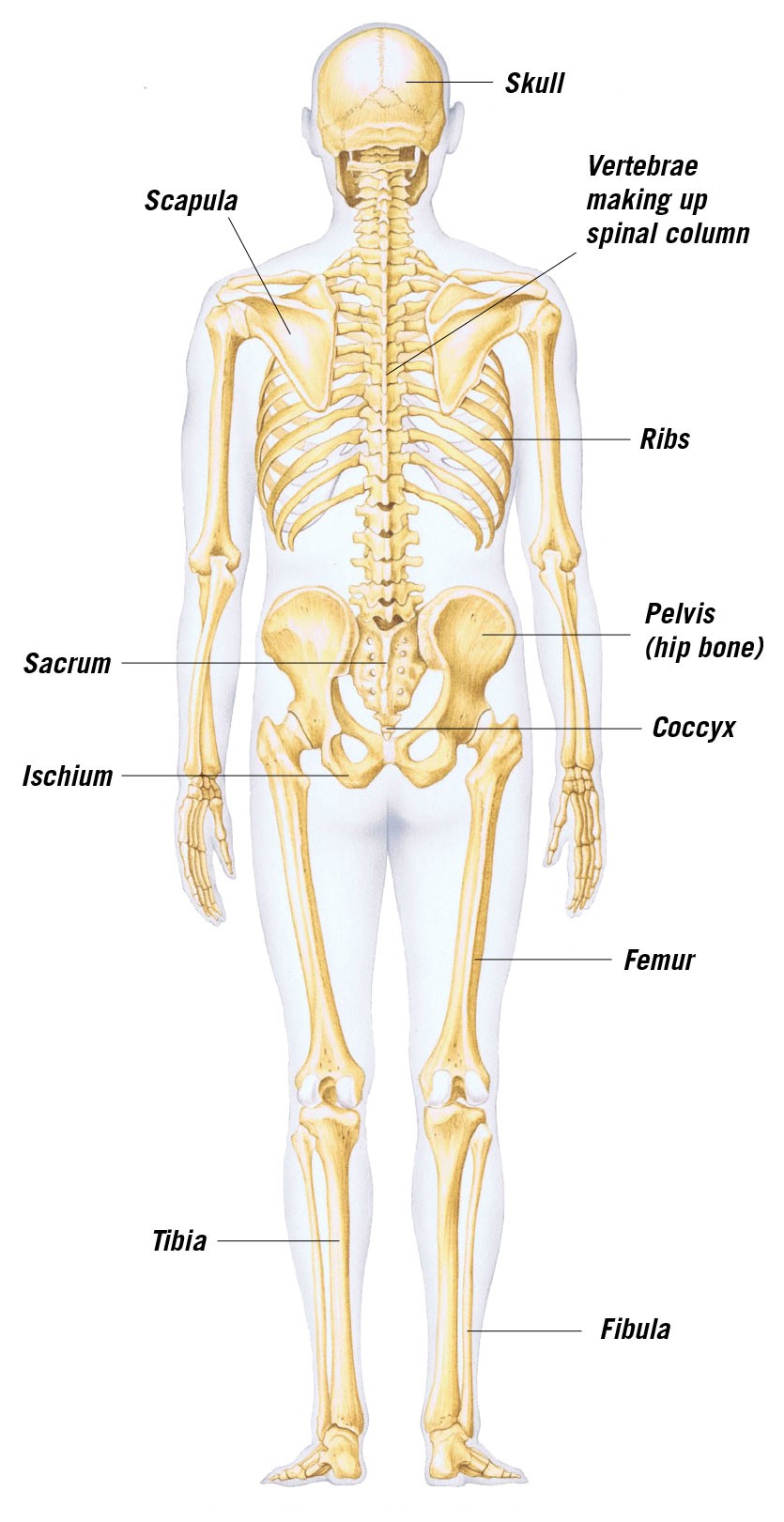
The 206 bones of the skeleton form a strong, flexible internal framework that supports the rest of the body. The skeleton also gives the body its shape, allows it to move and protects the soft organs inside against injury. Different parts of the skeleton have different roles. The skull, for example, protects the brain and shapes the face. The rib cage surrounds and protects the heart and lungs. The vertebrae of the backbone together provide a strong, flexible support for the body. The long bones of limbs work like levers to move the arms and legs.

Bones
An adult human's skeleton is made up of 206 bones. Bones are made from a combination of minerals, such as calcium phosphate, that give them hardness, and tough collagen fibres, that give them strength and some flexibility. Their internal structure makes bones light but strong. Weight for weight, bones are six times stronger than steel. As well as supporting the body, each bone provides anchorage points for the muscles that pull on the skeleton to move the body.
The old bones of a museum skeleton are dry and brittle. But inside a living body, a bone is moist and contains living cells that maintain it. It is neither dry—it contains around 20% water—nor brittle.
Like other body organs, bones have a supply of blood vessels to meet the demands of cells within the bone, along with nerves that carry signals from receptors within the bone.

Parts of a bone
There are several types of bones in the body, including long bones, such as the femur (thigh bone). Long bones are longer than they are wide, and have an expanded head at each end. The femur’s ball-shaped, upper head fits into a socket in the hip bone. Its lower, knuckle-shaped head forms part of the knee joint. Between the two heads is a long shaft.
The outer layer of a bone, called compact bone, is hard and dense. Beneath this is a strong but light, honeycombed tissue called spongy bone. The spaces within spongy bone are filled with jelly-like bone marrow. This also fills the central cavity in the
shaft of long bones.


Bone marrow
Bone marrow is a jelly-like material found inside bones. Yellow bone marrow, found in the hollow centre of the shafts of long bones, stores fat. Red bone marrow, found in flat bones and the heads of some long bones, produces millions of red and white blood cells every second.
Joints
Where the ends of two or more bones meet, they form joints. In a few joints, such as those between the bones of the skull (called sutures), the bones are fixed firmly to each other and cannot move. In some other joints, such as those between the vertebrae of the backbone, limited movement is possible. But the majority of joints, called synovial joints, are movable. The most flexible synovial joints include the shoulders, knees, hips and elbows.
The shapes of the bone ends of synovial joints show us the range of movements they allow. Hinge joints, like the elbow and knee, work like a hinge and allow opening and closing movements in one plane. The ball and socket joints in the shoulder and hip allow a wide range of movements—particularly in the shoulders—including circular motion.

Ellipsoidal, or condyloid, joints are found, for example, between the ulna (a lower arm bone) and wrist bones and in the knuckles. These joints allow movement both from side to side and up and down. A pivot joint between the top two vertebrae of the spine, the atlas and the axis, allows the head to shake. In addition, plane joints between wrist and ankle bones provide stability, while the flexible saddle joint at the base of the thumb allows it to touch the tips of the other fingers.
Inside a joint

In a movable synovial joint, the ends of the bones are covered with a smooth, shiny, slippery tissue called cartilage. This protects the bone ends and stops them rubbing against each other and wearing away. A flexible bag, the capsule, wraps around the bone ends. Within this, a synovial membrane makes an oily fluid which fills the space between the bone ends and lubricates the joint. This allows the cartilage-covered bone ends to move smoothly and without friction. The two bones are linked by flexible, strap-like ligaments around the synovial capsule that stop the bones coming apart.
Hips
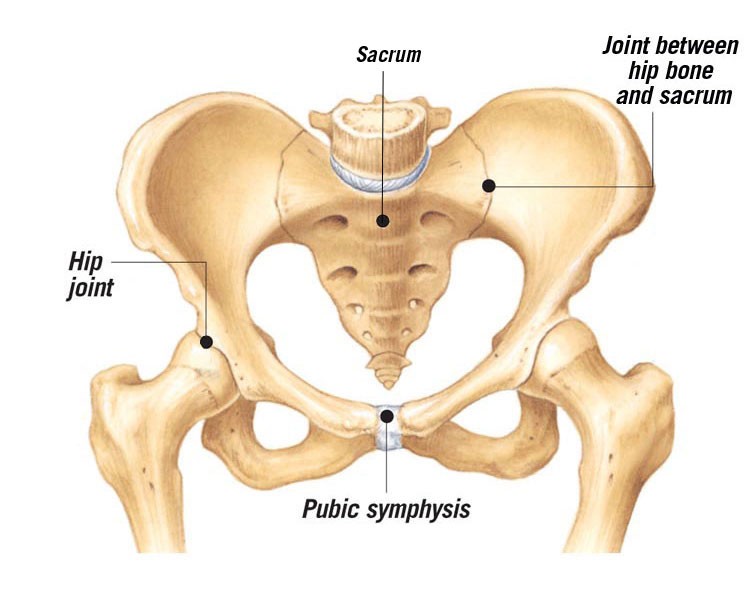
The hips are made up of the bowl-shaped pelvis and the upper thigh bones (femurs). The pelvis consists of two hip bones and the sacrum, part of the backbone. The hip bones join at the front at the pubic symphysis. At the back they form joints with the sacrum. All these joints allow limited movement. But the ball and socket joint between each hip bone and femur allows a wide range of movement. The pelvis supports the organs of the lower abdomen, such as the bladder and uterus.
Hands
Only the human animal can touch its thumb with the tip of every other finger. Your hands enable you to accomplish a wide range of delicate tasks, such as typing on a keyboard, playing a violin or holding a pen while unscrewing the top. They are also strong enough to allow you to grip, slap or flick with great power. An arrangement of 27 small bones moved by 37 muscles equips your hand for all these actions.
Feet
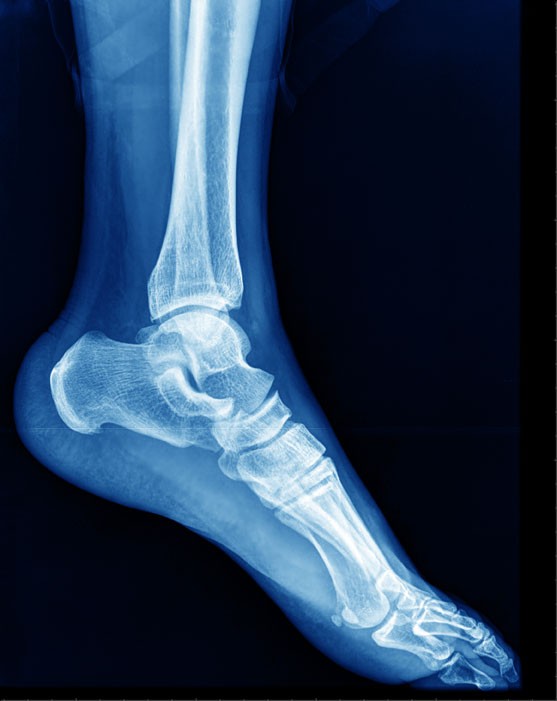
Your feet must bear the weight of your body, propel it forward when walking or running, and help keep it balanced upright. The toe bones are therefore broader and flatter than those in the fingers. Like some buildings, the foot has an arched shape specially designed to support a large weight. This structure, together with the heel pad, also helps cushion the foot against any jolting movement. More than 100 ligaments hold the assemblage of bones and joints together.

Backbone
The backbone is a column of stacked bones that supports the upper body, neck and head. It is also called the vertebral column or spine. The backbone is made up of 26 irregular bones called vertebrae, including the sacrum and coccyx, both of which consist of fused bones and are found at the base of the backbone.
Pairs of vertebrae are separated by a disc of cartilage (intervertebral disc) with a fluid-filled core. These discs absorb the shocks and jolts created by the impact of the feet hitting the ground during walking, running or jumping. In this they are aided by the S-shape of the backbone (as seen in side view), which gives it extra springiness. Each intervertebral disc allows limited movement, but over the whole backbone these limited movements add up, making it flexible and enabling it to twist and turn.
The backbone also surrounds and protects the spinal cord, which runs down the back through a bony "tunnel" created by neighbouring vertebrae.
Rib cage
The ribs are flat bones that curve around the chest. Together with the sternum (breast bone) at the front and the 12 thoracic vertebrae of the backbone at the rear, the 12 pairs of ribs form the rib cage. This surrounds and protects the heart and lungs. Ribs are joined to the sternum by bendy cartilage, and to thoracic vertebrae by movable joints. This gives the rib cage the flexibility, when moved by muscles, to expand and shrink in order to produce the breathing movements that move air into and out of the lungs. The two lowest ribs, known as the floating ribs, are attached only at the back.
Ear bones
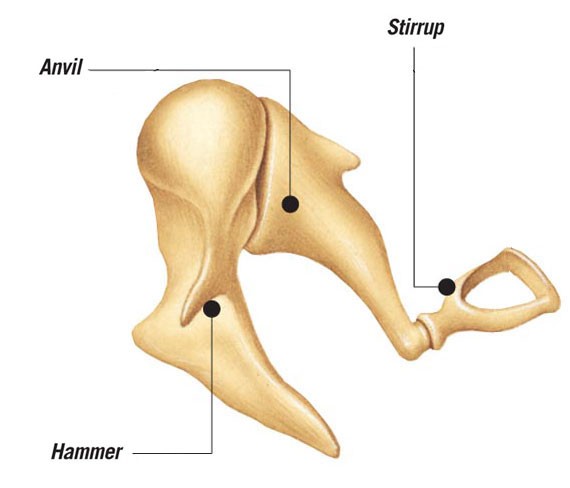
The smallest and lightest bone in your body is the stapes, or stirrup bone. Smaller than a grain of rice, it is one of three bones that transmit sounds from the eardrum to the inner ear (the other two are the malleus, the hammer, and the incus, the anvil). Together, they are called the ossicles. They work together to amplify the vibrations received by the eardrum about 20 times.
Male and female skeletons
Men and women have the same number of bones. Women generally have lighter and smaller skeletons, but otherwise there are only two important differences. One is the eyebrow ridges, which are somewhat thicker on the male skull. The other is the pelvis or hip—the bowl-shaped structure that connects the legs to the body—which in women is wider and has a larger central opening. This gives room for a baby to pass through when it is being born. As a result, a woman’s hips are relatively wide compared to her shoulders. The reverse is true for men: they have broad shoulders and slim hips. Both men and women have a coccyx—the bottom end of the spinal column, which on many other animals is much longer and forms a tail.


Bones in children
While adults have 206 bones in their skeleton, a newborn baby actually has over 300. As the baby grows, some of the bones fuse together, reducing the overall number. Before birth, for example, a baby’s skull is made of several separate bones. During birth some of them overlap like flower petals so the head is small enough to pass through the narrow birth canal. After birth, these skull bones have gaps between them called fontanelles; later they fuse together.
A baby’s skeleton is made of both bone tissue and cartilage, a tough, bendy tissue also called gristle. As a child grows, the cartilage is gradually replaced by bone. Cartilage at the ends of long bones is constantly expanding and being replaced by bone, allowing the arms, hands, legs and feet to get longer. Growth stops at around the age of 20.
Fractures
Strong though they are, your bones can break if too much strain is put upon them, especially in an accident. A bone may crack or snap. This is known as a fracture. X-rays can be used to investigate what sort of fracture has occurred.

A fracture may be "simple", with a clean break, or "compound", where the bone has pierced the skin. A comminuted fracture describes a condition where a bone is shattered into several pieces. If one bone is driven into another, it is known as an impacted fracture.
With the help of splints or a plaster cast, broken bones can be fixed back together again. The bone cells then get to work, fusing the separate pieces into one solid bone as before.
Consultant: Richard Walker
pics
Without in any way limiting Q-files Ltd’s exclusive rights under copyright, any use of this publication to “train” generative artificial intelligence (AI) technologies to generate text is expressly prohibited. Q-files Ltd reserves all rights to license use of this work for generative AI training and development of machine learning language models.