
Human body

CITE
We have made every effort to follow citation style rules, but there may be some minor differences. If in doubt, please refer to the appropriate citation style manual.
Muscles. (2026). In Q-files Encyclopedia, Life, Human body. Retrieved from
https://www.q-files.com/life/human-body/muscles
"Muscles." Life, Human body, Q-files Encyclopedia, 23 Mar. 2026.
https://www.q-files.com/life/human-body/muscles.
Accessed 6 Aug. 2026.
Muscles 2026. Life, Human body. Retrieved 6 August 2026, from
https://www.q-files.com/life/human-body/muscles
Life, Human body, s.v. "Muscles," accessed August 6, 2026.
https://www.q-files.com/life/human-body/muscles


Muscles
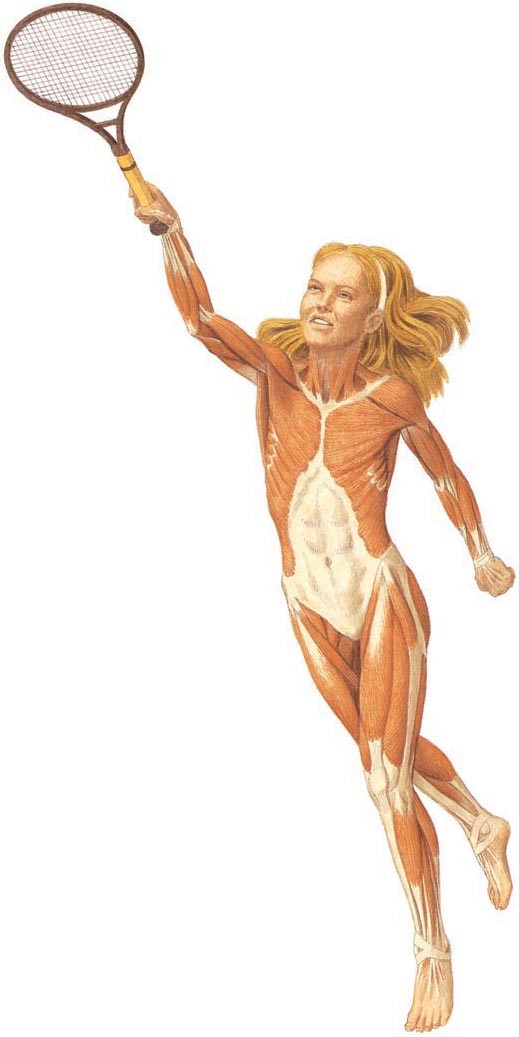
About two-fifths of the body’s weight is made up by the skeletal muscles—more than 640 of them. These types of muscle keep us upright and provide the force that allows us to move our bones, and so our bodies, into different positions. They enable us to walk, stand, jump, pick things up and perform many other actions. In most parts of the body the skeletal muscles are in two main layers. There are superficial muscles just under the skin and deep muscles lying below them. Other types of muscle keep our hearts beating (cardiac muscles) and our other organs working (involuntary muscles).


What muscles do
Every movement that the body makes is powered by muscles. All types of muscle exert a pulling force by being able to contract, or shorten. Most skeletal muscles are attached to the bones of the skeleton and pull on them to make the body move. Skeletal muscles taper at each end into tough cords called tendons which attaches the muscle firmly to a bones of the skeleton. As a muscle contracts, it becomes thicker and pulls on the bone, moving that part of the body.
Combinations of muscles—sometimes hundreds at a time—bend, straighten, rotate and generally move bones in many directions, as when, for example, you straighten your arm then rotate your hand from palm-up to palm-down. One bone may have several muscles attached to it.
Working in pairs
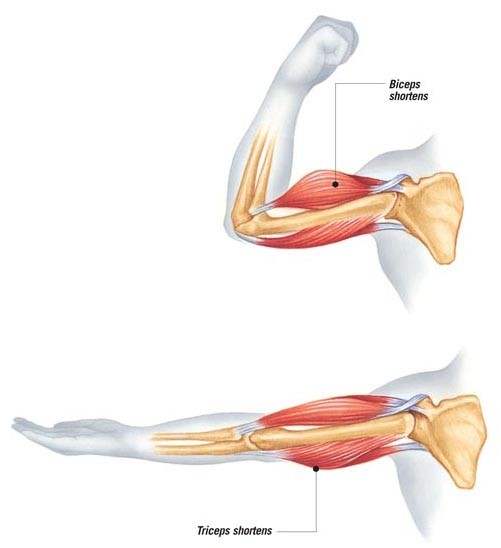
A muscle can only pull on a bone, not push it. So most muscles have opposing partners, like the biceps and triceps in the upper arm. To move your arm, the brain gives the muscles a signal, causing the biceps to shorten, pulling up the radius bone and causing the triceps to lengthen. To straighten the arm, the triceps shortens and so the biceps relaxes to its original shape.
Face muscles
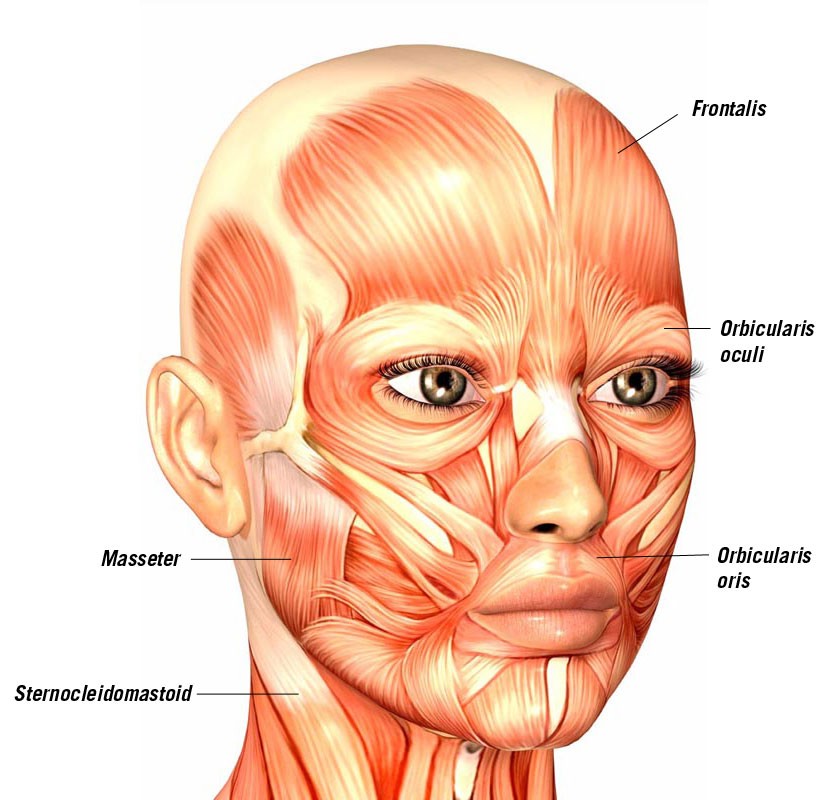
Blinking your eye involves the movement of just one muscle, called the orbicularis oculi, an O-shaped muscle inside the eyelid. It is attached not to bones, but to other muscles and soft tissues. When it shortens, the two sides of the O move together and close the gap between them. The lip muscle, the orbicularis oris, works in the same way. Many of the remaining 40 small, facial muscles pull on the skin of the face to create a wide range of facial expressions, such as smiling or fear. Smiling alone involves over 10 muscles.
The masseter, one of the muscles you chew with, is the strongest muscle in the body. There are even muscles for waggling your ears. Most of us never use them, so they weaken through lack of exercise.
Largest and smallest
The largest muscle is the gluteus maximus in the buttock. It pulls the thigh bone backwards at the hip when you walk, and with greater speed and power when you run and jump. The smallest muscle is the stapedius, deep inside the ear. It is just a few millimetres long and thinner than cotton thread. It pulls on a tiny ear bone, the stirrup, to prevent very loud noises from damaging the delicate inner ear.
Involuntary muscles
Many of our muscles, including our arm and leg muscles and those which control breathing, are called voluntary or skeletal muscles: we can control them at will. Not all muscles are voluntary, however. There are also involuntary, or visceral, muscles, which we cannot control at will. An involuntary muscle, for example, moves food though the intestine. A third kind, called the cardiac muscle, makes up the heart and squeezes blood around the arteries and veins. It is an "involuntary" muscle but with a structure very similar to a "voluntary" one.

Structure of a muscle
Each skeletal muscle is linked by nerves to the brain. The muscle itself is made up of bundles of long, very thin cells called muscle fibres. Everyone has the same number of muscles, but muscle cells increase in size the more they are used. They are unusually long cells—fibres extending from your hip to your knee average 30 centimetres (1 foot)—but are thinner than a strand of hair.

Each fibre is itself filled with bundles of incredibly thin tubes of protein called myofibrils. In turn, each myofibril contains—arranged along its length—two types of long protein filaments, called actin and myosin. When a muscle contracts, the brain sends signals along the nerve to the muscle. The signals make the actin and myosin proteins slide past each other, rather like people pulling hand-over-hand on a rope. But these tiny movements, each a fraction of a millimetre, added together make the myofibrils, fibres and their muscle contract. Most muscles can shorten to about two-thirds of their length.
Consultant: Richard Walker
pics
Without in any way limiting Q-files Ltd’s exclusive rights under copyright, any use of this publication to “train” generative artificial intelligence (AI) technologies to generate text is expressly prohibited. Q-files Ltd reserves all rights to license use of this work for generative AI training and development of machine learning language models.