
Mammals

CITE
We have made every effort to follow citation style rules, but there may be some minor differences. If in doubt, please refer to the appropriate citation style manual.
Lemurs and relatives. (2026). In Q-files Encyclopedia, Life, Mammals. Retrieved from
https://www.q-files.com/life/mammals/lemurs-and-relatives
"Lemurs and relatives." Life, Mammals, Q-files Encyclopedia, 24 Mar. 2026.
https://www.q-files.com/life/mammals/lemurs-and-relatives.
Accessed 21 Sep. 2026.
Lemurs and relatives 2026. Life, Mammals. Retrieved 21 September 2026, from
https://www.q-files.com/life/mammals/lemurs-and-relatives
Life, Mammals, s.v. "Lemurs and relatives," accessed September 21, 2026.
https://www.q-files.com/life/mammals/lemurs-and-relatives


Lemurs and relatives
Lemurs, tarsiers, bushbabies, lorises and pottos are all primates: relatives of monkeys, apes and humans. They form a group known as the lower primates, or prosimians. They have quite pointed faces, a good sense of smell and smaller brains than monkeys or apes, who have flat faces, better vision and larger brains. Most prosimians are tree-dwellers that leap or climb from branch to branch, feeding on fruit, insects or leaves. They usually have long tails to help them balance on landing. Some species will also catch small reptiles, birds or bats. There are about 100 species of lemur, most of which are endangered due to habitat loss (clearing of rainforest trees) or hunting.


Bushbabies, lorises and tarsiers
Bushbabies, lorises and tarsiers are nocturnal. Also known as galagos, bushbabies are named after their wailing cries. Bushbabies and tarsiers move quickly through the trees by running or leaping, while lorises move slowly and carefully. If they sense danger, they will freeze and may not move again for hours after the threat has passed.
The tarsiers are the only entirely carnivorous primates. They eat mostly insects, but will also prey on birds, lizards, snakes and bats. Their hind limbs are twice as long as the rest of their head and body combined.
Lemurs
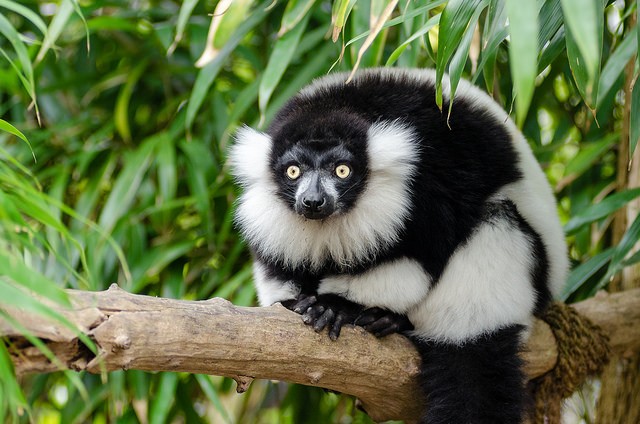
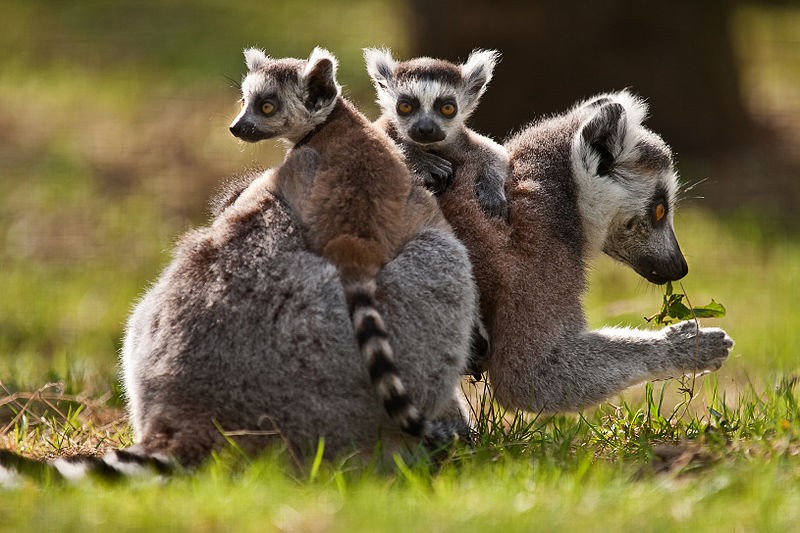
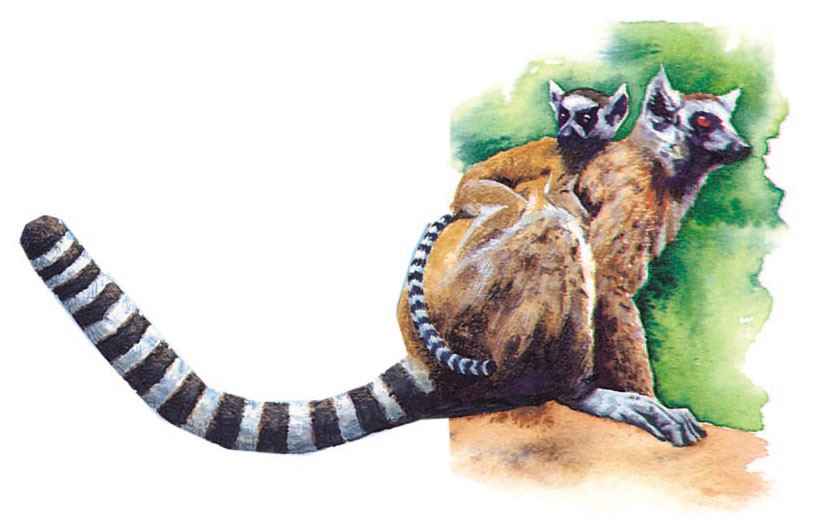
Lemurs are the largest group of lower primates, but they live only on the island of Madagascar off the African coast. Over millions of years, they have evolved into nearly 100 different species, all specially adapted to different habitats on the island. Most lemurs have long, bushy tails and soft coats, often with striking markings.
When on the ground, most lemurs move on all fours, but indris and sifakas bound along on their hind legs. Most lemurs prefer a diet of fruit and insects, but some types will eat anything, including other plant materials and small mammals.


Aye-aye
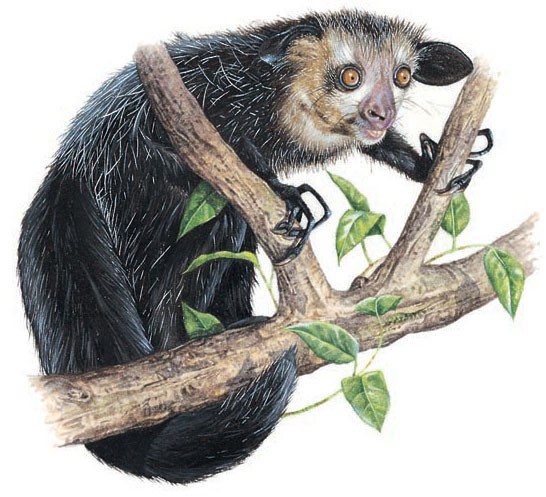
The aye-aye, a member of the lemur family, lives only in the rainforests of northeastern Madagascar. Moving around the branches at night, it uses its bat-like ears to listen out for insect grubs. It will then scrape them out from under the bark of a tree with its long, thin middle fingers. It also eats fruit and eggs. The aye-aye is now very rare, partly because of the loss of its habitat, but also because it has been hunted by local people, who think it brings them bad luck.
Consultant: Chris Jarvis
pics

Without in any way limiting Q-files Ltd’s exclusive rights under copyright, any use of this publication to “train” generative artificial intelligence (AI) technologies to generate text is expressly prohibited. Q-files Ltd reserves all rights to license use of this work for generative AI training and development of machine learning language models.