
Ecosystems

CITE
We have made every effort to follow citation style rules, but there may be some minor differences. If in doubt, please refer to the appropriate citation style manual.
Wildlife of Madagascar. (2026). In Q-files Encyclopedia, Life, Ecosystems. Retrieved from
https://www.q-files.com/life/ecosystems/wildlife-of-madagascar
"Wildlife of Madagascar." Life, Ecosystems, Q-files Encyclopedia, 30 Sep. 2026.
https://www.q-files.com/life/ecosystems/wildlife-of-madagascar.
Accessed 30 Oct. 2026.
Wildlife of Madagascar 2026. Life, Ecosystems. Retrieved 30 October 2026, from
https://www.q-files.com/life/ecosystems/wildlife-of-madagascar
Life, Ecosystems, s.v. "Wildlife of Madagascar," accessed October 30, 2026.
https://www.q-files.com/life/ecosystems/wildlife-of-madagascar


Wildlife of Madagascar
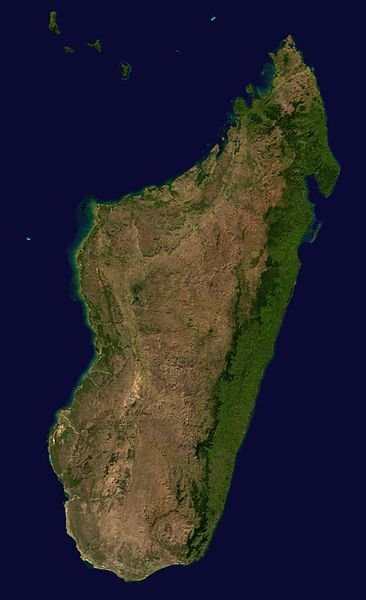
Madagascar is a large island (the world's fourth largest) lying about 400 kilometres (250 miles) off the coast of southeast Africa. About 88 million years ago, the island of Madagascar separated from the west coast of India (both had once been wedged together as part of the vast supercontinent of Gondwana which started to break up between 180 and 160 million years ago). Madagascar's plants and animals continued to evolve there in isolation from the rest of the world. Today, around 90% of its many thousands of species are found nowhere else on Earth: they are known as endemic species. As a result of deforestation—causing loss of habitat—and hunting, some of Madagascar’s animals, including most of its species of lemur, are critically endangered.


Habitats
A ridge runs north-south through Madagascar. Between it and the eastern coast lies much of the island's remaining tropical lowland forest. To the west of the ridge, there is a central plateau where most of Madagascar's population, the Malagasy, lives. Here there are terraced rice fields lying between grassy hills and small patches of forest that once covered the region.
To the west and south of the central highlands, the land slopes gently down to the coast. Here, where the climate is much drier, there are dry forests and scrublands.

Lemurs
Lemurs are kinds of primate that live only in Madagascar. Over millions of years, they have evolved into nearly 100 different species, all adapted to the many different habitats on the island. One of the most well-known is the ring-tailed lemur (known locally as maky or maki), with its striped tail and bright yellow eyes. It lives in a social group (or “troop”) of up to 30 lemurs, communicating with the others through a language of alarm calls and hoots. Compared to other species of lemur, ring-tailed lemurs spend a lot of time on the ground, moving on all fours across the forest floor. A group of ring-tailed lemurs can often be seen “sunbathing” together.

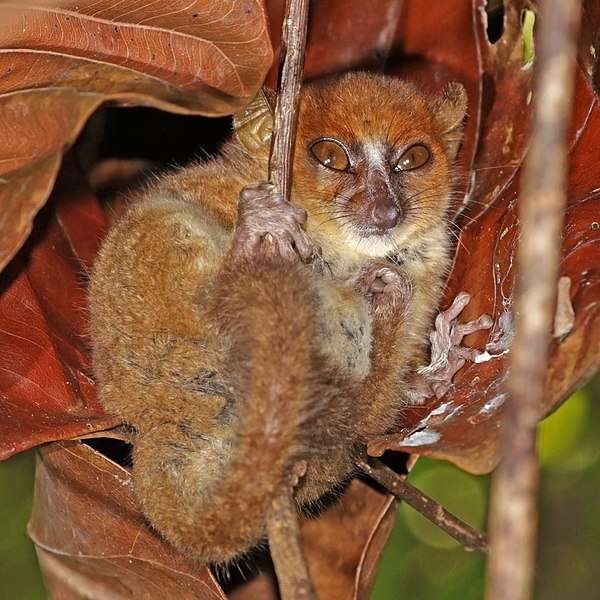
The tiny mouse lemurs are the smallest lemurs. Just the length of a human finger, Madame Berthe's mouse lemur, the world’s smallest primate, weighs just 30 grammes (1.1 oz). The largest lemur, the indri, by contrast, weighs around 8kg (18 lb). Unlike other lemurs, it has only a very short tail. It lives in the lowland forests of the eastern coast. Even though indris are sacred to the Malagasy, their survival is threatened by hunting and deforestation.

Sifakas
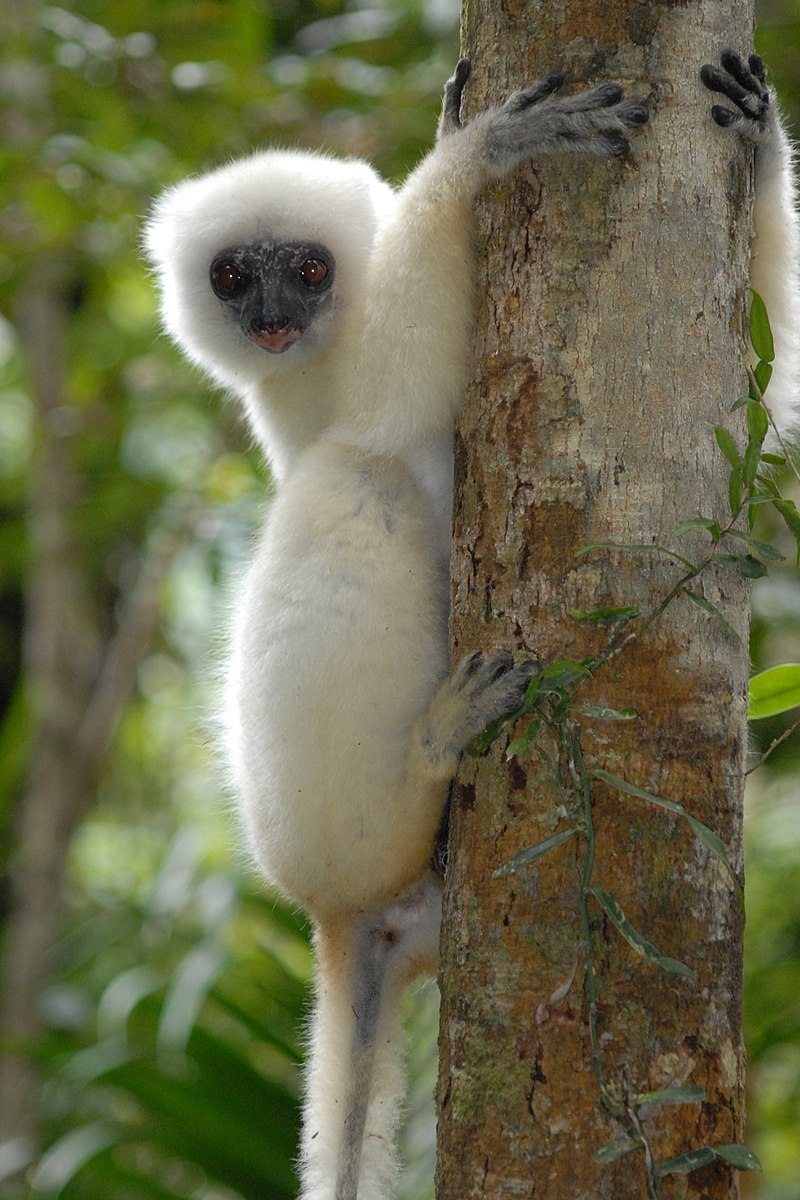
Closely related to indris are the sifakas. These lemurs are named after their hissing call, which sounds like “shee-fak”. The silky sifaka is one of the rarest mammals on Earth. There are estimated to be only around 250 left living in a tiny portion of northern forest. Because of its white fur, the silky sifaka is nicknamed “angel of the forest”. When crossing the forest floor, it bounds on its hind legs with its arms outstretched for balance.

Aye-aye
The aye-aye, another member of the lemur family, lives only in the rainforests of northeastern Madagascar. Moving around the branches at night, it uses its bat-like ears to listen out for insect grubs. It will then scrape them out from under the bark of a tree with its long, thin middle fingers. It also eats fruit and eggs. The aye-aye is now very rare, partly because of the loss of its habitat, but also because it has been hunted by local people, who think it brings them bad luck.
Fossa
The fossa is an unusual-looking predator that stalks the forests of Madagascar. Although it looks like a type of cat, this ferocious carnivore is actually more closely related to mongooses. Madagascar's largest predator, it can grow up to 1.8 metres (6 ft) long. The fossa’s long tail helps it to balance when it climbs along forest branches as it hunts for lemurs, its favourite prey.


Tenrecs
Tenrecs are a type of small insect-eating mammal endemic to Madagascar. Although they look quite similar to hedgehogs or shrews, they are not closely related. The smallest tenrec is 4.5 centimetres (1.8 inches) long. The largest, the tailless tenrec, measures up to 39 centimetres (15.4 inches) long and weighs nearly 2 kilos. It is covered with sharp spikes, which stand on end when threatened. Most tenrecs are nocturnal. They sleep by day and emerge during the night to hunt for insects, small frogs and mice. Unusually for tropical mammals, tenrecs hibernate for months on end during the hottest part of the year.
Chameleons
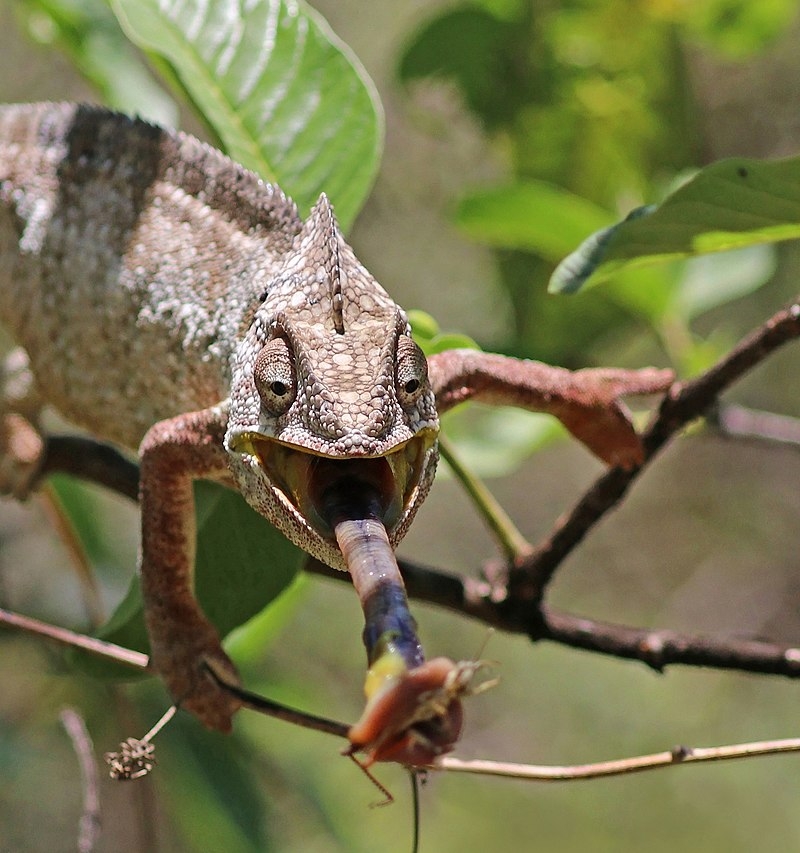
Around half of all the world’s 160 species of chameleon live in Madagascar. These slow-moving lizards can change colour to blend in with their background, as well as to communicate with one another and reveal their moods. The pygmy leaf chameleon measures just 26 millimetres (0.9 inches) long—no bigger than a fingernail. The recently discovered Brookesia nana is tinier still. The brightly coloured panther chameleon lives in the rainforests around the northern coast.


Birds
More than 250 species of birds can be found in Madagascar. Nearly half of them are endemic to the island, such as the tiny brightly-coloured asity, and the coua, a relation of the cuckoo, and the vangas. Like Darwin’s finches in the Galapagos Islands, a number of species of vanga evolved from a common ancestor millions of years ago, their different shaped beaks adapted for different kinds of food. The sickle-billed vanga, for example uses its curved beak to delve into tiny holes in search of insects.
The cuckoo roller is a large woodland bird. Although it is named after the cuckoo, it is not a relation. Cuckoo rollers mainly eat insects such as caterpillars and locusts, but have been known to take small chameleons.
The Madagascan fish eagle is the island’s largest bird of prey. It hunts for fish near inland waters such as estuaries and rivers. It perches high on branches where it can scan the water. When it spots a fish, it swoops and plunges from high above to catch its prey.

Insects
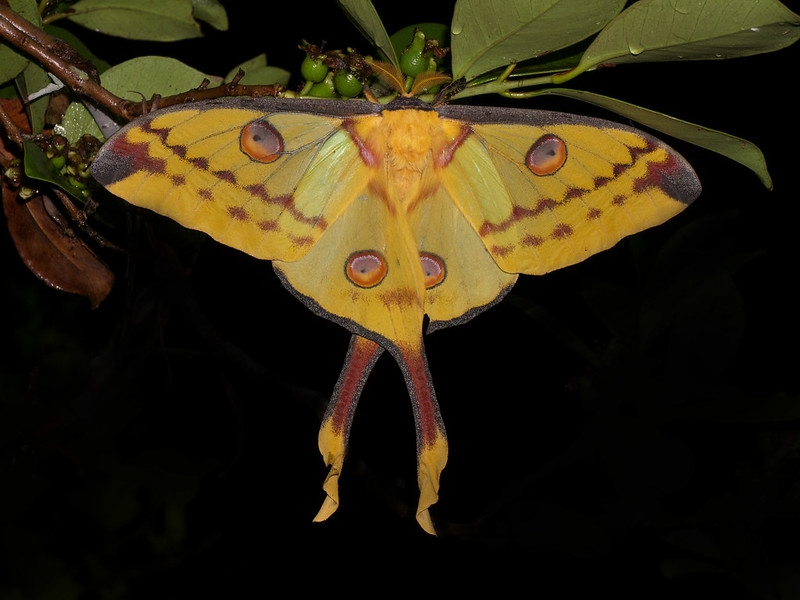

Madagascar’s rainforests are dense with insects. The enormous comet moth has a wingspan of 20 centimetres (7.8 inches), and a tail almost as long. After hatching, it lives for just five days. Another insect endemic to Madagascar is the giraffe weevil. It is named after the giraffe because of its long neck, which it uses for fighting.
The hissing cockroach lives in Madagascar’s tropical forests. It can measure up to 8 centimetres (3 inches) long. It has an unusual way of protecting itself: when threatened, it fills with air to look bigger and then forces the air out with a loud hissing sound, scaring its attacker away.
Plants
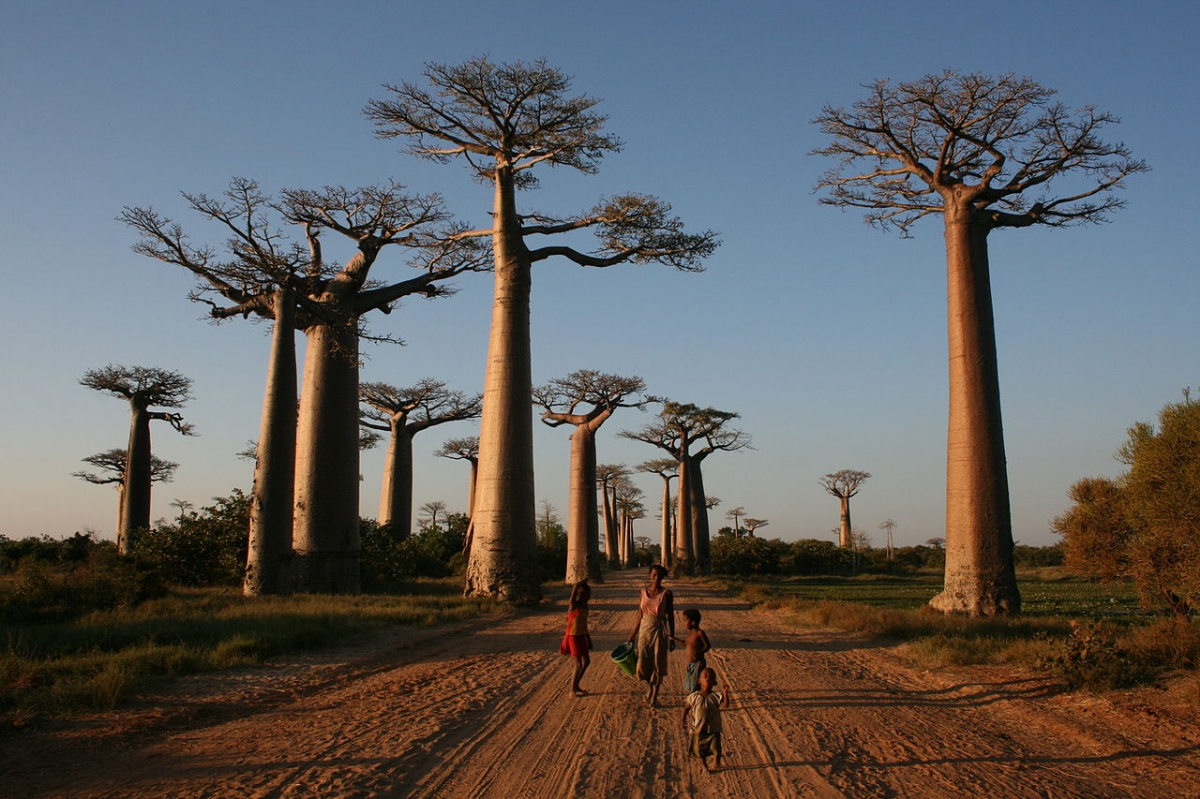
More than 80% of Madagascar's nearly 15,000 plant species are found nowhere else in the world. The rainforest of the island's humid east coast has a wide variety of palms, ferns and bamboo, while the dry eastern forest features tamarind and baobab (six of the world's eight species) among its dominant trees. Three quarters of the nearly 900 species of orchid are endemic to Madagascar.
Many native plant species are used as herbal remedies for certain diseases. Medicines used to treat Hodgkin's disease, leukaemia and other cancers come from the Madagascar periwinkle.


Deforestation
Madagascar was once covered with rainforest, but today only small areas of this forest remain, nearly all of it along the eastern coast. Since humans arrived to live in Madagascar more than 2000 years ago, they have cleared most of its forests (by slash and burn, called "tavy" locally) to cultivate rice, graze cattle, produce charcoal, and more recently, grow coffee. Deforestation continues in the dry forests of the southwest to clear land for maize and the tropical forests of the northwest, where logging for valuable hardwoods is practised. As a result, many of the island’s most endangered species, such as its lemurs and chameleons, which live in Madagascar's forests, will likely soon go extinct in the next few decades.
Consultant:Chris Jarvis
pics

Without in any way limiting Q-files Ltd’s exclusive rights under copyright, any use of this publication to “train” generative artificial intelligence (AI) technologies to generate text is expressly prohibited. Q-files Ltd reserves all rights to license use of this work for generative AI training and development of machine learning language models.