
Ecosystems

CITE
We have made every effort to follow citation style rules, but there may be some minor differences. If in doubt, please refer to the appropriate citation style manual.
What is soil made of?. (2026). In Q-files Encyclopedia, Life, Ecosystems. Retrieved from
https://www.q-files.com/life/ecosystems/what-is-soil-made-of
"What is soil made of?." Life, Ecosystems, Q-files Encyclopedia, 23 Mar. 2026.
https://www.q-files.com/life/ecosystems/what-is-soil-made-of.
Accessed 13 Sep. 2026.
What is soil made of? 2026. Life, Ecosystems. Retrieved 13 September 2026, from
https://www.q-files.com/life/ecosystems/what-is-soil-made-of
Life, Ecosystems, s.v. "What is soil made of?," accessed September 13, 2026.
https://www.q-files.com/life/ecosystems/what-is-soil-made-of


What is soil made of?
Soil is a mixture of broken down rocks, decaying organic matter, gases, liquids and countless micro-organisms. How much of each is in the soil depends on the type of rock, how long weathering (the process by which rock is reduced to fragments) has been occurring, the local climate (whether it is wet or dry, hot or cold), the abundance of living things, and human activities such as farming, grazing, earth-moving and gardening. An average soil will consist of about 45% rock fragments, 25% water, 25% air and 5% organic material.

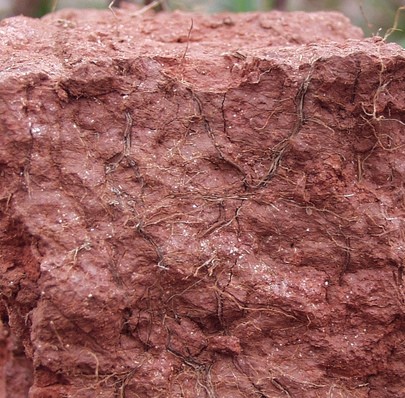
Rock fragments
The rocky part of soil is called the soil matrix. It is a mixture of sand (coarse fragments), silt (finer fragments) and clay (very fine fragments), eroded from rocks, the "parent material". The fragments are made up of different kinds of minerals. Soil can form from the rocks below, but in some instances the rock fragments may have been eroded from rocks by wind, water or glaciers, and deposited some distance away. Loess, or example, is a soil from windblown deposits.

Loam is soil composed of sand, silt and clay in roughly equal proportions. This mix of fragment sizes is considered ideal for gardening and agricultural purposes because it retains nutrients and moisture well, while allowing excess water to drain away.
Organic matter
Mixed in with the soil matrix is partially-decomposed organic matter: the remains of leaves, animal droppings and other plant and animal material. Organisms (living things) in the soil, such as fungi, bacteria, earthworms, protozoa, ants and spiders, break this organic matter down into nutrients. The end result is a nutrient-rich, dark-coloured, organic material called humus, essential to the fertility of any soil.


Soil life
A handful of soil is like a factory where a mass of minuscule organisms are working away recycling the remains of dead animals and plants into nutrients. The tiniest of the “workers” are called bacteria. That handful of soil will contain over 10 billion of them. Microscopic organisms made of only one cell, called protozoa, feed on bacteria, while they are themselves eaten by larger animals such as worms. Earthworms also have a vital role to play tunnelling through the soil, letting air in, helping water drain through and mixing the different soil layers.
Air spaces
Between the soil particles are large air spaces. These are important because they allow water to drain through the soil. They also allow oxygen to reach both the plant roots and the organisms that inhabit the soil.
Soil horizons
As soil develops, it forms layers, called soil horizons. The top layer, the O horizon, is a thin layer of mostly dead plant matter. Under it is a layer rich in humus, the A horizon. The A and O horizons together are also called topsoil. Minerals washed down (leached) by rainwater collect in the B horizon, called the subsoil. The C horizon, or substratum, consists of large chunks of parent rock that are in the process of weathering. Beneath that is the R horizon, or bedrock.

Consultant: Chris Jarvis
Other Q-&-As to explore:
For a full list of all our Q&As, please click here.
If you have a question that you would like to see answered on Q-files, please send us an email to info@Q-files.com or use the contact us page.
pics
Without in any way limiting Q-files Ltd’s exclusive rights under copyright, any use of this publication to “train” generative artificial intelligence (AI) technologies to generate text is expressly prohibited. Q-files Ltd reserves all rights to license use of this work for generative AI training and development of machine learning language models.