
Land invertebrates

CITE
We have made every effort to follow citation style rules, but there may be some minor differences. If in doubt, please refer to the appropriate citation style manual.
Spiders. (2026). In Q-files Encyclopedia, Life, Land invertebrates. Retrieved from
https://www.q-files.com/life/land-invertebrates/spiders
"Spiders." Life, Land invertebrates, Q-files Encyclopedia, 21 Jul. 2026.
https://www.q-files.com/life/land-invertebrates/spiders.
Accessed 6 Aug. 2026.
Spiders 2026. Life, Land invertebrates. Retrieved 6 August 2026, from
https://www.q-files.com/life/land-invertebrates/spiders
Life, Land invertebrates, s.v. "Spiders," accessed August 6, 2026.
https://www.q-files.com/life/land-invertebrates/spiders


Spiders
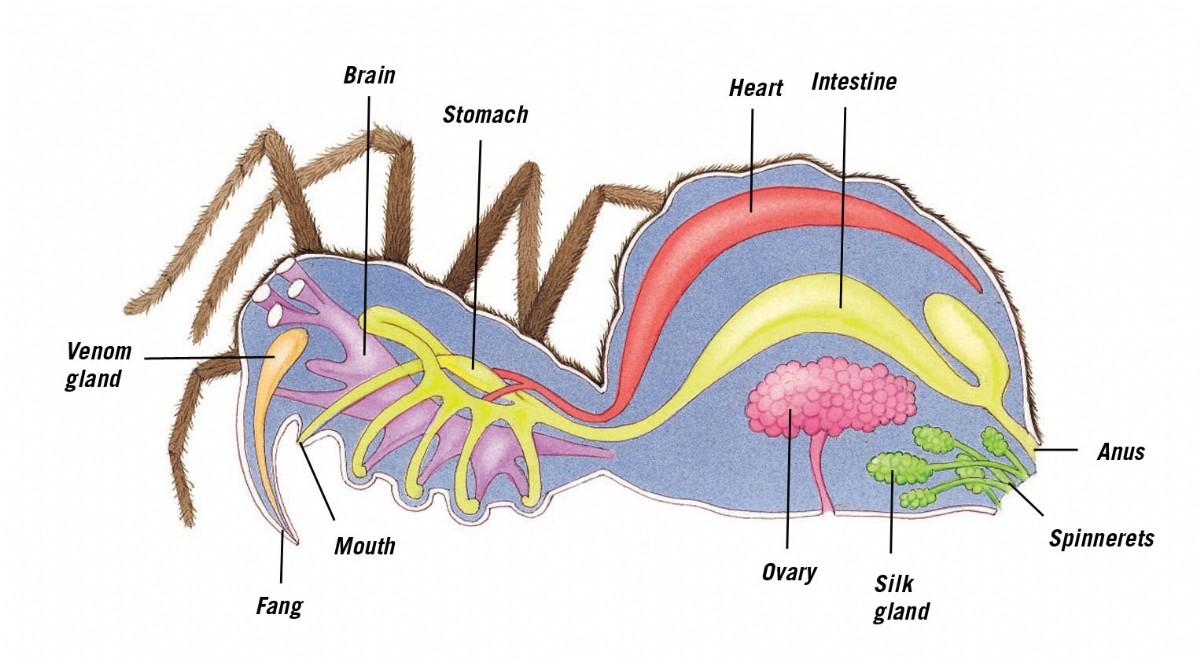
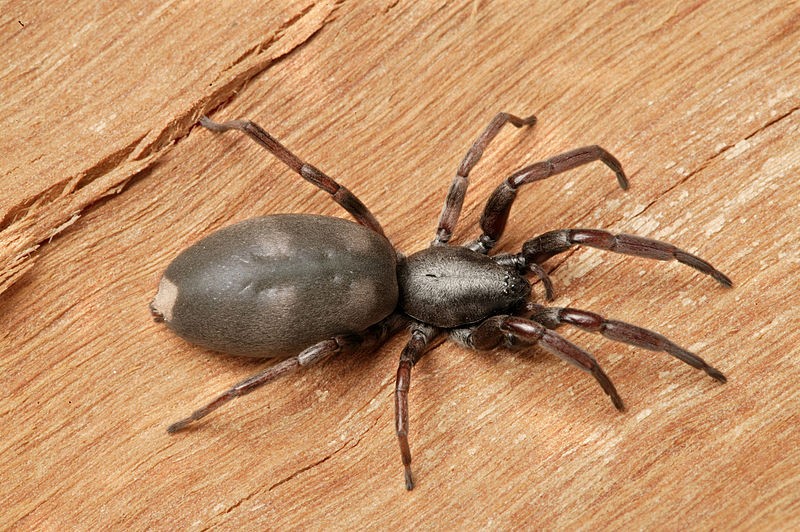
Spiders are a type of arachnid. They have eight legs and two grasping "limbs", called pedipalps. Spiders rely more on sound than sight. Most species have bristles on their legs that are sensitive to vibrations in the air or through the ground. Spiders feed by piercing their prey with their sharp fangs, paralysing or killing them with their venom. Their saliva turns the body tissues of the prey into liquid that can then be sucked up. A few species are so venomous that they can kill humans. All spiders make silk, but not all spiders build webs. Spiders that do not spin webs, such as the tarantulas, chase down or ambush their prey instead.

Spiderwebs
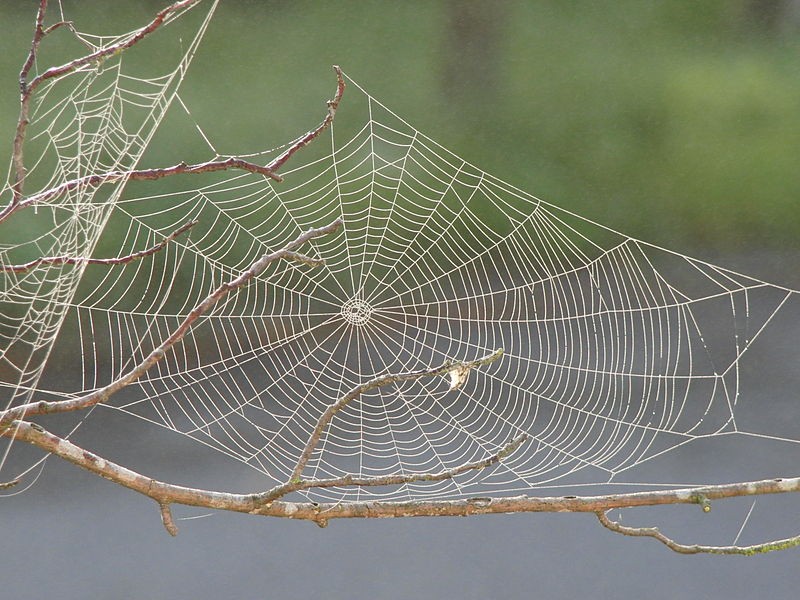
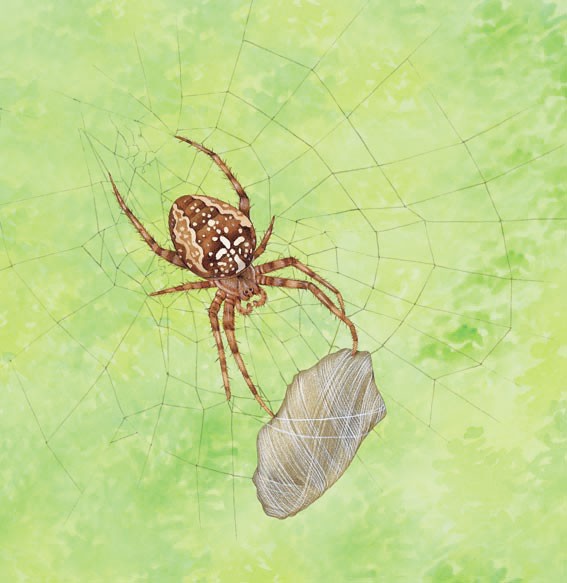
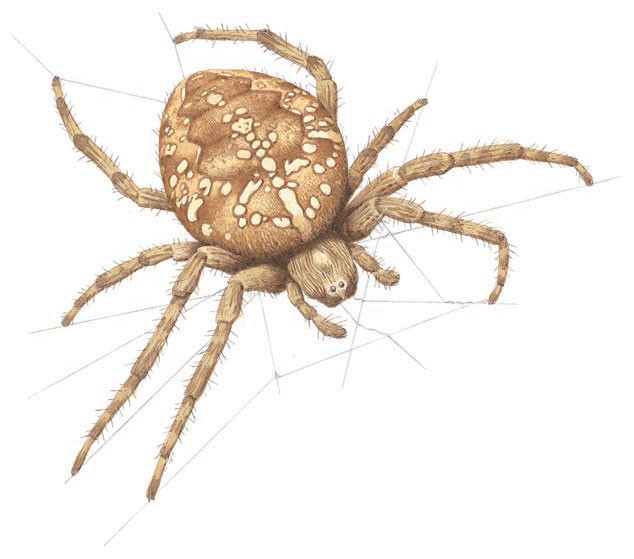
Many spiders catch their prey by spinning webs out of spider silk. Webs can be of a great variety of shapes, including delicate spirals, irregular cobwebs or thick funnels. Any insect that flies into a web is caught in the strands, which are often sticky. As the insect struggles to free itself, the spider, sitting at the edge of the web, feels the vibrations and comes to claim its prey. It avoids becoming caught in the threads itself by walking on the claw-like tips of its feet.

Some spiders, known as tangleweb spiders, weave the irregular, three-dimensional webs commonly known as cobwebs. They are less careful weavers, and may take several days to complete a web.
Spider silk
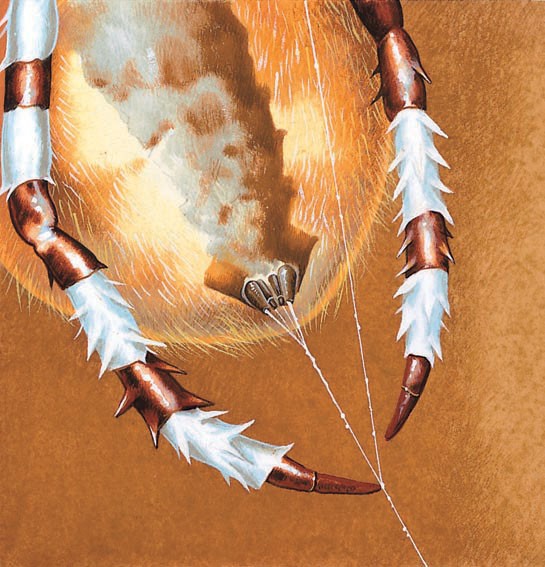
A spider makes silk from a liquid produced by silk glands inside its abdomen. As the silk is drawn out of the spider’s body through the spinnerets, it becomes a solid thread. It pulls out the silk using the claws on its back leg. Spiders use their silk to build webs, contain their eggs, wrap up prey or form a safety line when jumping. Spider silk is as strong as steel thread of the same thickness, but much lighter and bendier.
Mouthparts
In front of their mouths, spiders have mouthparts called chelicerae. They are hollow and are used to inject venom into prey. At the tips of the chelicerae are fangs, which fold away when they are not in use. The glands that produce the venom are in the roots of the chelicerae. When a spider bites, venom is squeezed out through the tips of the fangs.
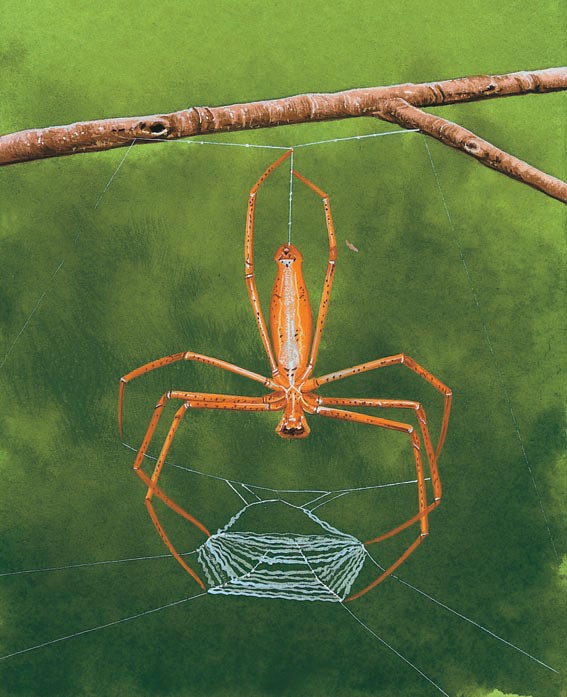
Ogre-faced spider
Ogre-faced spiders build webs which they hang between their front legs and lie in wait. When a likely insect comes near, it stretches the net out and throws it on top of it. The prey is soon completely entangled.
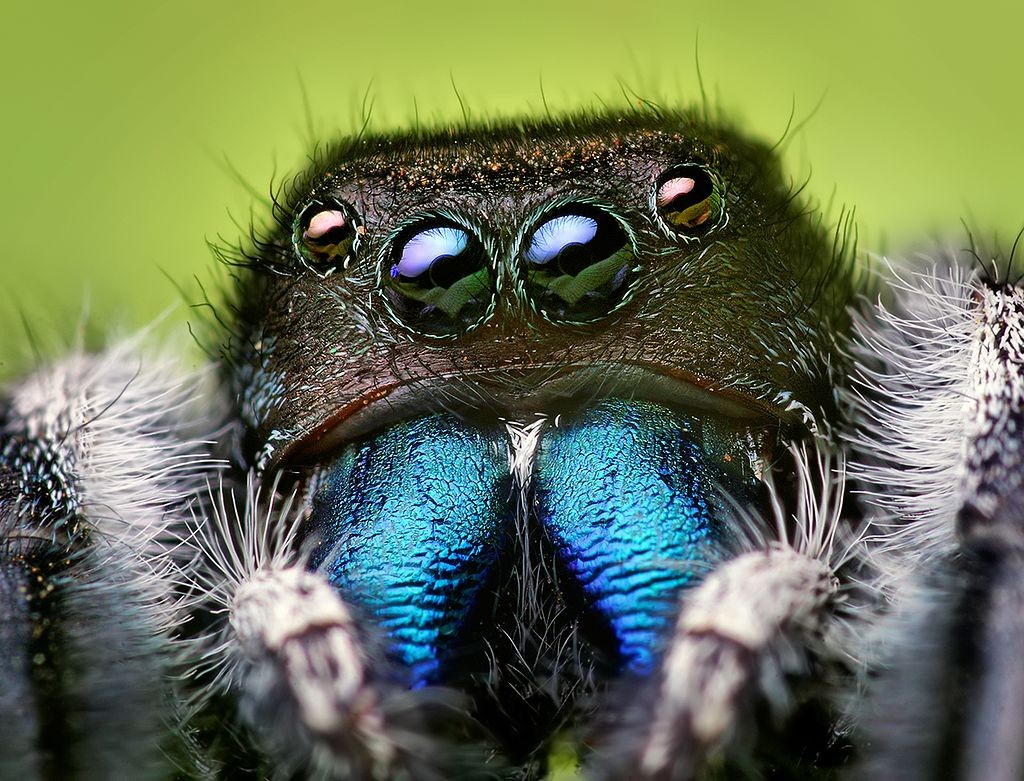
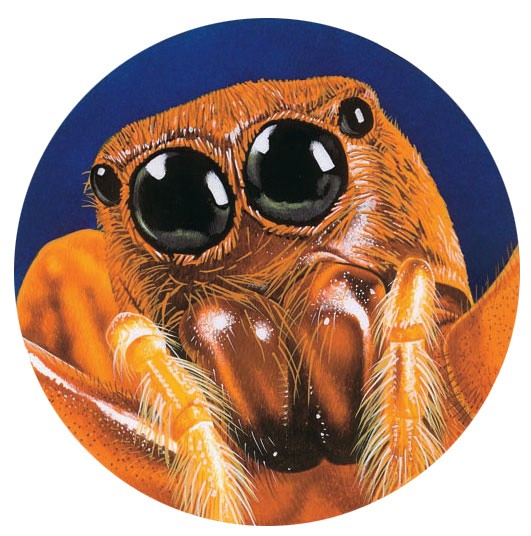
The ogre-faced spider has very good eyesight and relies on it to catch its prey, usually at night. It has eight eyes, but the front two are much bigger than the others. The scary, monster-like appearance in close-up gives the spider its name.
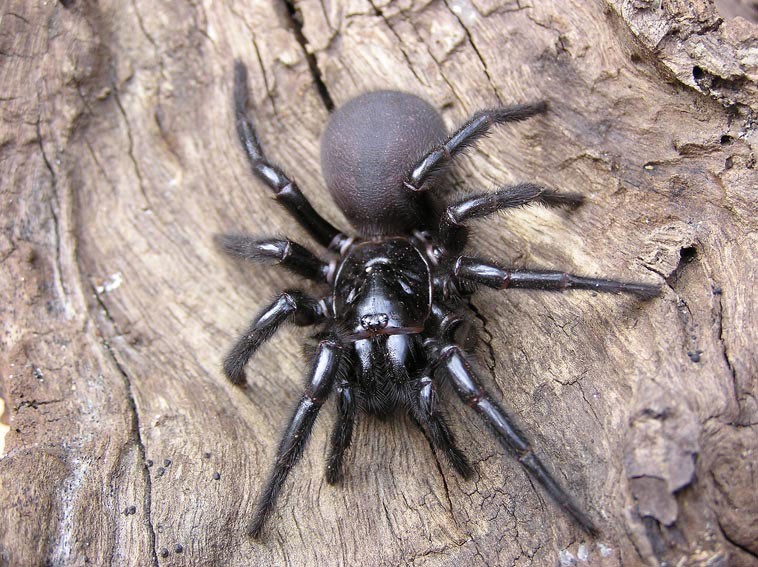
Funnel-web spider
The funnel-web spider builds funnel-shaped webs at the entrance to its burrow. The spider then lurks at the narrow end of the web, waiting for an insect to stumble into its trap. Funnel-web spiders live in Australia and Asia. They are aggressive and their bite can be fatal. Their fangs are so sharp, they can bite through shoes.


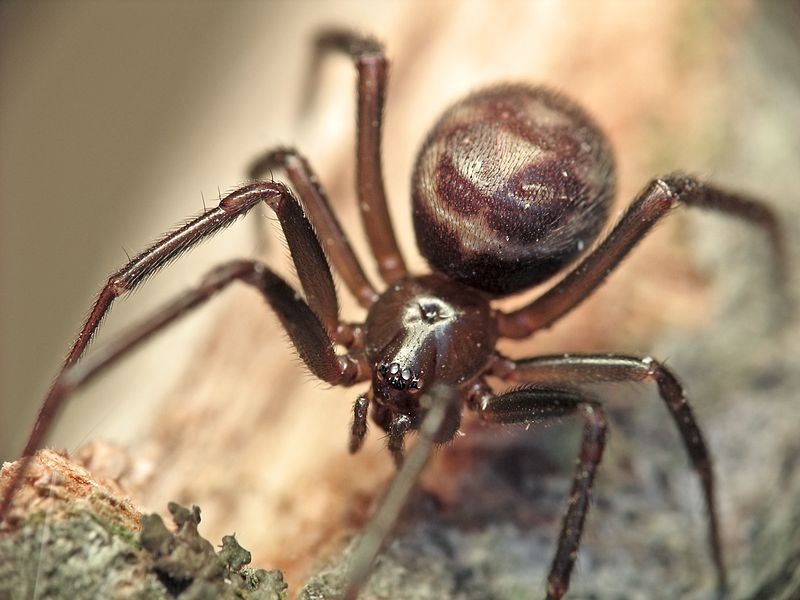
Black widow spider
The black widow is one of the deadliest spiders in the world, with venom up to 15 times as powerful as a rattlesnake’s. However, it lives in dark places and avoids humans. It will usually only bite if provoked, but its poison can easily kill humans. Like many other spiders, the black widow spins a web to catch flying insects. The female often eats the male after he has mated with her, a practice for which the spider is named.
Fishing spider
Fishing spiders skate across water in search of insects, tadpoles and fish to eat. They lure their prey by dangling a leg, which has a sharp claw at its tip, in the water. When a creature investigates, the spider snatches it up and drags it on to land where it gives it a venomous bite and feeds on it. Fishing spiders are nocturnal hunters, feeding at a time when birds, which prey on them, are asleep.

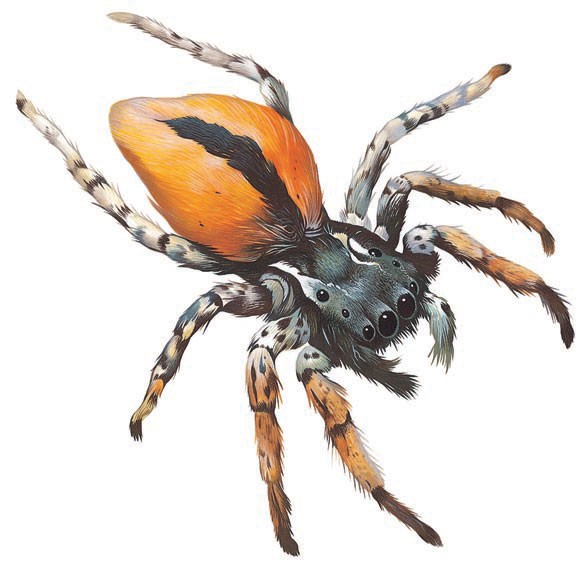
Jumping spider
There are thousands of kinds of jumping spider in the world. These tiny spiders do not spin webs, but, as their name suggests, they jump to get from twig to twig, and also to catch their prey. Jumping spiders have a better sense of sight than any other spider. Their eight eyes are able to spot movement in any direction around them. They capture their prey by leaping at it with their sharp fangs ready to strike. They often eat moths or flies, but some will attack creatures bigger than themselves, such as a mantis.
Spitting spider
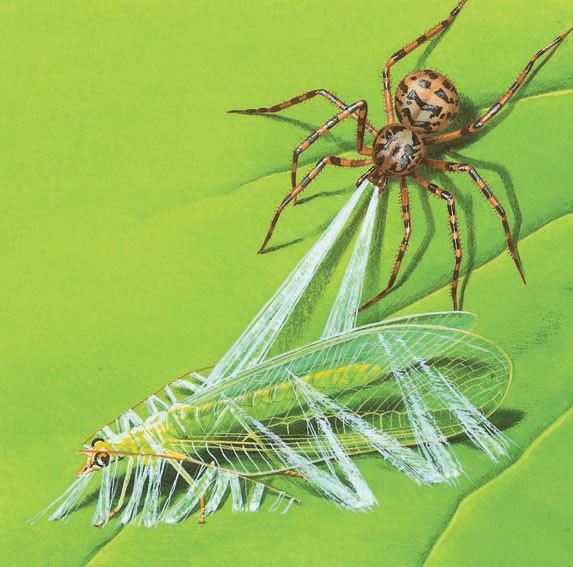
Spitting spiders are tiny spiders only a few millimetres long. They catch their prey by squirting a mixture of venom and liquid silk on to it. Shooting from a distance of up to 2 centimetres (0.8 inch), the spider's aim is deadly accurate. As soon as the insect is entangled, the spider moves forward to paralyse it with its bite and wrap it up in silk.


Trapdoor spider
Trapdoor spiders ambush their prey from a burrow. The entrance to the burrow is sealed by a lid, with a hinge made from spider silk. The spider rushes out when it detects vibrations made by its prey. It then drags the prey back into its burrow.
Diving bell spider
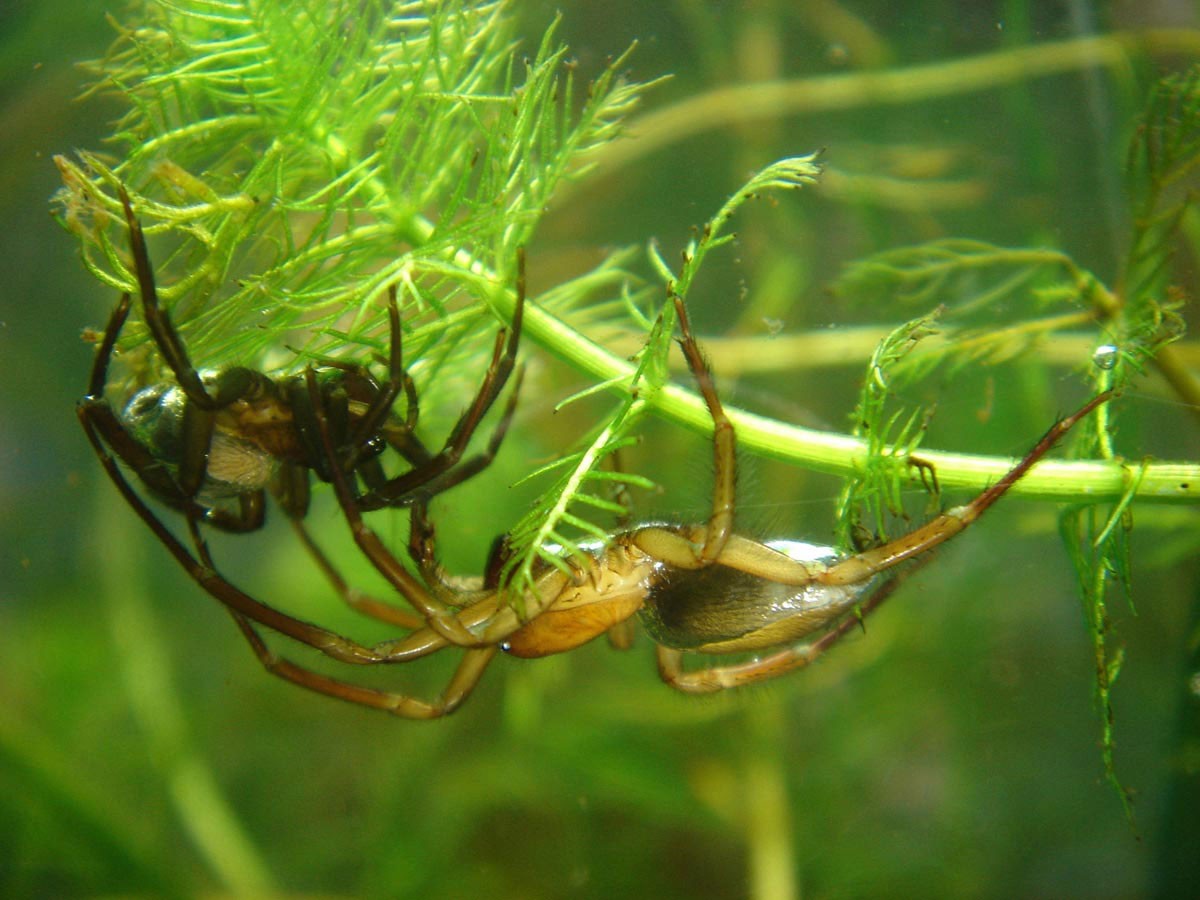
The diving bell, or water, spider is the only spider that lives underwater. Tiny hairs on its body and legs trap air bubbles, which the spider carries underwater to fill the lair it has built. When complete, the lair is like an air-filled diving bell. The spider darts out of its lair to snatch passing prey, such as aquatic insects, and paralysing them with its venomous jaws.

Huntsman spiders
Huntsman spiders belong to a family of more than 1500 species. They are found in most warm or tropical climate regions of the world, with a few species are native to cooler lands, such as as the green huntsman of northern and central Europe. Many species can grow large. While the average leg span is around 15 centimetres (6 inches), that of male giant huntsman spiders from Laos can reach between 25 and 30 cm (10–12 inches).
Huntsman spiders catch their prey—mostly insects and other invertebrates, but occasionally small lizards—by hunting rather than in webs. Large and hairy, they are often confused with tarantulas, but can be distinguished by their crab-like legs and their less bulky bodies. They live under rocks or in the crevices of tree bark. Like most spiders, huntsman spiders use venom to immobilize their prey. Their venom is mild, and bites generally result in only minor pain for humans.
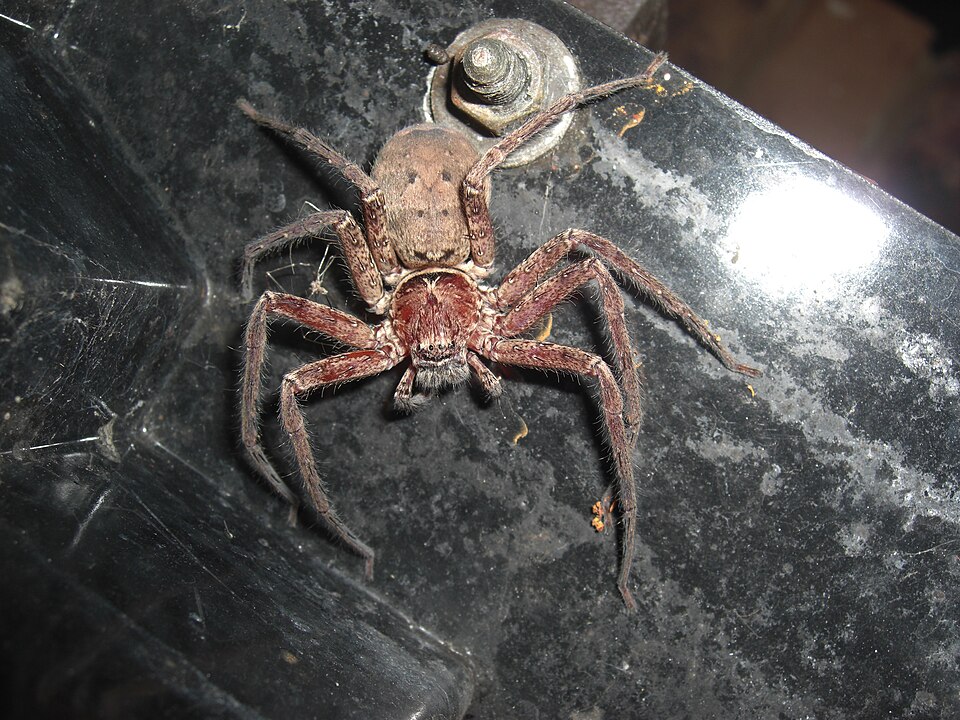
They are able to move extremely quickly, with an average speed over distance of about 2 metres (6.5 feet) per second. The brown huntsman, from Queensland, Australia, has been clocked at a maximum speed of 3.59 metres per second (13km/h or 8mph), making it possibly the fastest spider on Earth.
Consultant: Chris Jarvis
pics
Without in any way limiting Q-files Ltd’s exclusive rights under copyright, any use of this publication to “train” generative artificial intelligence (AI) technologies to generate text is expressly prohibited. Q-files Ltd reserves all rights to license use of this work for generative AI training and development of machine learning language models.