
Oceans

CITE
We have made every effort to follow citation style rules, but there may be some minor differences. If in doubt, please refer to the appropriate citation style manual.
Why is the sea salty?. (2026). In Q-files Encyclopedia, Earth, Oceans. Retrieved from
https://www.q-files.com/earth/oceans/why-is-the-sea-salty
"Why is the sea salty?." Earth, Oceans, Q-files Encyclopedia, 6 Mar. 2026.
https://www.q-files.com/earth/oceans/why-is-the-sea-salty.
Accessed 6 Aug. 2026.
Why is the sea salty? 2026. Earth, Oceans. Retrieved 6 August 2026, from
https://www.q-files.com/earth/oceans/why-is-the-sea-salty
Earth, Oceans, s.v. "Why is the sea salty?," accessed August 6, 2026.
https://www.q-files.com/earth/oceans/why-is-the-sea-salty


Why is the sea salty?
The salt in the sea comes originally from the chemical reaction of rainwater on rocks. Rainwater contains some dissolved carbon dioxide from the surrounding air. This makes it a weak acid. Every time it rains, the rainwater passes through the soil and seeps through tiny holes in the rocks called pores. The water's weak acidity causes most kinds of minerals, of which rocks are made, to dissolve in it. The water eventually washes into the rivers, which flow into the sea (or lakes). Some of the dissolved elements, such as sodium and chloride, the ingredients of common salt, stay in the seawater. When the water evaporates from the water's surface, most of the dissolved salts remain in the sea. Over many hundreds of millions of years, the salt content of seawater has built up. Animals have evolved to live in these conditions.
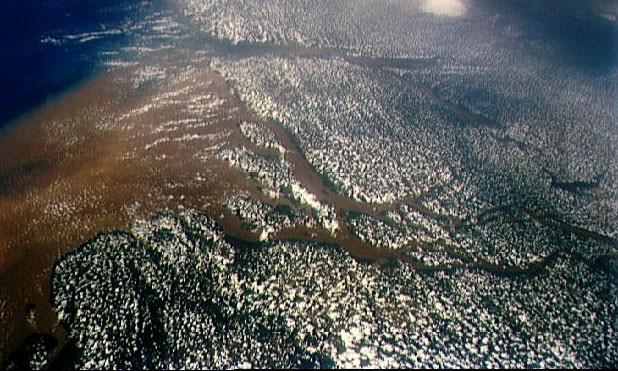
The concentration of salt in seawater (its salinity) is, on average, about 35 parts per thousand, or approximately 35 grams per litre of water. It is not the same everywhere. The Mediterranean Sea, for example, is saltier than the Atlantic Ocean near the mouth of the River Amazon, where fresh river water mixes with seawater.
The salt in seawater doesn’t only come from the land. Hot water jetting out from hydrothermal vents—cracks in the ocean floor running along the crests of oceanic ridges—also contains mineral salts. Seawater seeps into the ocean floor, where it is heated by magma (melted rock). The hot water dissolves minerals, made up of sodium, magnesium and other elements, from the rocks before gushing back into the ocean through the vents. Underwater volcanoes also add to the salts in seawater in a similar way.

Consultant: Ian Fairchild
Other Q-&-As to explore:
For a full list of all our Q&As, please click here.
If you have a question that you would like to see answered on Q-files, please send us an email to info@Q-files.com or use the contact us page.
pics
Without in any way limiting Q-files Ltd’s exclusive rights under copyright, any use of this publication to “train” generative artificial intelligence (AI) technologies to generate text is expressly prohibited. Q-files Ltd reserves all rights to license use of this work for generative AI training and development of machine learning language models.