
Oceans

CITE
We have made every effort to follow citation style rules, but there may be some minor differences. If in doubt, please refer to the appropriate citation style manual.
Coral atolls. (2026). In Q-files Encyclopedia, Earth, Oceans. Retrieved from
https://www.q-files.com/earth/oceans/coral-atolls
"Coral atolls." Earth, Oceans, Q-files Encyclopedia, 6 Mar. 2026.
https://www.q-files.com/earth/oceans/coral-atolls.
Accessed 6 Aug. 2026.
Coral atolls 2026. Earth, Oceans. Retrieved 6 August 2026, from
https://www.q-files.com/earth/oceans/coral-atolls
Earth, Oceans, s.v. "Coral atolls," accessed August 6, 2026.
https://www.q-files.com/earth/oceans/coral-atolls


Coral atolls
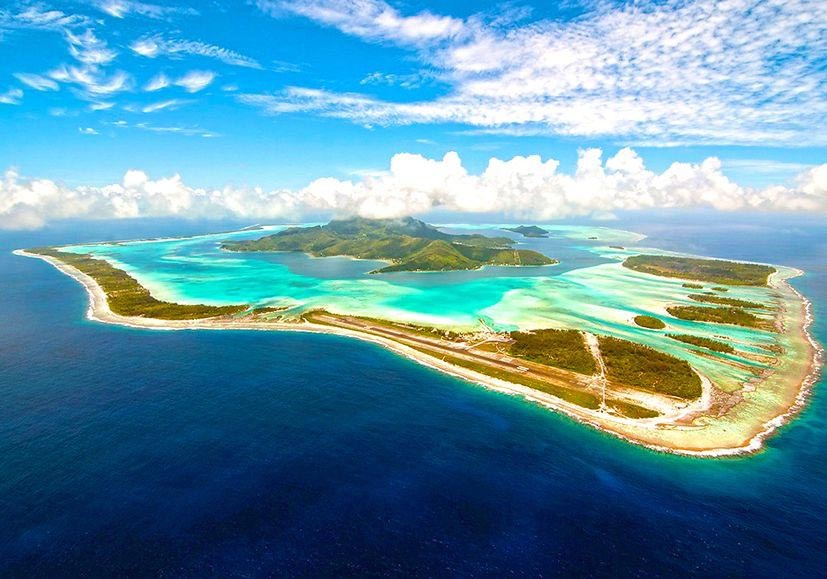
Layers of lava from eruptions eventually build underwater volcanoes high enough for them to rise above sea level as islands. In tropical waters, coral reefs sometimes form in the warm shallows around these volcanic islands. After they stop erupting, the volcanoes will, over thousands of years, sink back into the Earth's crust. But the reef keeps growing upwards so that when the islands eventually disappear below water, ring-shaped reefs, called atolls, remain. Most atolls are in the South Pacific Ocean and Indian Ocean. Many are inhabited.
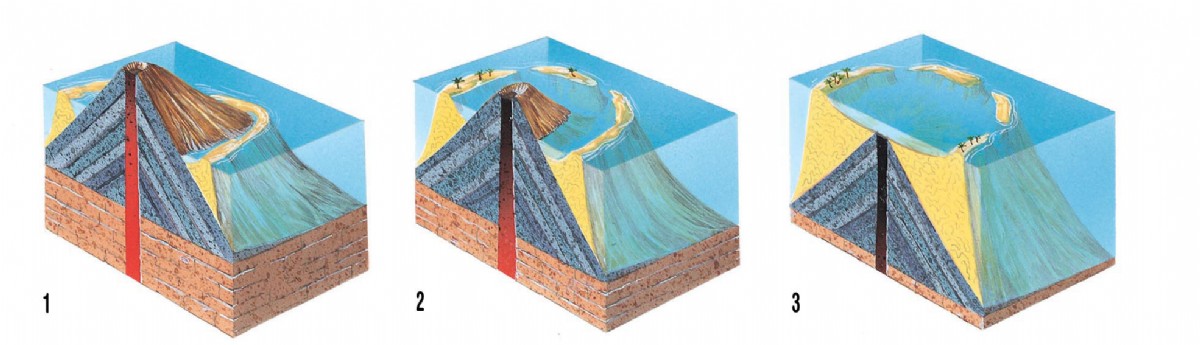
How an atoll forms
When magma stops rising up through a volcano—as when the volcanic island no longer lies above a hot spot—the volcano will sink back into the ocean floor. If it sinks very gradually, coral that formed a fringing reef around it will carry on growing upwards (1). Coral animals must stay near the sunlight, so they will build up the reef in order to remain close to the surface.
Eventually the coral will form a circular barrier reef, enclosing a lagoon around the dwindling volcanic island (2). By the time the volcanic island disappears completely, there is a ring of low-lying coral reefs, called an atoll (3). The Society Islands in the South Pacific include examples of a fringing reef (Tahiti), an “almost-atoll” (Bora Bora) and an atoll (Tetiaroa).
As a result of waves piling up sediment and reef rubble on top of the reef itself, some parts of an atoll may emerge above sea level as low-lying islands. In most cases, the land area of an atoll is tiny in comparison to the undersea portion.

Coral reef
Formed from the hard skeletons of tiny animals, coral grows in an amazing variety of shapes. It lives in shallow, warm waters fringing volcanic islands or rocky coastlines in the tropics—no further north or south than 30° latitude. Over hundreds of years, great banks of coral, called reefs, can build up. Coral reefs are home to thousands of species of marine animals.


Cays
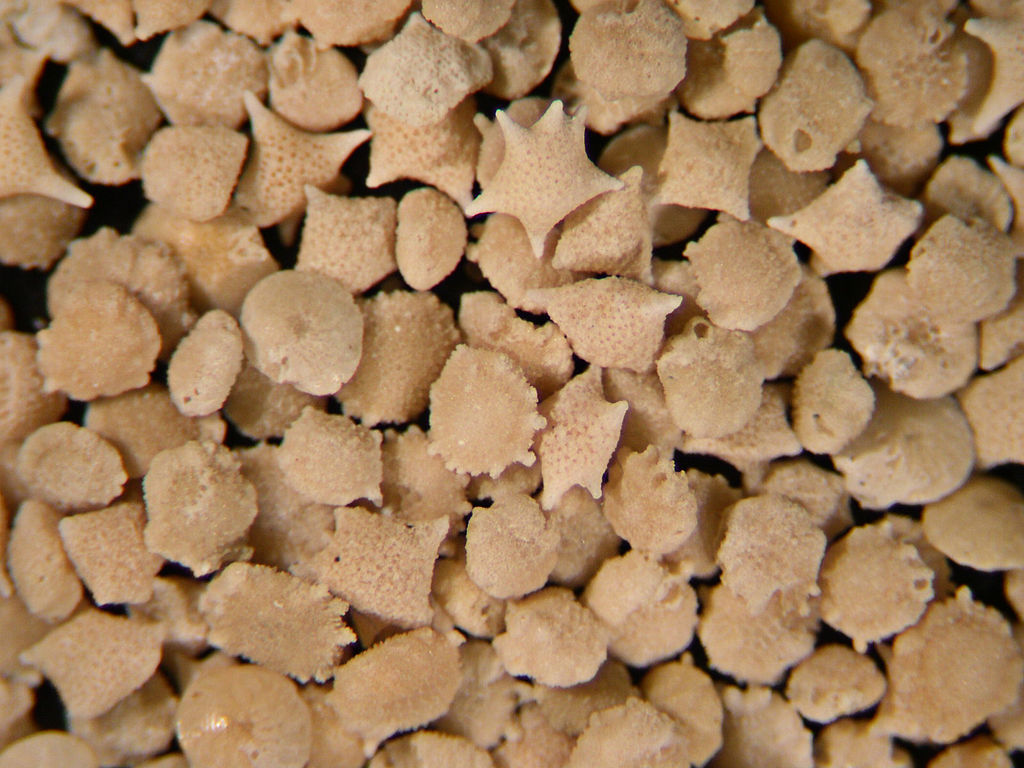
A cay (or key), is a low sandy island on a coral reef. Cays are found in tropical seas, especially in the Caribbean, on the Belize Barrier Reef and on the Great Barrier Reef. A cay forms when ocean tides and currents deposit loose sediments—made up of the skeletal remains of algae and animals (including coral) ground up into sand—on to the surface of a reef. Gradually, layers of sand build up above the level of the sea.
Over time, soil and vegetation may start growing on a cay, especially where sea bird guano (waste) builds up. Plant roots help to bind the sand and stop it being washed away by high seas and tropical cyclones. Many cays have been populated, but because of the rising sea levels caused by global warming, are under threat of flooding.
Consultant: Ian Fairchild
pics


Without in any way limiting Q-files Ltd’s exclusive rights under copyright, any use of this publication to “train” generative artificial intelligence (AI) technologies to generate text is expressly prohibited. Q-files Ltd reserves all rights to license use of this work for generative AI training and development of machine learning language models.